




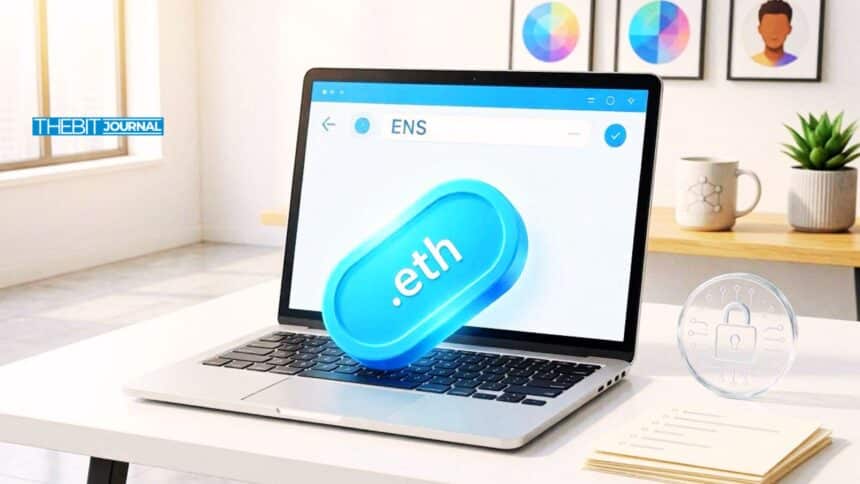

This article was first published on The Bit Journal.
Ethereum addresses are usually long, complicated strings that are easy to miscopy. An ENS domain (Ethereum Name Service domain) solves this by giving wallets and smart contracts a name that sounds like something a human would use (like alice.eth) that maps to those addresses.
Think of ENS like a blockchain’s version of a phonebook or the internet’s DNS system but for cryptocurrency. Instead of having to send funds to some long string of characters like 0xA12b…Ff3A, you can just send them to alice.eth.
This simple change makes crypto transfers and identity much easier. In 2025-2026, ENS adoption has taken off rapidly. For instance, “.eth” has become a top-10 global domain with over 1.6 million active registrations.
What Are ENS Domains?
An ENS domain is a web3 name on the Ethereum blockchain. It is run by smart contracts on the blockchain, not a company, which means no single entity can take it away without your consent. Just like traditional DNS maps website names to IP addresses, ENS maps names to blockchain data.
The ENS system lets you register names that end in .eth and also links some internet domains to the blockchain too. Each ENS name is represented by a special NFT (or an ERC-721 token) that you own the rights to.
Owning this NFT lets you control all the information associated with that name. For instance, you might register mywallet.eth and then use that to link to your Ethereum address. Other people can then send you crypto to mywallet.eth and it will automatically get sent to your address.
It should be noted that ENS governance tokens (ticker: ENS) are a different thing, buying ENS tokens gets you a vote in the ENS DAO but it won’t automatically give you a .eth name or let you control it.
According to Coinbase, “The Ethereum Name Service (ENS) is a decentralized, open and expandable naming system that interacts with the Ethereum blockchain” – Coinbase.
This means ENS domains work like a decentralized version of DNS. Anyone can register a name (you just have to pay a fee to do it), and the system uses a few on-chain Registry and Resolver contracts to keep track of all the names and where they point. Due to the fact that everything exists on Ethereum, ENS is resistant to censorship, no central company can shut your .eth address down as long as you keep it renewed.

How ENS Domains Work
ENS resolution involves several smart contracts: a Registry, Registrar, Resolver, and Universal Resolver. These work together to link names to records:
Registry: The ENS Registry contract stores who owns each name, where the resolver is, and how long the name is good for. Every time you register or transfer a name, the Registry gets updated.
Registrar: This imposes the rules for registering names in a particular namespace, like .eth. For example, there’s an official Registrar for second-level .eth names, called the ETH Registrar Controller, which handles auctions and renewals. When you register a name through the ENS app, it interacts with this Registrar.
Resolver: A resolver contract actually holds the records for your ENS name ( like addresses, text, content hashes, and more) and provides the output. The registry just points to which resolver to use for each name. Some popular resolver contracts, like the Public Resolver, make it easy to set your Ethereum address, link to an IPFS website, and metadata.
Universal Resolver: This is a shortcut for convenience so wallets and apps can query any name without knowing in advance which resolver to use. It standardizes the lookup process across different name systems.
When you type in alice.eth in a wallet app, it queries the ENS system to “resolve” that name. First it checks the registry to see who owns the name and which resolver they use, and then it asks the resolver for the address or content that’s linked to alice.eth.
This usually takes just a few seconds. The wallet shows the actual address behind alice.eth so you can double-check it before sending any funds. This two-way check (looking up the name and then checking the address again) helps keep everything secure.
ENS names follow the same rules as ERC-721 NFTs, which means each name is totally unique and transferable. Think of owning an ENS domain as owning an NFT. You can sell or transfer it to someone else and track it in your wallet. This NFT structure also means ENS names can be bought and sold on NFT marketplaces.
Key Features and Use Cases of ENS Domains
An ENS domain can store way more than just an Ethereum address. It’s kind of like having your own mini profile or DNS that you have total control over. Here are some common things you can do with an ENS name:
Cryptocurrency Addresses: You can set a primary Ethereum address for your name (so alice.eth points to Alice’s ETH address). But ENS can also store addresses for other crypto chains, like Bitcoin, Solana, Polygon, and more. This means you can get funds on a ton of different blockchains all from one ENS name if the platforms support it.
Text Records: ENS names can have text fields where you can put things like your email, website URL, or Twitter handle. A lot of dApps use these fields to display profile info.
Avatar or Profile Picture: You can upload a profile picture or avatar to your ENS name (usually an NFT image or file hosted on IPFS). Some wallets and platforms will show this picture alongside your name.
Content Hash (IPFS): You can link a file or decentralized website to your ENS name by setting its IPFS content hash. Then alice.eth can basically host a Web3 site, which makes it easier to find and link to your content.
Subdomains: Owners can create unlimited subdomains: for example, pay.alice.eth, blog.alice.eth, or team.company.eth. Subdomains are a great way for organizations or families to share a namespace and still have their own separate addresses. The owner of the main name can manage those subdomains without having to register new names.
DNS Integration: You can even import your traditional domain name if you already own one (like myname.com). ENS lets you verify ownership of your DNS domain and then use it within ENS. For example, some registrars like GoDaddy let you link a ” .eth” record to a DNS name.
By bringing all these on-chain, ENS makes blockchain identities easier. For example, a DeFi app might automatically show a user’s ENS name, their avatar, and verified contacts any time they interact with others and that can make interacting with the app a lot easier.
A lot of the major wallets (like Coinbase and MetaMask) and exchanges (like Uniswap) already support ENS lookup, so sending crypto or verifying identity with an ENS name is becoming more common.
Example: Converting 0x12b3… to alice.eth not only simplifies transfers, it can carry a full identity. The wallet might show Alice (alice.eth) with her profile picture, and even link to her Twitter and personal site if she’s set those records.
ENS Domains vs Other Naming Systems
ENS is just one type of Web3 domain, but there are plenty of other systems out there too. Here’s a quick rundown of the options:
Traditional DNS Domains: These are the internet domains (kind of internet domains you’re used to) like example.com. They’re managed by ICANN and registrars (like GoDaddy). They use DNSSEC to prove ownership, and you can link them to ENS via DNS-SEC TXT records.
ENS (.eth) Names: These are built on Ethereum, owned and controlled by the user, and don’t rely on any central authority. They offer the best support from the Ethereum toolset, and they can’t be seized as long as you keep renewing them.
Other Crypto Domains (e.g. Unstoppable Domains): These provide domains like .crypto or .nft on other blockchains (like Polygon). ENS domains are still a bit more popular, mainly because Ethereum is the biggest smart-contract platform out there. The ten most expensive crypto domains ever sold , according to CoinGecko, were all ENS names, showing just how much people are willing to pay for an ENS domain.
ENS’s real strength is its deep integration with Ethereum wallets and DeFi. If most of your crypto activity is on Ethereum or EVM chains, ENS is natively supported by almost every big wallet and explorer. If you’re using multiple chains, you’ll need to check which ones support ENS before relying on it as your sole identity solution.
Recent Developments: ENSv2 and Governance
The ENS ecosystem is constantly evolving. One main upgrade is ENSv2, an update aimed at making ENS easier to use and giving it some cross-chain features. In 2026, ENS Labs announced that ENSv2 will be launching straight onto Ethereum L1 (no separate ‘Namechain’ Layer-2 needed) thanks to Ethereum welcome scaling upgrades. That means the next-gen ENS will have:
Single-step registration: You can get signed up with fewer on-chain transactions, making it a lot easier to get started.
Multi-chain payments: You’ll be able to pay registration fees with tokens from any EVM chain, not just ETH.
Flexible ownership: Each name can have its own sub-registry, which reduces all the conflicts that can come up (a new registry architecture). ENSv2 is already in public alpha testing via an updated ENS App and ENS Explorer.
Nick Johnson of ENS Labs points out that because of Ethereum’s upgrades, the gas costs for registering ENS have plummeted by about 99% over the past year, now it’s often under $0.05. That means simple L1 deployment is now pretty affordable for all users.
On the governance side, the ENS DAO (which is basically a community run by ENS tokens) continues to fine-tune its structure. As of June 2026, the DAO started considering proposals that’d give the ENS Foundation more power (like handling grants and budgets) while still keeping the token holders in ultimate control.

Why ENS Domains Matter Today (Expert Analysis)
ENS domains are fast-becoming a necessary part of the Web3 infrastructure. As of 2026, ENS is expected to have gained real-world uses, for example you may see something like Coinbase Wallet and Rainbow displaying ENS names in your contact lists, and even Apple’s iOS (via an app) will be accepting ENS addresses.
Experts say that with ENS’s integration with the legacy internet via DNSSEC and partnerships with the likes of GoDaddy , D3 and others, it is well on its way to becoming the bridge between Web2 and Web3 naming. ENS’s growth is backed by data: over 1.3 million ETH addresses have now got “ENSified” (with several million if counting all blockchain records).
Security and trust are also of high importance. Unlike traditional wallets where a single typo can send a transaction to the wrong place and cost you, ENS reduces the chance of that happening by letting you verify a name like vitalik.eth exists and is actually pointing to the address you want it to. But there’s still need to be careful. If an ENS name expires or is transferred, it could be squatted by someone else.
A name can expire, expose wallet activity, or send funds to the wrong place if records are not checked.
This is why users should always double-check ENS records and expiry dates in their wallets.
Table 1. Example of high-value ENS domain sales (USD). These record sales show how valuable memorable ENS names have become:
| ENS Domain | Sale Price (USD) | Year Sold |
| paradigm.eth | $1,508,884 | 2021 |
| 000.eth | $317,759 | 2022 |
| abc.eth | $253,100 | 2022 |
| deepak.eth | $220,401 | 2022 |
| porno.eth | $204,505 | 2022 |
Notice that all the top crypto domain sales have been ENS .eth names, revealing ENS’ leading role.
Conclusion
ENS domain is one of the important building blocks in the crypto space. It makes it easy to get rid of messy blockchain addresses and just use simple names for wallets, on-chain profiles and websites.
As of mid-2026, ENS domains have hit the mainstream with over a million names registered, supported by all major wallets, and even interoperability with DNS domains.
With the ENSv2 update coming up and all the community efforts to improve governance, it’s clear the trend will keep going, and ENS domains are expected to get even easier to use.
These days, it’s becoming standard for anyone sending crypto or building web3 apps on Ethereum to get an ENS domain and get to know how it works.
Analysts say ENS is right at the forefront of innovation in the blockchain world, making it simpler for millions of people to interact with blockchain.
Glossary
ENS (Ethereum Name Service): A decentralized system on Ethereum that takes normal names like name.eth and maps them to blockchain addresses and info.
DNS (Domain Name System): The traditional system that maps website names to IP addresses.
Resolver: basically a smart contract thats got all your ENS name records stored and can hand them back out when asked.
Registry: the ENS smart contract thats keeps track of who owns each name and which resolver to use.
ERC-721: a token standard for non-fungible tokens (NFTs); each ENS domain is basically an ERC-721 NFT, making it unique and transferable.
Subdomain: a prefix to an ENS name, like subname.domain.eth. owner of domain.eth can create any subdomains (e.g. like pay.domain.eth)
Frequently Asked Questions About ENS Dommain
How do I get my hands on an ENS domain?
What You register an ENS name using the official ENS app or a wallet that supports it. Search for an available name, choose a registration period (minimum 1 year), and pay a small fee in ETH (or other crypto in ENSv2). The name then appears in your wallet as an ERC-721 NFT you own.
What can I do with an ENS domain?
Once you own an ENS name, you can set it to point to your Ethereum address and just add some more details like addresses for other blockchains, link a website or some IPFS content, add a bit of text with your contact info or social links, and even create subdomains like pay.alice.eth. People and dApps can then use your ENS name to send you crypto or access some content.
Do I have to hold ENS tokens to use one of these domains?
No, you don’t need to own ENS tokens to have an ENS domain, owning an ENS token just lets you vote in the ENS DAO. A domain is controlled by whoever holds the NFT for that name, and its all renewed using ETH (or other crypto).
What happens if I don’t renew my ENS domain?
ENS names expire if not renewed. If yours expires, it goes back on sale and anyone can register it. That’s a risk (someone else could register your old name). So it’s important to monitor expiry dates and renew your ENS domain periodically.
References