





The crypto gambling market continues to grow in plain view. More people place bets with digital assets. They arrive through sports, live casino tables, and casual games.
Better wallets reduce friction. Faster networks, lower fees, and speed up settlement. Stablecoins make value move like a message. Regulators in key hubs now write clearer rules. This mix points to an active year in 2025.
This guide explains the size and direction of the crypto gambling market. It shows how product design and policy shape adoption. It gives practical ways to judge platforms without hype.
It also includes a simple market projection and a compact table of core numbers. The writing stays simple on purpose. The topic touches on money and risk. Clear words help readers make better choices.
What The Crypto Gambling Market Covers
The crypto gambling market includes betting and gaming that settle in digital assets. A player funds an account with Bitcoin, Ethereum, a stablecoin, or another token.
The player then places bets on sports, plays slots or cards, or enters a lottery. Some platforms settle part of the logic on a public chain.
Others run the game engine on servers but use crypto for payments and rewards. In both cases the wallet becomes the center of the user journey.
Size, Signals, And Trajectory
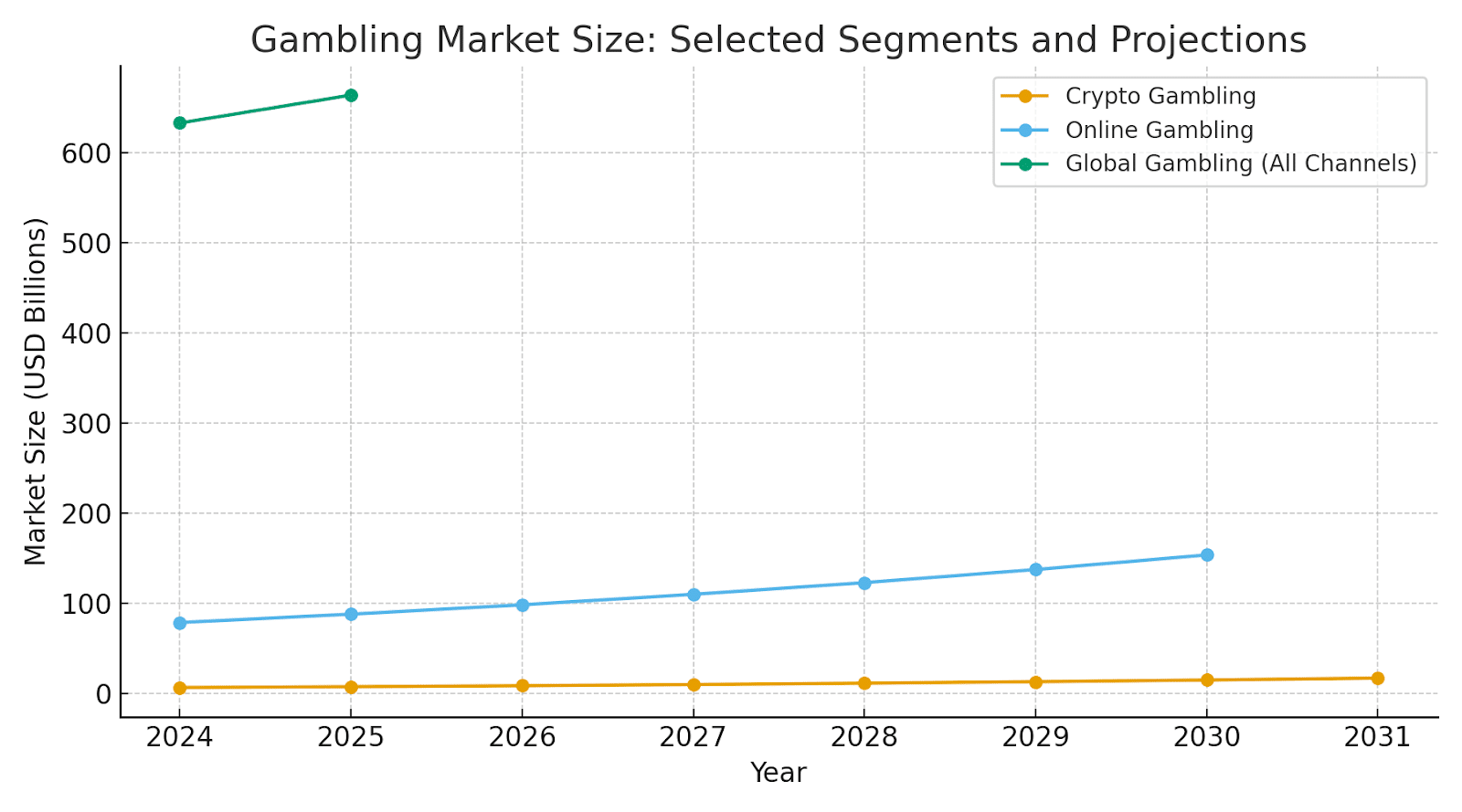
No single firm owns the truth on market size. Still, the sources agree on the direction. A recent estimate for the crypto gambling market places 2024 near $6.6 billion and projects $17.1 billion by 2031.
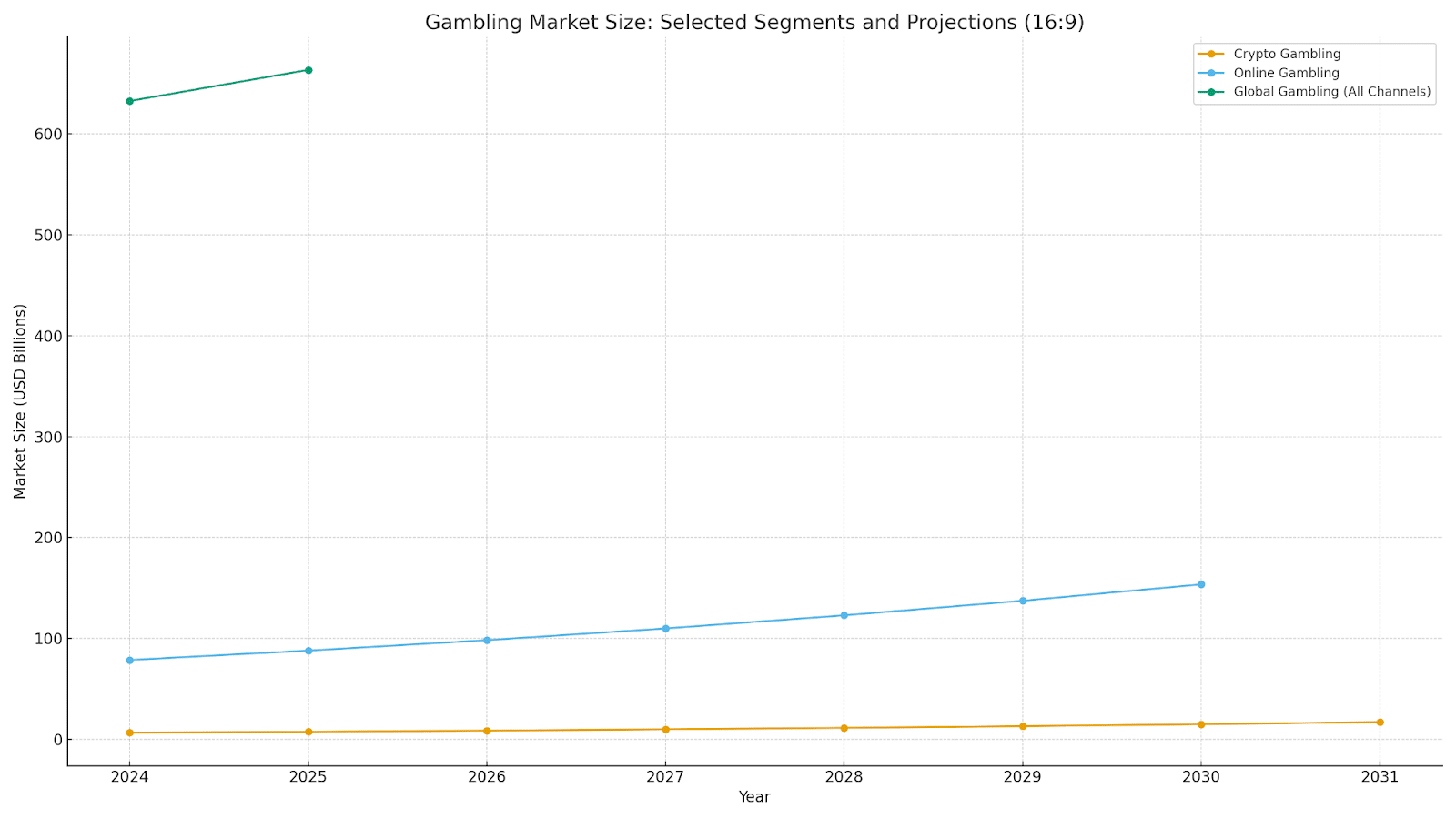
That path implies compound growth near 15.1 percent. The online gambling market more broadly sits near $78.66 billion in 2024 and is forecast to reach roughly $153.6 billion by 2030 at about 11.9 percent compound growth.
Analysts place global gambling across all channels above half a trillion dollars for 2024, with a line toward $663.5 billion in 2025. These numbers set a clear frame.
The base is very large. Online grows faster than the base. The crypto gambling market grows faster than online because it starts from a smaller slice.
The United States adds a strong signal. The commercial industry posted record results again in 2024 under the American Gaming Association.
Sports betting led much of that momentum. When the legal channel expands, more users learn a clean online flow. That habit carries over to casino products and to platforms that accept crypto for payments. It does not mean all crypto play sits in the legal state market. It does mean the funnel for digital wagering keeps growing.
Market Table
| Segment | Latest Size Or Figure | Period | Notes |
| Crypto gambling market | $6.6B | 2024 | Projection to $17.1B by 2031 at about 15.1% CAGR. |
| Online gambling | $78.66B | 2024 | Forecast to $153.57B by 2030 at about 11.9% CAGR. |
| Global gambling, all channels | $632.6B | 2024 | Projection to $663.5B in 2025. |
| U.S. commercial industry | Record year | 2024 | Sports betting growth drives new highs. |
| Great Britain remote GGY | £6.9B | Apr 2023–Mar 2024 | Official UKGC figure for remote casino, betting, and bingo. |
Crypto Gambling Market Projection
The chart below shows a simple line from $6.6 billion in 2024 to $17.1 billion by 2031. It uses a constant growth rate between the two endpoints. The purpose is not to claim precision. The purpose is to show the shape of the story and the scale of change if the path holds.
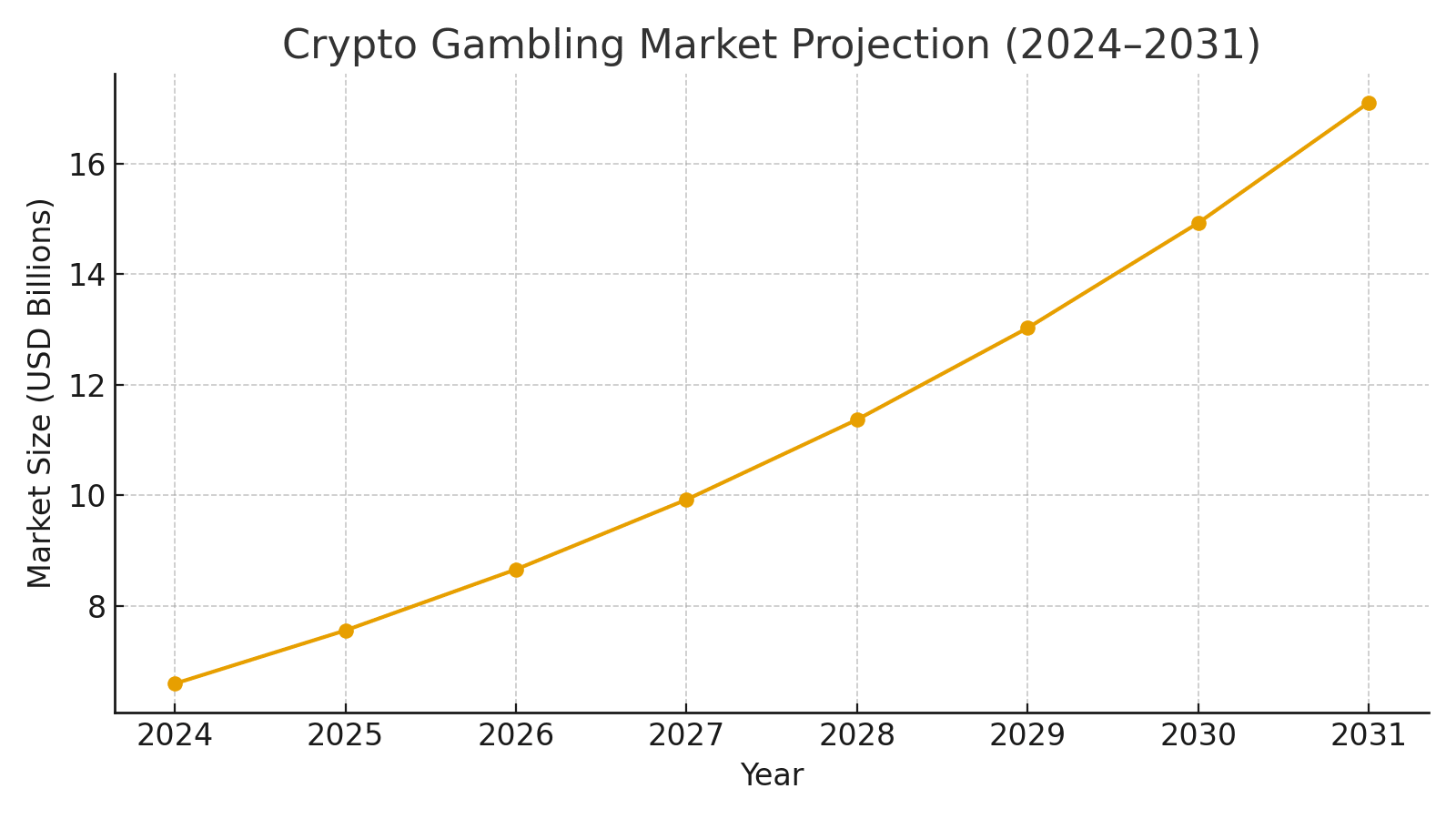
The data points for the start and end of the line come from third-party research. The intermediate values follow the same growth rate each year.
Why The Crypto Gambling Market Grows In 2025
The first driver is payment quality. Stablecoins reduce friction for deposits and withdrawals. A player can fund an account without a card decline. The player can withdraw without a long wait. This change improves trust because it keeps control in the hands of the user. Wallets improve as well.
They now include cleaner sign-in flows, stronger recovery, and better alerts. Networks also cut fees and speed up confirmation. Layer 2 rails on Ethereum and fast chains on other stacks make small bets viable. When fees fall, casual users enter the market.
The second driver is product fit. Some games work well with simple cryptographic proofs. Dice, crash games, and simple card draws allow an easy check with a server seed, a client seed, and a nonce.
The platform can also use a verifiable random function for jackpots or lotteries. The player can test the math. This add-on does not replace licensing or audits. It does give the player another way to confirm fairness without trust in a black box.
Security And Regulatory Context With Real-World Stats
Rules shape the market. They decide who can offer games. They set the guardrails for payments and marketing. They also protect players from abuse. 2025 brings more clarity in several important hubs.
In the United Kingdom, the Gambling Commission provides a mature template. The regulator reported £15.6 billion in total gross gambling yield for the period from April 2023 to March 2024. The remote sector reached £6.9 billion across casino, betting, and bingo.
These numbers show scale and strict oversight. They also show that online channels can live under heavy rules and still grow. Crypto-facing platforms that want a long life should learn from this model. They should expect stronger affordability checks and more real-time risk controls over time.
In the United States the legal map changes often. Still, the path is clear. More states allow sports betting. The American Gaming Association reported a fourth straight record year in 2024. Mobile use drives most of it.
The country will keep a patchwork for now. iCasino is legal in fewer states than sports betting. The trend still points to more legal online activity. That trend supports the digital habits that the crypto gambling market can use, even where crypto play sits in a separate channel.
How Provably Fair Works In Plain English
A provably fair game starts when the platform commits to a secret server seed. It publishes a hash of that seed before play. The player brings a client seed. A nonce increases with each round. The game uses these inputs to produce a number. That number maps to a dice roll, a card draw, or some other outcome.
After the round the player can combine the inputs and confirm that the result did not change. If the platform tried to switch the server seed after the fact, the published hash would not match. The check would fail. Many platforms now add a verifiable random function to lottery or jackpot logic.
Opportunities In 2025
Compliance is not only a cost. It can become a growth driver. Teams that build to FATF standards earn better payment access. They also win trust from banks and vendors. Clean policies on KYC, sanctions, and Travel Rule messaging speed up onboarding with partners. The same discipline improves the player experience. People deposit and withdraw with fewer problems. That drives retention.
Risks To Watch And A Practical Checklist In Prose
Counterparty risk comes first. If a platform uses custody, it controls user funds at some point. Hot wallets can get drained. Cold storage can get mismanaged.
A user should ask where funds sit and how keys are protected. Proof of reserves helps when it includes liabilities, clear dates, and a method that others can test.
Responsible play sits across all other risks. A site that promotes limits, time-outs, and self-exclusion shows respect for players. It also shows that the team wants long term value rather than short term volume.
The NGAGE 3.0 survey makes the human case. Risk remains real even as some indicators fall. Design choices shape outcomes. A site that shares helplines and uses risk-based nudges moves users toward safer choices.
Regional Picture In 2025
North America enters 2025 with strong momentum. The U.S. commercial industry hit another record in 2024. Mobile sports betting continues to expand.
Some states still restrict iCasino, but the path for sports looks clear. This trend supports digital behaviors that matter to the crypto gambling market.
The mix includes faster onboarding, cleaner risk checks, and better payments. Each step supports the use case for wallet based play. The main constraint is the patchwork. Rules differ by state. Operators must map products to local law.
Europe shows a mature approach. The UK gambling market reports strong remote numbers. The regulator treats AML and safer gambling as core duties.
Malta supports on-chain features within license terms. Curaçao upgrades oversight through LOK. The theme is higher standards and stronger reviews. Good teams will treat this as a chance to build trust rather than as a barrier to growth.
The Role Of The Crypto Gambling Market In A Larger Industry
The crypto slice remains smaller than the fiat slice. That fact should not surprise anyone. The base for fiat is huge. The share for crypto rises because users move from other parts of the digital asset world.
Traders and wallet holders bring funds and skills. They expect fast settlement and clear control. They respond to proof and transparency. Online gambling itself also grows. Projections out to 2030 show steady gains in this channel.
The crypto gambling market benefits from both forces at once. It grows as online grows. It also grows as wallets and stablecoins spread through other use cases.
A small share shift can carry weight when the base is large. If global gambling sits near two thirds of a trillion dollars in 2025, a move of one or two percent into crypto play would already move billions.
That kind of shift does not need perfect conditions. It needs safe payments, solid rules, and good products. The industry now has room to deliver all three.
How To Think About Tokens That Link To Gambling
Some platforms issue a token. They say it powers rewards or gives access to features. A simple frame helps a reader judge these claims. The token should have a clear use in the product that a normal user can explain in one breath. It should have an emission schedule that a normal reader can read without a chart. It should sit on top of a treasury policy that reduces volatility risk and keeps funds in stablecoins for liabilities.
Simple Guidance For Players In Continuous Prose
A player should start by reading the license page. The page should list the jurisdiction and the current status. Curaçao now runs the LOK regime, so new claims should match the new process. The player should then read the page on KYC and withdrawals.
The text should give exact steps and time frames. The next step is a small test. The player can run a few rounds in a provably fair game and verify the outputs with the seeds and the nonce. If the platform claims a verifiable random function for jackpots, it should provide links and clear guides.
Conclusion
The crypto gambling market moves into 2025 with real momentum. The wider gambling industry grows from a very large base. The online segment continues to climb. The crypto slice grows faster from a smaller starting point.
Payments improve through stablecoins and better wallets. Fairness improves through proofs and VRF. Rules sharpen in hubs that matter, such as the United Kingdom, Malta, and Curaçao. The United States continues to expand legal sports betting and sets mobile habits that support digital play.
Players will reward this behavior with loyalty. If those habits spread, the crypto gambling market can scale in 2025 without scaling harm. The best path forward blends growth with care and turns trust into a durable asset.
Frequently Asked Questions For Crypto Gambling Market
How big is the crypto gambling market today, and where can it go by 2031?
Estimates point to about $6.6 billion in 2024. The projection shows $17.1 billion by 2031 if growth near 15.1 percent continues across that span.
How large is online gambling in general, and why does it matter for crypto?
Online gambling sat near $78.66 billion in 2024 and could reach about $153.6 billion by 2030.
What is the role of U.S. sports betting in this story?
The legal market keeps expanding and breaks revenue records. That shift puts more users on mobile flows with strong KYC and fraud checks.
What does provably fair mean in simple terms?
The platform commits to a server seed, the player brings a client seed, and a nonce increments each round. The system produces an outcome in a way that the player can check.
What are the main risks for players, and how can they manage them?
The big risks are smart contract bugs, custodial failures, and weak AML. Bad actors seek gaps in controls.
Glossary
- AML and CFT: A set of rules and controls that aim to stop money laundering and terrorist finance. The Financial Action Task Force sets the global standard for these topics.
- CAGR: Compound annual growth rate. A way to show how much something grows each year over a period.
- DLT: Distributed ledger technology that stores data across many computers. The Malta Gaming Authority created a policy so licensees can use DLT in a supervised way.
- GGY: Gross gambling yield. It is the amount an operator keeps after paying prizes. The UK regulator reports industry figures using this measure.
- iCasino: Online casino games such as slots, blackjack, and roulette. The term appears in U.S. policy and industry reports.
- LOK: The new law in Curaçao that replaces the old licensing framework. It brings direct licenses and stronger oversight.
- Provably Fair: A method to check game outcomes using seeds, hashes, and known code. It lets players confirm that a platform did not alter results after the fact.
- Stablecoin: A digital asset that tracks a stable value, often the U.S. dollar. It helps users avoid price swings during a session.
- Travel Rule: A requirement for VASPs to share sender and receiver data with certain transfers. It aims to align crypto flows with AML rules.
- VRF: A verifiable random function that creates randomness with a proof that others can verify on chain. It works well for jackpots and lotteries.
Summary
The crypto gambling market heads into 2025 with tailwinds from payments, product fit, and policy. Third-party estimates place the segment near $6.6 billion in 2024 with a projected climb to $17.1 billion by 2031. The broader online gambling market reached about $78.66 billion in 2024 and could double by 2030. The United States adds scale through record commercial results and the spread of mobile sports betting. Global rules tighten as FATF presses standards on AML and Travel Rule coverage. The UK posts strong remote GGY under strict oversight. Malta supports on-chain features under license. Curaçao moves to the new LOK regime. Risks remain in custody, smart contracts, and problem gambling. Platforms that prove fairness, own payments, and design for safer play will lead. Users should choose licensed brands, verify outcomes, and set limits.