





Blockchain casinos promise open math, faster payouts, and full control over funds. In 2025, players want proof, not promises. The good news is that “provably fair” systems let anyone confirm a game’s result with simple checks. This guide explains about best provably fair crypto casinos how that works, how to judge risk, and what rules apply today.
It also shows what separates strong, licensed operations from fly-by-night brands. The focus stays on blockchain casinos and the steps that make each spin, roll, or card draw something you can verify. If you’re serious about safer crypto play, knowing the best provably fair crypto casinos is your first step.
What “Provably Fair” Really Means
Provably fair games let players confirm each outcome after the round. The casino publishes a cryptographic fingerprint of its secret number, called the server seed, before play. The player adds a client seed. A counter called a nonce tracks each bet. After the round, the casino reveals the server seed. Players can hash it and check that it matches the earlier fingerprint. Then they can reproduce the result with the server seed, client seed, and nonce. If the replayed result matches, the round was fair.
Why It Matters
Traditional casinos rely on audits and closed RNGs. Provably fair adds a second layer that anyone can test. Players can rotate their client seed at any time before wagering. That small control helps block subtle manipulation and builds trust round by round. Open source examples use standard hashes like SHA-256 or HMAC variants, which are well studied and easy to verify.
10 Best Provably Fair Crypto Casinos For 2025 (Editor’s Shortlist)
Stake — HMAC provably fair
Run a tiny bet, then use the on-site verifier to replay the round with server seed, your client seed, and the nonce. Rotate your client seed between sessions and screenshot hashes for your records. Always confirm the live license on the regulator’s portal before you deposit.
Primedice — Classic dice PF
Dice is perfect for learning PF: note the server seed hash before rolling, then verify the revealed seed afterward to reproduce the exact roll result. Keep your client seed fresh and track the nonce count. Start with micro-stakes to sanity-check variance.
Roobet — Originals verifier
Test one of the “originals” with a $1 spin/roll, then plug seeds into the verifier to confirm fairness. Check RTP per game and read the cashier page for limits and confirmation times. If the PF flow feels opaque, treat that as a red flag.
BC.Game — Seed/nonce checks
Make sure you can set your client seed and see a visible nonce counter for each round. After play, verify that the revealed server seed matches the pre-round hash and reproduces the result. Scan bonus terms—especially rollover and withdrawal windows.
Bitsler — PF bet checker
Use the bet-level checker to replay outcomes and confirm the math, not just the marketing. Verify that RTP is disclosed per title and that audit/test lab links are live. If withdrawals are “pending” without reason, pause and contact support.
Duelbits — PF on originals
Stick to the titles with a clear PF tab and step-by-step verification. Cross-check that seeds and nonces line up with your bet history. Read the payments page for per-transaction limits and network confirmations before sending any coin.
Rollbit — VRF-backed games
For VRF games, confirm the proof is exposed per round and independently verifiable. Compare PF/VRF notes across a couple of titles (e.g., crash vs. mines) to ensure consistency. Keep a log of hashes, timestamps, and payouts to spot anomalies.
TrustDice — On-site PF tools
Walk through the whole PF loop: seed hash → play → seed reveal → replay result. If the site allows, export logs for your own archive. Favor games with transparent RTP and skip anything that hides RNG details behind vague language.
FortuneJack — “Instant” PF suite
Test one Instant/Original game first and verify before scaling your bet size. Confirm cash-out rules, KYC triggers, and network fees up front. If docs don’t show the hashing algorithm or inputs, move on.
Bitcasino.io — PF docs + CGA
Read the PF help page, then replicate a round with the site’s verifier or a public one. Double-check license info on the regulator’s portal and scan the RTP table by game. Prefer stablecoin rails if volatility stresses you out.
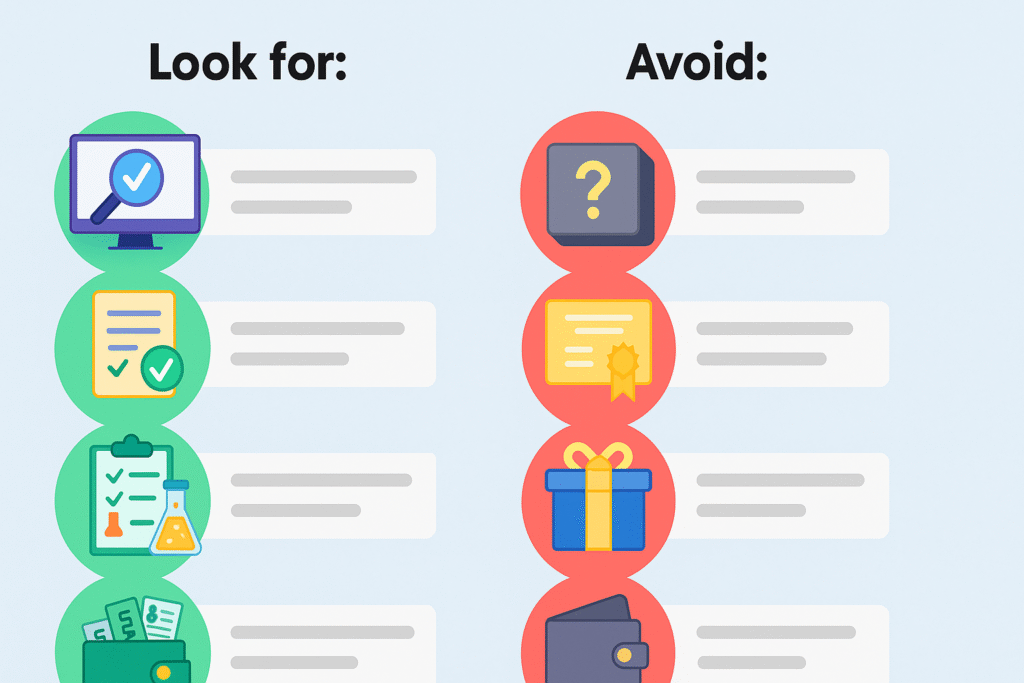
Quick Checklist for Best Provably Fair Crypto Casinos
Look for:
- A clear, simple verifier that shows the server seed hash, client seed, and nonce.
- License details and the regulator’s name.
- RTP disclosure and links to game test labs.
- Payment pages that show network fees and confirmation steps.
- KYC, AML, and self-exclusion tools.
Avoid:
- Hidden seeds or “trust us” RNG claims.
- Mystery licenses or expired seals.
- Forced bonuses with unclear rollover rules.
- Wallets that hold withdrawals for days without reason.
How to Verify a Round in Practice
- Note the server seed hash shown before play.
- Set or confirm your client seed.
- Place a bet. The game increments the nonce.
- After the round, copy the now-revealed server seed.
- Hash it and confirm it matches the pre-round hash.
- Use the casino’s verifier, or a public one, to recreate the result from your seeds and the nonce.
What Makes a Crypto Casino “Provably Fair”?
| Feature | What to check | Why it matters |
| Server seed commitment | Hash of server seed shown before play | Stops the casino from swapping seeds mid-round |
| Player seed control | Player can set and rotate client seed | Adds independent randomness |
| Nonce counter | Visible round counter | Reproduces exact bet sequence |
| Public verifier | On-site or open tool | Lets anyone replay results |
| Audit links | Testing and RNG policies | Supports long-term integrity |
| Transparent RTP | Clear RTP by game | Aligns with regulator rules and player expectations |
Where the Market Stands in 2025
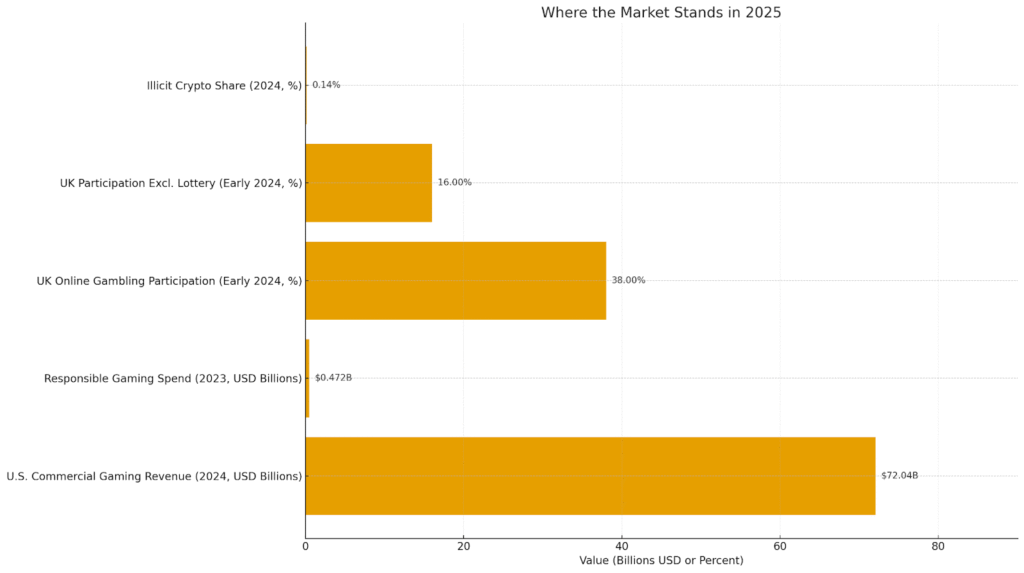
Online gambling keeps growing. In the United States, commercial casinos set a new revenue record in 2024 at $72.04 billion, with three straight record years and strong growth in regulated online markets. Responsible gaming spending by companies reached $471.8 million in 2023, up 72 percent since 2017.
Crypto play is also shifting. Reports from major iGaming suppliers show altcoins gaining share across bets in 2024, with Bitcoin no longer the only choice. Tether, Litecoin, and Ethereum gained ground. This trend continues in 2025 as operators add stablecoin rails and cross-chain support.
Participation data in Britain shows how common online play has become. In early 2024, 38 percent of adults gambled online in the past four weeks, with 16 percent when lottery-only players are excluded. Lotteries still dominate, but instant win games and betting also show steady use.
Illicit crypto share remains small in the wider blockchain economy. Chainalysis estimates 0.14 percent of 2024 on-chain volume linked to illicit activity. Compliance still matters, but the data shows most crypto use is lawful.
Security and Regulatory Context
The Rules That Matter
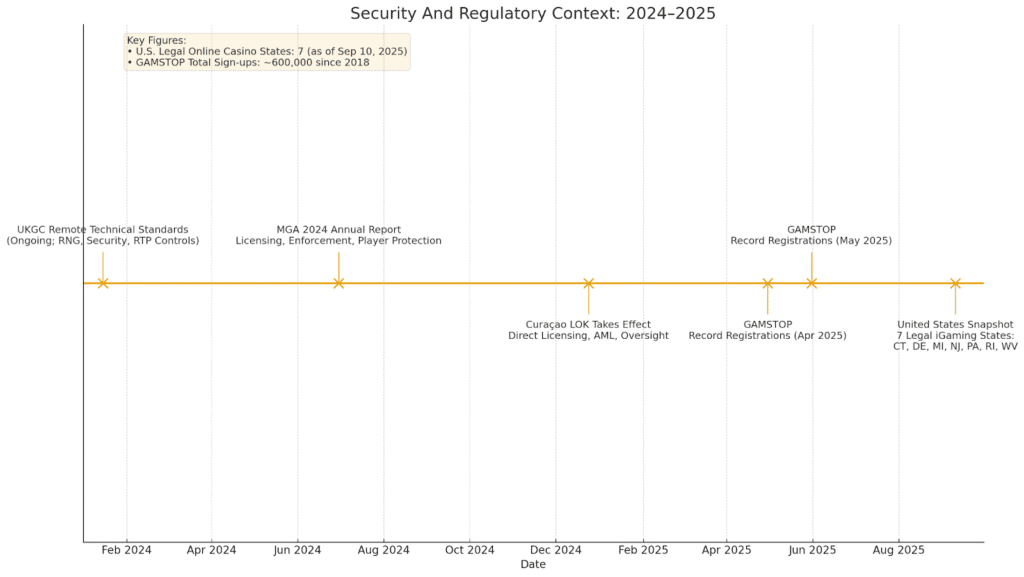
- UKGC Remote Technical Standards. Licensed remote operators must meet strict technical and security rules. These standards cover RNG testing, systems security, and controls like live RTP monitoring.
- MGA oversight. Malta’s regulator released its 2024 annual report and continues to issue and enforce licenses for B2C and B2B gaming companies. The report covers market figures, enforcement, and player protection efforts.
- Curaçao’s new LOK law. On December 24, 2024, Curaçao’s National Ordinance on Games of Chance took effect. The new Curaçao Gaming Authority now issues licenses directly, replacing the old master-license model. The framework adds AML, substance, and compliance requirements and tightens oversight.
United States Snapshot
Only a small set of states offer legal, state-licensed online casinos. As of September 10, 2025 the list includes CT, DE, MI, NJ, PA, RI, and WV. Other states continue to debate frameworks, taxes, and consumer protections. Players in the U.S. should use regulated sites in their state, and check rules on deposits and identity checks.
Safer Gambling Signals
Britain’s self-exclusion data shows rising awareness. GAMSTOP reports record monthly registrations in April and May 2025, with total sign-ups nearing 600,000 since launch in 2018. Spikes often follow major events, which mirrors broader engagement trends.
How Blockchain Changes the Player Journey
Deposits and Withdrawals
Crypto payments settle faster, often within minutes after network confirmation. Stablecoins reduce price swings between deposit and withdrawal. Clear fee displays help avoid surprises. Many licensed sites now blend crypto and fiat rails, so players can pick the route that fits their wallet and tax needs.
Transparency and Control
Provably fair tools shift trust from marketing to math. Players can export seeds and logs, then verify outcomes at any time. This mirrors norms in open finance, where public proofs build confidence without exposing personal data.
Compliance and Protection
Regulated casinos add KYC, AML screens, and self-exclusion links. In strict markets, operators must publish RTP ranges, run regular tests, and report incidents. That baseline reduces risk for players who want crypto speed with licensed safeguards.
What to Look for Before Signing Up for Best Provably Fair Crypto Casinos
Licensing and Jurisdiction
- Tier-1 and Tier-2 regulators set strong baselines on testing and player funds.
- Curaçao’s LOK now requires direct licensing and more compliance, which raises the floor for sites that choose it. Check the license number on the regulator’s portal.
Game Providers and Audits
Reputable providers publish RTP and support regulator audits. Look for independent test lab seals and documents that explain RNG methods. The site should link to a verifier or show how to check seeds.
Payments and Limits
Quality sites show per-transaction limits, confirmation counts, and withdrawal timeframes. U.S. players should stick to state-licensed sites. Crypto is not a path around state law.
Common Myths About Blockchain Casinos
Myth: Provably fair means no risk.
Reality: It proves the randomness, not bankroll safety. Choose licensed sites, read terms, and use limits.
Myth: Crypto gambling is legal everywhere.
Reality: Laws vary by state and country. Always check local rules and use licensed options.
Myth: Bitcoin is the only coin that works.
Reality: Players now favor a mix of Bitcoin, Ethereum, Litecoin, and stablecoins. Altcoin share grew in 2024, and the mix keeps shifting.
How to Compare Blockchain Casinos in Minutes
Step 1: Check the License
Confirm the regulator and the license number. Curaçao LOK and MGA sites should list current details. For U.S. play, confirm the brand is legal in your state.
Step 2: Test the Verifier
Run a small bet. Save the server seed hash. After the round, verify the outcome. Rotate your client seed and repeat. If the site makes this hard, move on.
Step 3: Review Payments
Scan deposit fees, withdrawal speeds, and limits. Favor clear rules and stablecoin support if price swings worry you.
Sample Evaluation
| Criterion | Strong signal | Weak signal |
| License | Live entry on regulator site | Missing or unverifiable number |
| Provably fair | Seed hash, client seed control, nonce, verifier | Vague “fair RNG” claim |
| RTP and testing | RTP per game, audit seals, live RTP policy | No RTP, no lab link |
| Payments | Clear fees, timeframes, stablecoin option | Hidden fees, slow releases |
| Support | 24/7 help, clear dispute steps | Unclear contacts |
Risk Management for Players
- Set a budget and a time limit before logging in.
- Use self-exclusion tools if play feels hard to control.
- Keep records of deposits, withdrawals, and seeds.
- Favor stablecoins if price volatility causes stress.
- Treat bonuses as extras, not income.
The Road Ahead
Two shifts will shape 2025 and 2026. First, more regulators will demand clearer disclosure on RTP, testing, and safer gambling controls. Second, crypto rails will keep blending with fiat options, as licensed sites add stablecoin support and clearer audit trails. The winners will publish math, follow rules, and make verification simple.
Conclusion
Blockchain casinos can earn trust when they prove every spin. The best brands pair provably fair tools with real oversight, clear RTP, and strong payments. Check the license, run the verifier, and review fees before play. The aim is simple, pick blockchain casinos that show their math and meet the rules.If you want faster payouts and provable fairness, stick with the best provably fair crypto casinos that show their math and meet the rules.
Glossary
- Blockchain casinos: Online casinos that accept crypto and often offer provably fair games.
- Provably fair: A system that lets players verify each game result with seeds and hashes. (SlotsGuy.com – Vegas Style Slots)
- Server seed: The casino’s secret number, revealed after a round for verification.
- Client seed: The player’s number that adds independent randomness.
- Nonce: A counter that increments with each bet to keep rounds unique.
- RTP: Return to Player, the long-term expected payout of a game.
- KYC/AML: Identity and anti-money laundering checks required by regulators.
- MGA: Malta Gaming Authority, a leading regulator.
- UKGC: UK Gambling Commission, the regulator for Britain.
- LOK (Curaçao): The 2024 law that created the Curaçao Gaming Authority and direct licensing.
FAQs About Blockchain Casinos
Are blockchain casinos legal in the U.S.?
Only in states with licensed online casinos. As of September 2025 that includes CT, DE, MI, NJ, PA, RI, and WV. Players should use state-approved operators.
Can provably fair games still be rigged?
The math proves the result of each round. It does not replace licensing, audits, or fund protection. Pick licensed sites and verify each round as needed.
Which coins work best for gambling?
Bitcoin, Ethereum, Litecoin, and stablecoins are common. Altcoins gained share across 2024, and that trend continues. Stablecoins help reduce volatility.
What is a safe RTP?
Higher RTP means less house edge. Many regulated markets require clear RTP disclosure and testing, which helps players compare games.
How big is online gambling now?
U.S. commercial gaming revenue reached $72.04 billion in 2024, a record. Growth was strong in regulated online markets.
Summary
Blockchain casinos use provably fair systems so players can verify each game with seeds and hashes. A server seed is hashed before play, the player adds a client seed, and a nonce counts each bet. After the round, the casino reveals the server seed, and anyone can recreate the result. In 2024, U.S. commercial gaming revenue hit $72.04 billion, while UK data shows strong online participation. Crypto betting mixes now include more altcoins and stablecoins. Strong sites show a live license, clear RTP, audits, and a simple verifier. Curaçao’s LOK law created a direct licensing regime and tougher AML rules, while the UKGC and MGA keep strict technical standards. Players should verify rounds, check fees, set limits, and use self-exclusion if needed.