





NFT lending absolutely exploded in 2023-2024 and then sharply contracted in 2025. According to recent reports, monthly NFT loan volumes fell roughly 97% from nearly $1 billion in January 2024 to only about $50 million by mid-2025.
This collapse is evidence of the wider NFT market crash which has drained liquidity for loans. Long term projections are positive though as market researchers predict a global NFT loan DApps market worth about $2.46b in 2025 rising to approximately $37.14b in 2035 (+31% CAGR.)
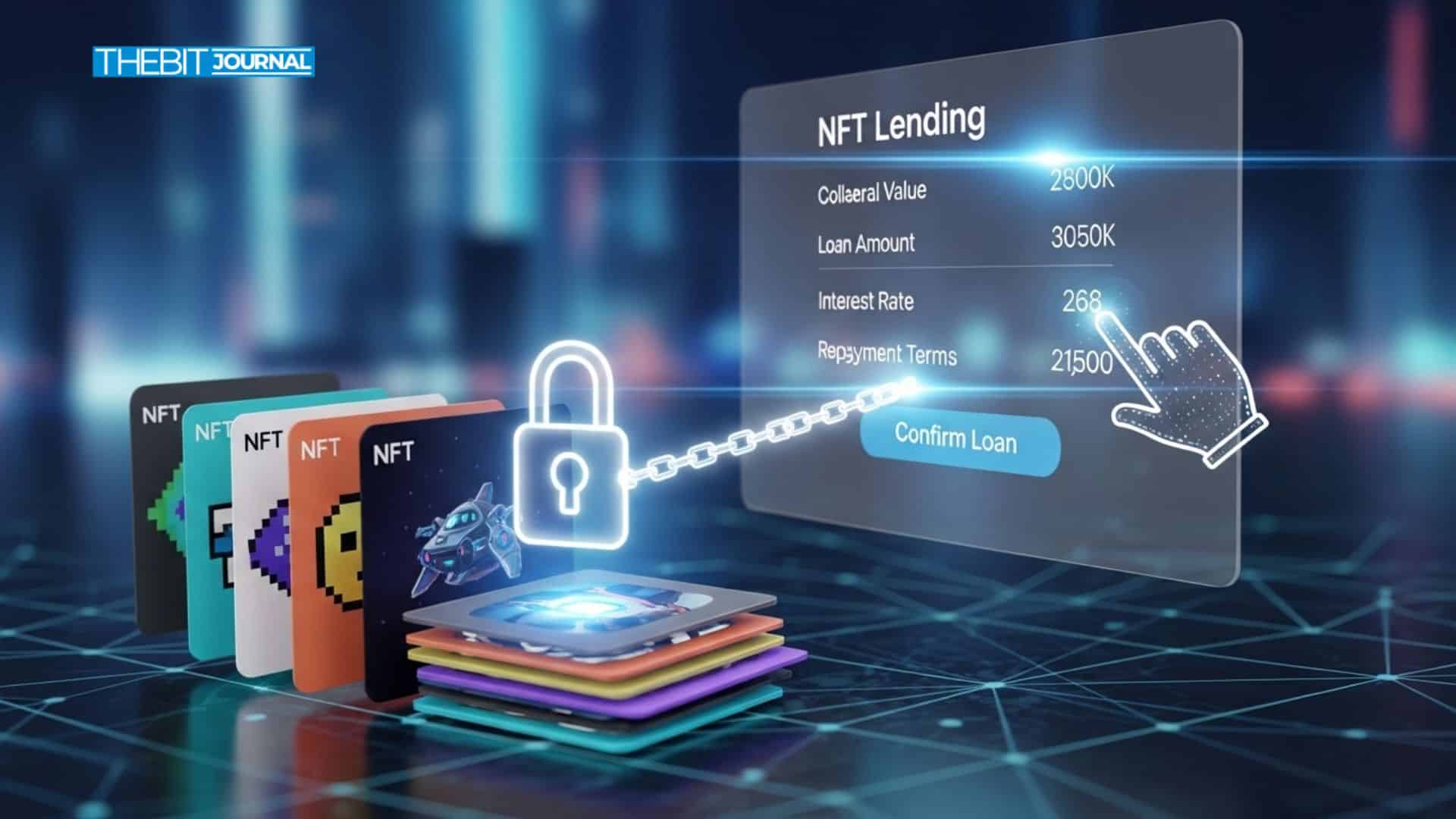
In other words, NFT lending enables NFT owners to borrow funds without selling their digital collectibles. They lock an NFT into a smart contract as collateral, and in return, the NFT users get a crypto loan. If they repay, they get the NFT back, while if they don’t repay their collateral can be liquidated.
How NFT Lending Works
NFT lending is built on blockchain smart contracts and borrows concepts from traditional secured loans.
- Choose a Platform and Connect Wallet: A borrower with a Web3 wallet (MetaMask, etc.) can log into a lending platform (e.g. NFTfi, BendDAO, GONDI etc.).
- List NFT as Collateral: The borrower lists one of their NFTs as the collateral and proposes loan terms (amount, currency, duration). Borrowers may need to choose an LTV ratio (usually 30% – 60% of the NFT floor price) on the platform.
- Matching with Lender Offers: In P2P systems, lenders will read the NFT and make loan offers against it. In peer-to-pool models, liquidity providers stake collateral crypto in a pool and an algorithm quotes a loan amount and interest rate based on floor price oracles.
- Locking Collateral and Fund Transfer: Once a deal is struck, the NFT is sent into a smart contract (vault) that locks it up. The loan value will be automatically deposited into the borrower’s wallet (e.g. in ETH, wETH, DAI, USDC etc)
- Repayment or liquidation: The borrower repays principal and interest by the due date. The NFT is returned check by the smart contract if re-payed. If the borrower fails to repay or if the price of NFT falls below a safety level, it is transferred (or auctioned) to the lender.
This is unlike crypto lending for fungible tokens, as each NFT is unique. Valuation is more art than science; platforms can set loan limits based on recent sale history, NFT indexing services or negotiated appraisal to set loan limits. Due to this uniqueness, NFT loans tend to have lower LTV and higher interest rates than fungible loans.
NFT Lending Models and Platforms
Multiple business models have come up to cover NFT lending:
Peer-to-Peer (P2P) Lending: On platforms such as NFTfi and Arcade, individual lenders can negotiate loans by striking terms with borrowers directly. Borrowers post NFTs; would-be lenders propose terms for loan. Since NFTs do not have a price oracle, each loan is negotiated on a case-by-case mode. NFTfi pioneered this model. It imposes a fee on lender interest (for example, NFTfi takes 5% of interest earned) but nothing from borrowers.
Advantage: Flexible, renegotiable terms.
Drawback: Tedious matching process, and lenders tend to be more conservative (low LTV loans).
Peer-to-Pool (P2Pool) Lending: Services such as BendDAO run an automated lending pool. Borrowers submit an NFT and immediately receive a loan using on-chain oracles. BendDAO (Ethereum) lends up to 40% of the NFT floor price. No term on loans (borrower can pay any time; protocol sells if value drops). This model is built with smart-contract calculations: it calculates automatically how much ETH you are able to borrow against your NFT collateral.
Advantage: Fast, no counter-party negotiation.
Drawback: Typically lower LTV and risk of “cascade” liquidations if several NFTs fall simultaneously.
Hybrid / Multi-Party Lending: Astaria introduced a three-party model where “strategists” create vaults that allow for adjustable terms. It’s a cross between pool and peer lending. Strategists curate loan pools for particular NFT collections, attracting capital from lenders. Borrowers select a vault that fits their NFT and preferred terms, then borrow from it. The idea behind Astaria was to simplify the matching process but keep it sufficiently flexible.
Innovative Features: As of 2025-2026, few platforms came up with creative twists. Arcade (formerly Pawn.fi) allows for bundling of NFTs into a wrapped token that can then be leveraged for more borrowing. Zharta automates the process of choosing collateral: participants tell it a size for their desired loan and it tells them which NFTs (or combinations) to pledge. These functions are designed to enhance international liquidity and overall user experience.
Popular Platforms and Examples
As of 2025-2026, key NFT lending protocols include:
NFTfi (peer-to-peer, Ethereum), Arcade (peer-to-peer bundles, Ethereum), BendDAO (peer-to-protocol pool), Blur/Blend (peer-to-peer with perpetual loans), GONDI (emerged leader in 2025; 54% market share), Zharta, JPEG’d, Honey Finance and Astaria.
NFTfi, for instance, supports 150+ NFT collections and leverages on-chain floor prices plus analytics (NFTBank valuations) in order to determine the terms of lending.
BendDAO focuses on blue-chip collateral (BAYC, CryptoPunks) and issues ‘bentETH’ tokens to lenders. These platforms tend to take in major NFTs (BAYC, Azuki, CryptoPunks e.t.c.) as collateral.
NFT Lending Market Trends
The volatility that NFT lending has experienced is quite extreme. NFT lending briefly looked like it was in a breakout trend in early 2024. Thousands of loans were made within hours of Blur’s new Blend protocol.
However by mid-2025, usage had crumbled. NFT loan volume was just $50M in May 2025, a fall of 97% from the January 2024 high, according to DappRadar data. Active lenders and borrowers also dropped (lenders down 78% and borrowers down 90%, year on year).
Yet, the average amount borrowed by each NFT shrunk from $22K in 2022 to $4K by May 2025, implying either poorer collateral or more conservative borrowing.
The slowdown is generally attributed to the overall NFT bear market, falling floor prices translated to less available collateral value, so there were fewer new loans.
Platforms outside the top 8 have largely disappeared by mid-2025. Average loan terms contracted (from 40 days in 2023 to 31 days in 2025), and the ecosystem is in a “holding pattern” awaiting either a market rebound or new use cases.
Some still see NFT lending as resilient infrastructure despite the downturn. FutureMarketInsights projects the NFT lending DAssets market to increase 15x from 2025 to 2035 (from $2.46B to $37.14B).
NFT lending is quiet right now but has upside potential if the crypto market recovers or with new use cases.
Benefits of NFT Lending
Liquidity Without Selling: NFT loans free up cash (or crypto) while letting owners hold on to the basic asset. That can be valuable for holders who believe in their NFTs’ future value but require funds now.
Access to DeFi/Yield Opportunities: Borrowers have the ability to use funds they borrow as investment elsewhere while holding the NFT. Similarly, lenders collect interest off loans backed by high value digital art, diversifying their DeFi portfolio. There is no credit check or traditional underwriting, the NFT itself serves as collateral.
Flexible Terms (Platform-Dependent): In peer-to-peer lending, terms may be negotiated, which can give borrowers some say. Some protocols (e.g. Blend, Arcade) allow borrowers to repay at any time (no fixed maturity).
New Use Cases: NFT lending opens up new business models; for instance, “buy now pay later” schemes for NFT purchases (loan financed buys), and fractionalization of NFTs itself for availing loan. It also encourages NFT holders to continue participating (they can earn passive yield on crypto and keep assets without selling it).
Risks and Challenges of NFT Lending
Price Volatility and Liquidation Risk: NFTs can be highly volatile. A sudden drop in floor price can trigger rapid liquidations of collateral. Unlike fungible crypto, the value of an NFT is subjective and not particularly straightforward to establish safe LTV ratios with. As Blockworks cautions, NFT markets are “inherently illiquid and hard to price,” so “cheap debt” in NFTs may create unexpected risks. If a borrower’s NFT tanked in value, they could lose it altogether.
Collateral Liquidity: It’s not always easy to find a buyer for seized NFT, especially when it comes to niche collections. If a lot of loans begin to default, there might be large-scale selloffs that could drive prices even lower. Lenders might find it difficult to exit positions, and when forced to liquidate, borrowers may get less value.
Smart Contract and Platform Risk: NFT lending is facilitated by smart contracts. Bugs, hacks or exploits (as with other DeFi sectors) could freeze or steal funds. If a lending platform’s contract is faulty, the borrower and lender can potentially lose assets. Research on platform security is important.
Counter-Party and Operational Risk: In peer-to-peer systems, borrowers are dependent on honest counterparties. In the event of a borrower defaulting, there could be disputes or delays in foreclosing on the NFT. Platforms ease this by specifying default mechanics, but even new protocols could be flawed.
Regulatory and Legal Uncertainty: NFT lending is in a gray area of financial regulation. In most jurisdictions, what it means for NFTs to qualify as collateral is still not clear. For lenders, having a security interest in an NFT doesn’t necessarily come easily (e.g., there could be additional legal footwork such as the filing of UCC-1 statements). NFTs are now recognized under the U.S. Uniform Commercial Code as “controllable electronic records” to clarify ownership and lending rights, though this is a new area. Borrowers and lenders should stay awake to regulation.
These all amounts to a pile of risks, which is why experts caution. It is advisable to borrow conservatively (low LTV), take only trusted NFTs as collateral and deal with reputable platforms only.
A smart borrower will check the platform’s reputation, understand the appraisal process, familiarize themselves with loan terms and be realistic about liquidation risks.
Conclusion
NFT lending is an innovative practice used within the DeFi sector, by converting the value of a collectible NFT in the form of collateral for taking loans. It allows owners to tap liquidity without parting with digital art or game assets.
In 2025, Lending volumes for NFTs shrank sharply (−97% YoY) but forecast shows a multi-billion dollar industry on the horizon. There are different NFT lending models like peer-to-peer, peer-to-pool and hybrid, which aim to blend between borrower flexibility and lender protection.
NFTfi, BendDAO, GONDI, Arcade and Astaria are some of the leading ones which have rapidly evolving features like NFT bundling, auto pricing to make it easier for users.
Financially, one should carefully evaluate interest rates, LTV ratios, and platform stability before borrowing. Regulatory and legal structures are still behind the times, so participants should exercise caution and consider NFT loans to be a form of specialized credit instrument.
Overall, NFT lending combines art and finance, which opens up for new opportunities in the Web3 economy. But its continued viability depends on market comeback and innovation.
Glossary
NFT: Non-Fungible Token, a blockchain token which stands for digital unique asset (piece of art, collectable, virtual item). Unlike cryptocurrencies (which are fungible), each NFT is unique and contains its own metadata and value.
Collateral: Something of value that a borrower offers as a pledge for a loan. In NFT lending, the collateral is the NFT.
LTV (Loan-to-Value): The ratio that compares the amount of a loan to the value of collateral securing it. I.e., $10k loan on a $20,000 NFT is 50% LTV. Lower LTV means more cushion on price drops.
Smart Contract: A self-executing program on a blockchain.
DeFi (Decentralized Finance): A financial system or model built on blockchains (such as Ethereum) that has no central authority like banks.
Liquidation: The process of liquidating collateral to settle a loan. In NFT lending, “liquidation” is the process where if you don’t pay back or the value of your collateral falls below some set amount that has been agreed upon, the lender will transfer the NFT from you to him (or sell it).
Frequently Asked Questions About NFT Lending
What is NFT lending?
NFT lending is a process where owners use their NFT (non-fungible token) to borrow funds in the form of a loan (and normally it’s done with cryptocurrency). Instead of selling the NFT, a borrower deposits it into a smart contract and receives a loan, which is repaid to get the NFT back or if defaulted on, the NFT gets transferred to the lender.
Which NFTs are eligible to be put up as collateral?
The majority of NFT lending platforms use blue-chip or popular NFTs as collateral, usually famous art/collectible collections which have liquid markets. Examples are Bored Ape Yacht Club (BAYC), CryptoPunks, Azuki and other top collections.
What is the average loan-to-value (LTV) ratio in NFT loans?
NFT loan LTV is usually on the low side, in 20-50% of an NFT’s valuation. For example, BendDAO usually provide like 40% LTV based on floor prices. A lower LTV creates a cushion for the lender regarding price fluctuations.
What if one fails to make payments on an NFT loan?
If the borrower doesn’t pay back by the deadline, or if price of NFT drops below the maintenance threshold, the smart contract is allowed to seize and auction off the NFT collateral. This typically involves turning over the NFT to the lender (or auctioning it off). Lenders reclaim lent funds (contract value limit) with the borrower’s NFT.
Are NFT loans safe?
All loans carry risk. Risks of crypto volatility, smart contract bugs and illiquid collateral. Borrowers should use only NFTs that they are willing to lose, and they should do so through audited platforms from reputable developers. Lenders also should closely evaluate the NFT’s value as well as the security of the NFTs platform.
References