
Metals Are Running Hot While Crypto Blinks: Inside the AI-Driven Split
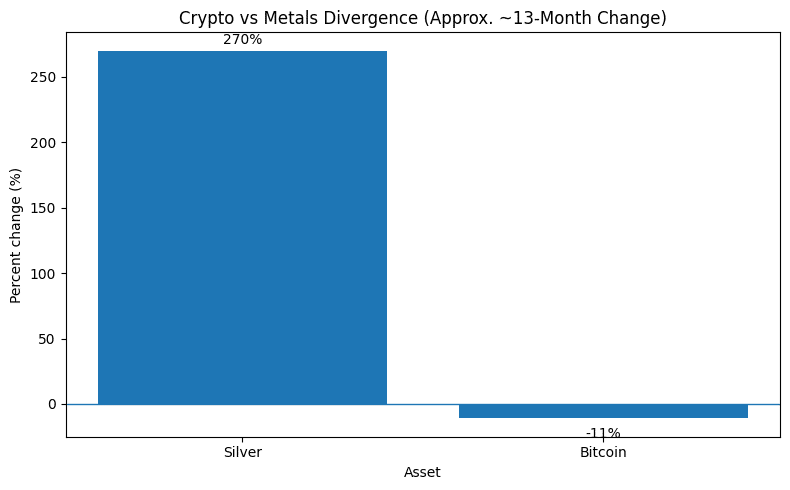
Gold is printing fresh records and silver is acting like it has somewhere urgent to be, while Bitcoin has struggled to hold the spotlight. On January 28, 2026, spot gold pushed past $5,200 and set another record, with silver trading around $115 in the same burst of momentum.
That contrast is turning into a serious market conversation because it is not only about fear and safe havens. It is also about infrastructure, power demand, and the kind of long-term spending cycle that investors tend to follow when they smell a structural trend. In other words, the current crypto vs metals debate is starting to look less like a weekly narrative and more like a positioning map for 2026.
Crypto vs metals: Why the gap widened in early 2026
A softer dollar is usually a tailwind for risk assets, and it often helps Bitcoin as well, at least historically. Yet the U.S. dollar has been sliding hard, with the dollar index hovering near multi-year lows and investors openly pricing in policy uncertainty and rate expectations.
At the same time, metals have had a clean, easy-to-understand story that plays well across macro desks: central bank buying, geopolitical risk, and a rush into tangible assets. Reuters reported gold’s jump above $5,100 earlier this week and noted the mix of safe-haven demand, a weaker dollar, and steady official-sector interest as key drivers.
This is where crypto vs metals becomes more than a chart comparison. Metals are getting both the fear bid and the future bid, and that second part is where AI enters the room.
The AI infrastructure angle investors keep pricing in
AI is not only software and GPUs, it is power, cooling, wiring, and new data center buildouts. Those physical requirements pull demand forward for industrial inputs, especially copper, and investors have been leaning into that logic.
S&P Global’s January 2026 research projects global copper demand rising from 28 million metric tons in 2025 to 42 million metric tons by 2040, and it also flags a large potential supply gap without major new mine development. In the same package, S&P estimates copper demand tied specifically to data centers rising from 1.1 million metric tons in 2025 to 2.5 million metric tons by 2040, with AI training data centers becoming a major share of that load. Reuters separately summarized the same study and highlighted the scale of the demand increase and the need for more supply.
UN Trade and Development has also been tracking how big the data center wave is getting. It reported that data centres captured more than one-fifth of global greenfield investment in 2025, and another UNCTAD update announced investment tied to data centres above $270 billion in 2025.
Put together, it explains why crypto vs metals is being framed as “AI trade versus digital asset trade” in some circles. One has visible shovels and receipts, the other depends more on liquidity, risk appetite, and narrative timing.
What crypto indicators say when metals steal the oxygen
Bitcoin does not need to rise every day, but it does need strong participation and clean liquidity signals to break higher in a sustained way. Recently, analysts have been watching a mix of price behavior, ETF flows, and on-chain positioning to judge whether weakness is structural or simply a pause.
U.S. spot bitcoin ETFs recorded about $1.22 billion in weekly outflows through January 23, one of the largest pullbacks since November, according to reporting that cited SoSoValue data.
Outflows like that often show that fast money is trimming risk, or that hedges are getting heavier, right when metals look simpler to hold. That flow picture has also been choppy, with reports of a small net inflow on January 26 after several days of outflows, which suggests sentiment is unstable rather than one-directional.
On-chain, Glassnode has described early 2026 as more of a transitional phase than a clean breakout. In its mid-January commentary, it noted that long-term holder distribution has slowed and that structural flows have stabilized, even while the market still faces overhead supply near key price levels. That matters for crypto vs metals because it hints that Bitcoin’s issue might not be “no demand,” but “demand that keeps meeting supply at the wrong levels.”

A practical checklist investors watch
In this environment, the market’s most-watched crypto indicators tend to cluster into a few buckets.
First is liquidity and access: ETF flows, exchange volumes, and stablecoin supply growth. If capital is entering through regulated rails, price tends to respond faster, and when that capital retreats, rallies often stall.
Second is positioning: funding rates, futures basis, and open interest. When leverage gets too one-sided, price can chop violently, and that can make metals look calm by comparison.
Third is on-chain cost basis and holder behavior: whether long-term holders are distributing, whether short-term holders are underwater, and whether price is reclaiming key realized levels that often act like psychological floors. Glassnode’s recent work has emphasized the importance of reclaiming cost-basis zones to confirm stronger upside conditions.
This is why crypto vs metals is not simply “Bitcoin failed.” It is more like two markets reacting to the same macro inputs in different ways, because the buyer bases are different and the time horizons are not aligned.
The gold and silver surge is not only “risk-off”
There is a temptation to explain everything as fear. Yet the speed of the metals move has also been tied to a mix of monetary dynamics and real-world demand. Reuters described silver’s move above $100 as a blend of momentum, tight supply, and strong investor interest, with analysts warning about volatility even as the rally continued.
Gold’s move has been directly linked to the dollar’s slide and the broader push toward non-dollar stores of value, with Reuters noting gold above $5,200 as the dollar hit a nearly 4-year low.
So when crypto vs metals is framed as a “divergence,” it is worth remembering that metals currently have multiple engines running at once, and Bitcoin is leaning more heavily on liquidity and conviction to do the same.
Conclusion
The current crypto vs metals split is a reminder that markets do not reward good stories; they reward crowded flows and clear catalysts. Metals have both: a visible AI infrastructure buildout, a soft dollar backdrop, and a straightforward safe-haven narrative. Crypto, meanwhile, is fighting through uneven ETF flows and overhead supply, even as on-chain signals suggest some of the late-2025 selling pressure has cooled.
If the dollar stays weak and liquidity conditions improve, Bitcoin can still regain momentum. But as long as AI capex and data center spending keep pulling investors toward tangible inputs, the crypto vs metals conversation is likely to stay front and center through 2026.
Frequently Asked Questions (FAQs)
Why is crypto vs metals trending now?
The comparison is heating up because gold and silver have surged to records while Bitcoin has struggled to break higher, even with a weaker dollar that often supports risk assets.
Does AI really affect metal prices more than crypto prices?
AI buildouts require power infrastructure, wiring, and data centers, which directly raises demand for industrial inputs like copper. Research from S&P Global links data-center growth to a large increase in copper demand over time.
What single crypto indicator matters most in this setup?
ETF flows are one of the clearest near-term signals because they reflect how much capital is moving through the easiest institutional access point. Large outflows can coincide with weaker price action.
Glossary of Key Terms
Bitcoin ETF flows: Net money moving into or out of spot Bitcoin exchange-traded funds, often used as a proxy for institutional demand and risk appetite.
Overhead supply: A zone where many holders bought previously and may sell when price returns to their break-even level, which can cap rallies.
Long-term holders: Investors who have held Bitcoin for extended periods; changes in their selling or accumulation can shape market structure.
Greenfield investment: New build projects such as new facilities or infrastructure, often used to measure real-world expansion like data centers.
Copper demand for data centers: Copper usage tied to building and powering data centers; S&P Global projects a significant rise through 2040.
References