
This article was first published on The Bit Journal.
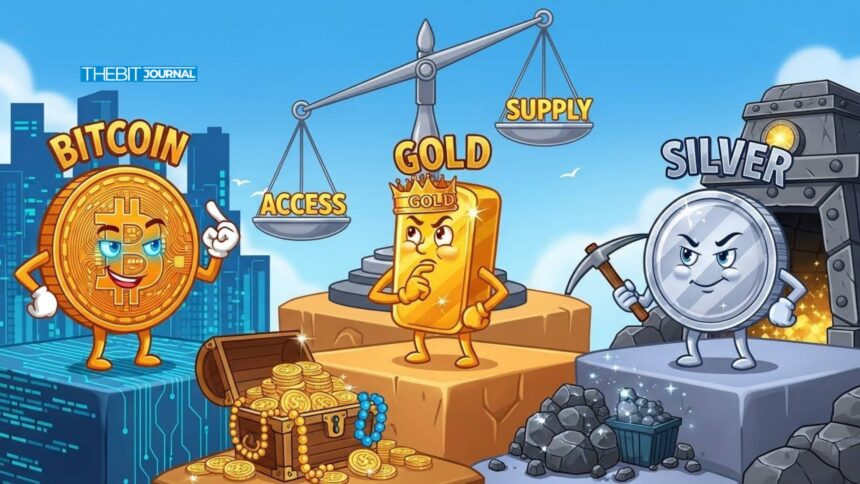
Investors in 2026 are no longer arguing over whether Bitcoin is more scarce than gold or silver. Most of that question has already been settled. What is new is how scarcity itself is being understood, valued and priced.
Scarcity repricing in 2026 is no longer just due to raw supply and extraction constraints only. It is a mix of access to the market, financial structure, liquidity pathways and credibility.
Bitcoin, gold and silver are each a different expression of scarcity, but investors are increasingly evaluating them through the same question: how does scarcity function inside modern financial systems.
Today, scarcity is situational, dependent on where assets travel and how fast and easy one can gain exposure.
Scarcity Repricing in 2026: From Supply Limits to Market Structure
The concept of scarcity used to be linked directly with a notion of production constraints. Gold and silver just happen to fit that model since they are finite in the geological sense and expensive to extract.
Breaking that model was Bitcoin, which introduced algorithmic scarcity through code rather than nature.
Today, when scarcity is discussed, it has more and more to do with credibility, liquidity and portability. Credibility asks whether the mechanism enforcing scarcity is trusted and resistant to interference. Liquidity is the capacity to allow capital to move into and out of exposure without moving prices. Portability quantifies how easily value can be transported across jurisdictions, platforms and financial systems.
These dimensions influence how scarcity is priced, and absolute supply numbers really do not anymore. Investors aren’t just buying scarcity; they’re buying access to scarcity under certain market circumstances.
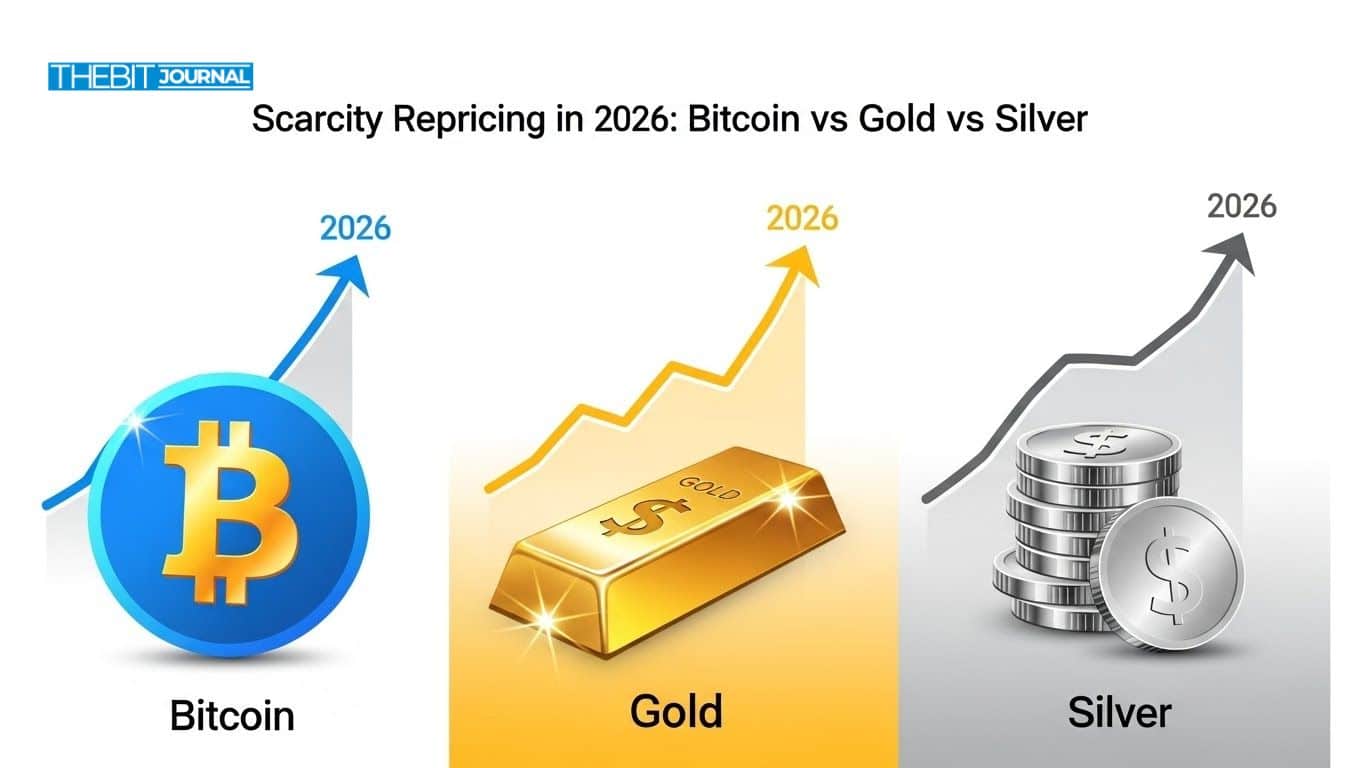
Bitcoin Scarcity Repriced Via Market Structure
Scarcity of Bitcoin has always been a fixed number of 21 million units with an unchangeable supply that is open for anyone to audit. This is one of the fundamental factors why investors appreciate Bitcoin’s scarceness. Its issuance schedule, codified in protocol and unaffected by monetary policy, is distinct in financial history.
Unlike gold, its supply schedule is written into code and cannot be manipulated by central bank policy makers.
However, the way Bitcoin is being accessed has changed. Increasingly, demand is funneling into spot Bitcoin exchange traded-product (ETPs) and derivatives rather than blockchain products.
These regulated means create an intermediation between Bitcoin’s scarcity and the traditional financial channels it provides access to, through which money flows rapidly into and out of Bitcoin exposure, altering its scarcity interpretation.
This doesn’t affect Bitcoin’s structural scarcity. Rather, ETF and derivatives access has remodeled Bitcoin as a financial asset in addition to the digital self-sovereign money stance.
The net result is a hybrid of institutional access and decentralized protocol scarcity, where scarcity becomes an experience within traditional investment frameworks.
Gold’s Scarcity Rooted in Trust and Institutional Function
The scarcity of gold in 2026 isn’t just about supply but how untouched it remains as neutral collateral for institutions and central banks. Having functioned for thousands of years as a value container, gold’s scarcity today is also pushed by trust, regulatory recognition and the role it plays as a reserve asset.
Between 2025-2026, the trust and demand for this specific store of value drove gold prices sharply upward. Gold reached record high in late 2025 amid world financial worries and strategic reserve accumulation.
Physical supply was increasingly scarce, as central banks were buying gold not based on pricing expectations but because it was a neutral reserve asset in the absence of any one nation’s monetary policy.
Further, gold is traded as physical bars, futures or exchange-traded products (ETPs), so scarcity narratives will be different depending on the format in question: In its raw form, it’s all about settlement and custody certainty; while paper gold products can provide a level of liquidity and certain portfolio accessibility.
The diversity in access channels thus influences the reevaluation of scarcity among different investors.
Silver’s Double Duty in Shortage of Industry and Investment
Silver’s scarcity in 2026 is a far cry from the strictly monetary or algorithmic models of gold and Bitcoin. The scarcity for silver is two-sided: it’s a monetary metal, but also a critical industrial input for electronics, solar power and manufacturing.
Unlike gold, silver supplies do not readily increase in response to higher prices because most of the world’s supply comes from by-product production from other base metals such as copper and zinc.
Virtually this entire supply network is determined by dynamics independent of the silver price, and it is why silver’s supply remains relatively inelastic to price, meaning structural deficits continue even when prices spike.
In late 2025, markets experienced severe withdrawals from physical silver supplies coupled with a narrowing gold-to-silver ratio and a disruption of price discovery between the paper contracts and true metal demand.
Physical premiums continued in early 2026 because the inventory had been depleted and the industry wanted some, reflecting how silver scarcity is actually part of real usage rather than purely financials.
Silver’s price patterns which are more sensitive to supply shocks and industrial demand than gold or Bitcoin give the metal its own unique place in scarcity repricing conversations.
Bitcoin vs Gold vs Silver: Scarcity Repricing in 2026 (Quick Comparison)
| Feature | Bitcoin | Gold | Silver |
| Why it’s scarce | Fixed supply written into code | Naturally limited and hard to mine | Limited supply + heavy industrial use |
| Can supply increase? | No, capped at 21 million | Very slowly over time | Hard to increase because it’s mined as a by-product |
| What drives demand in 2026 | ETFs, institutions, digital access | Central banks and safe-haven demand | Industry (solar, tech) + investors |
| How people access it | Exchanges, ETFs, derivatives | Physical gold, ETFs, futures | Coins, bars, ETFs, futures |
| Portability | Very high (digital) | Low physically | Low physically |
| Main scarcity risk | Too much financial “paper BTC” | Paper gold vs real gold | Paper silver vs real metal |
| Big 2026 takeaway | Scarce by rules, priced by access | Scarce by trust and history | Scarce because the world actually uses it |
One-line takeaway: Bitcoin = digital scarcity with fast financial access; Gold = trusted reserve scarcity; Silver = real-world shortage driven by industrial demand
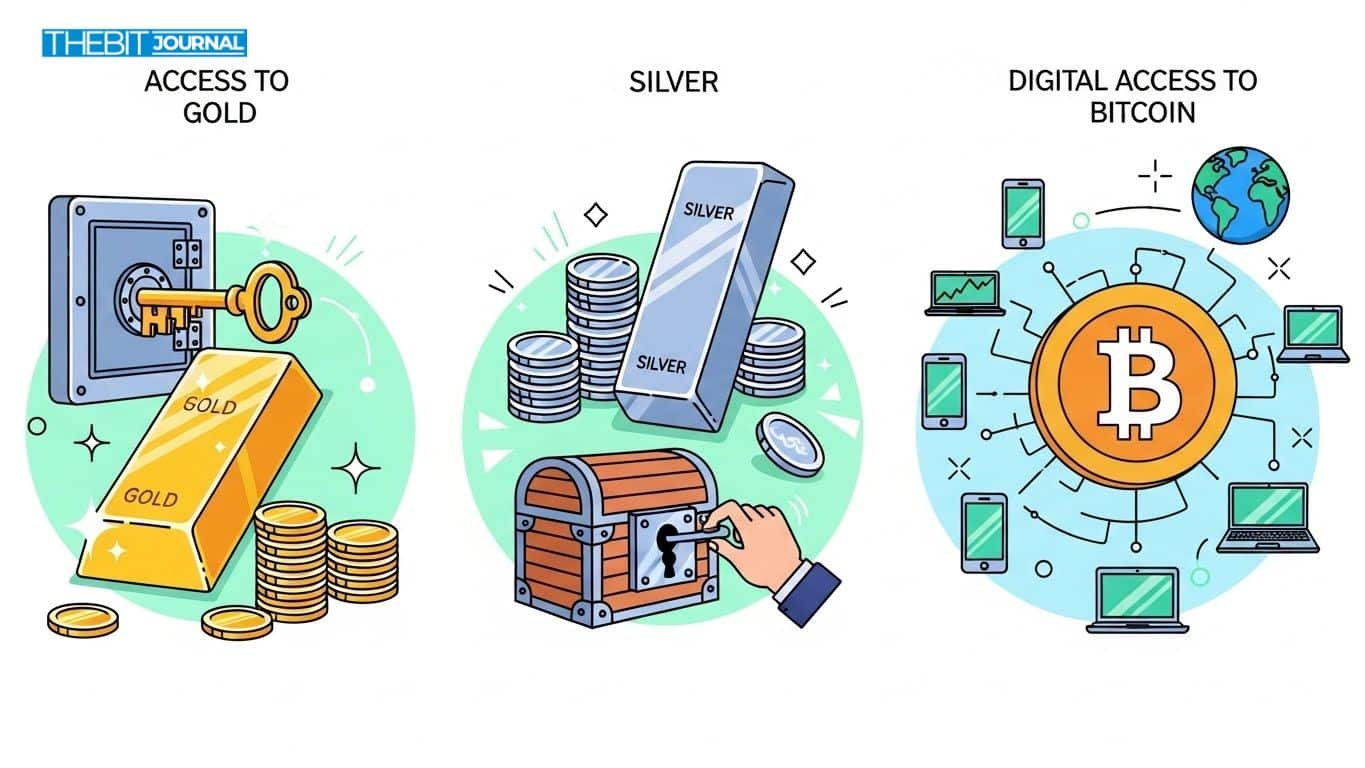
Scarcity Repricing Through Financial Infrastructure and Derivatives
Market structure innovations, more notably ETPs and derivatives, largely drive scarcity repricing across Bitcoin, gold, and silver. ETPs don’t change the scarcity. Instead, they widen access and make scarcity tradable and hedgable in ways that physical or blockchain-native scarcities could not.
In the Bitcoin space, ETPs enable institutional and retail access to a new high-performing asset without bearing self-custody, leading to additional liquidity and associating Bitcoin scarcity with conventional portfolio allocations.
In precious metals, ETPs package scarcity of physical material as securities that can be traded swiftly around the world and which serve to influence price discovery.
Derivatives in all three markets, futures and options, allow investors to express beliefs about scarcity without taking possession of the actual asset.
This can sometimes give the impression of abundance, but it also adds sophistication to price signals and shows just how modern financial structure mediates scarcity in real time.
Scarcity in 2026 is now a product of not just physical limitations, but financial systems that determine how scarcity is accessed, priced, and allocated.
Conclusion
Scarcity repricing in 2026 has changed the way investors perceive Bitcoin, gold, and silver. Bitcoin’s algorithmic scarcity today is intermediated through financial products and derivatives, moving its story away from mere self-sovereign money toward a hybrid scarce instrument.
Gold’s physical shortage is already deeply embedded within institutional trust and reserve functions. Silver’s rarity is due to its connection to industrial demand and structural supply inelasticity that doesn’t play out as easily in some models of supply-limit.
Rather than choosing one scarce asset over the others or considering them fundamentally different from each other, 2026 markets give separate functions to each: digital scarcity through fixed rules in Bitcoin and market availability, sovereign collateral via neutrality of gold, and industrially anchored scarcity through silver.
Glossary
Scarcity repricing:: process by which the market reassesses the value of scarce assets on access/liquidity and finance, not just physical supply limits.
Exchange-traded products (ETPs): Governed investments that enable investors gain exposure to an asset without owning it, increasing liquidity and flexibility.
ETF: Exchange-traded fund, the ETP is utilized the most for Bitcoin and precious metals.
Industrial demand: Demand for manufacturing and technology purposes, particularly important in the case of silver.
Frequently Asked Questions About Scarcity Repricing 2026
What is scarcity repricing 2026?
Refers to how investors value limited assets today, based on liquidity and market structure rather than physical scarcity alone.
Why is Bitcoin’s scarcity important?
Bitcoin supply is fixed at 21 million, and its scarcity is enforced by software. In 2026, scarcity comes through blockchain fundamentals and financial access in the form of ETFs and derivatives.
How does gold’s scarcity differ?
Gold’s scarcity in 2026 is based on institutional trust and central bank reserve functions, not just physical constraints.
Why is silver’s scarcity unique?
The scarcity of silver is directly tied to investment and industrial demand, so the price is sensitive to real use and limitations on supply.
References