

Last updated: November 7, 2026
Dex routing finds a path through available liquidity to exchange one token for another. A router or aggregator compares pools, intermediate tokens and transaction costs, then proposes a swap. The quote is an estimate, and conditions can change before execution.
Key Takeaways
- A swap can use one pool, several pools or multiple decentralized exchanges.
- Routers weigh expected output against liquidity, price impact and network costs.
- Splitting a trade may improve its estimated result, but doesn’t assure execution.
- Slippage settings, deadlines, smart contracts and token risks matter.
How dex routing builds a swap path
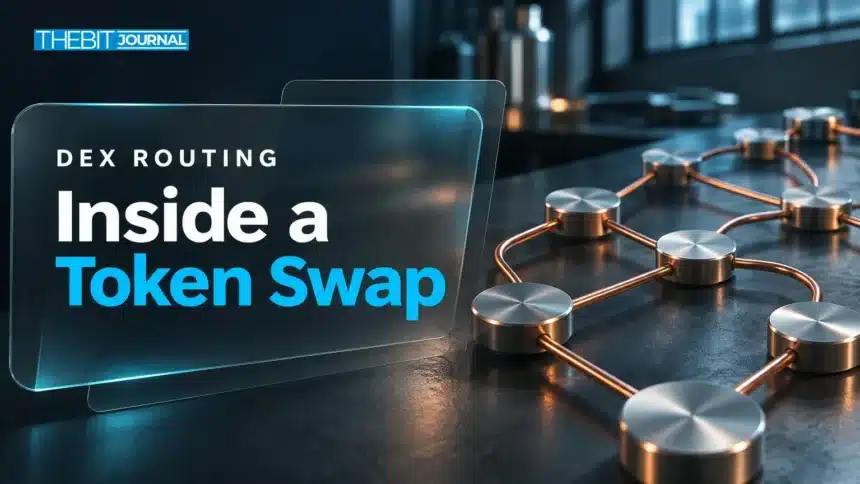
Think of token pools as connected points in a network. To exchange token A for token C, a router can compare a direct A-to-C pool with a route through token B. Each additional hop uses another pool and may add fees and network costs.
The pool with the largest balance isn’t automatically the best choice. A trade needs enough liquidity, and it can move a pool’s price. Routers estimate output across candidate paths, considering price impact and gas. The highest gross output may not be the best net result after costs.
Uniswap Labs’ routing explainer, updated October 22, 2026, says its app router considers Uniswap v2, v3 and v4 liquidity, estimates gas and adds a hop only when expected price improvement outweighs extra network costs. It can also simulate a route. According to the Uniswap routing explanation, a swap reverts if it exceeds the user’s slippage tolerance or deadline. The app excludes pools with fees above 11%, the explainer says.

Why a router may split a trade
A large swap through one pool can move the price more than a smaller order. Dex routing may divide an order among pools or paths to reduce that effect. A portion might use a direct route while another passes through an intermediate token. The router estimates whether improved output justifies extra fees and complexity.
A 1inch Help Center article dated September 10, 2026, says Pathfinder can split trades among multiple DEXes, market makers and market depths within one protocol. It compares expected rate, liquidity, price impact and gas costs. Its candidates are limited to sources compatible with Pathfinder’s routing and execution logic, so it may not include every available pool.
Algorithm results don’t assure better execution. In a report published June 10, 2025 and updated April 24, 2026, 1inch said its upgraded Pathfinder produced swap rates up to 6.5% better than its previous algorithm, based on more than 30,000 real-time trades. That’s a company-reported comparison, not an assurance about future swaps.

Aggregators, solvers and different routing choices
Swap systems don’t all find routes the same way. Uniswap’s API documentation, checked November 7, 2026, lets integrators choose among V2, V3, V4, UniswapX V2 and UniswapX V3 liquidity. It also offers BEST_PRICE and FASTEST preferences. The highest estimated output and quickest path aren’t always the same.
Some systems use solvers to find settlement options for trade intents. CoW Protocol’s documentation describes batch auctions where independent solvers compete. The solution generating the greatest surplus for the batch wins, subject to users’ signed price and quantity constraints. Solvers can also match traders directly rather than use an automated market maker. In CoW’s example, one trader sells $2,000 of DAI for 0.5 ETH while another sells 0.5 ETH for $2,000 of DAI. If the match is partial, the solver sources the remainder elsewhere.
Jupiter’s swap documentation shows route details such as routePlan, outAmount, otherAmountThreshold, priceImpactPct and slippageBps. These fields appear in a quote example; they don’t assure a particular final result.
What can change between quote and execution
Prices and liquidity can shift while a transaction is pending. Slippage tolerance limits how far the result can differ from the quote before the transaction fails. Uniswap Labs says its app reverts a swap that exceeds the user’s tolerance or deadline. A revert means the exchange doesn’t complete, though network costs may still apply depending on the chain and transaction.
Check the estimated output, price impact and minimum-output threshold. Pool fees and network costs can vary. Uniswap Labs’ exclusion of pools with fees above 11% also shows that routing tools apply eligibility rules rather than searching every possible source.
Dex routing simplifies path comparisons, but doesn’t remove smart contract, token or interface risks. Tokens may carry risks unrelated to routing, and decentralized trading differs from a custodial exchange, where a platform holds customer assets. Crypto prices are volatile, and users can lose some or all of the value involved.

How to read a DEX swap quote
Check the amount being sent and the estimated amount to receive. Review the pools or hops, price impact, fees and slippage limit. A displayed minimum amount is the lower bound accepted under the interface’s settings, not a promise that the transaction will succeed.
Apps can return different paths because they search different sources, use different execution methods or prioritize different outcomes. Uniswap’s API, for example, offers price-focused and speed-focused routing preferences. A route is a proposal based on available information, not an assured price.
Frequently asked questions
How does dex routing choose the best path?
A router compares eligible paths using estimated output and costs such as fees and gas. Results depend on the liquidity sources and routing rules available to that tool.
Can a DEX swap use more than one pool?
Yes. A route can pass through multiple pools, and some routers can split an order across pools or paths when estimates suggest it could improve the result.
Why did my swap fail after I received a quote?
The price may have moved beyond the slippage limit, or the transaction may have passed its deadline. A failed transaction doesn’t mean the quoted exchange completed.
Does a DEX aggregator always find the cheapest route?
No. An aggregator searches sources compatible with its logic and settings. Its quote is an estimate, and execution can differ or fail as liquidity and network conditions change.
Sources
- How does routing work? (support.uniswap.org)
- Swap Routing in the Uniswap API (developers.uniswap.org)
- Why 1inch May Not Route Through Certain Liquidity Pools (help.1inch.com)
This article is for informational purposes only and does not constitute financial or investment advice. Cryptocurrencies are highly volatile; always do your own research before investing.