







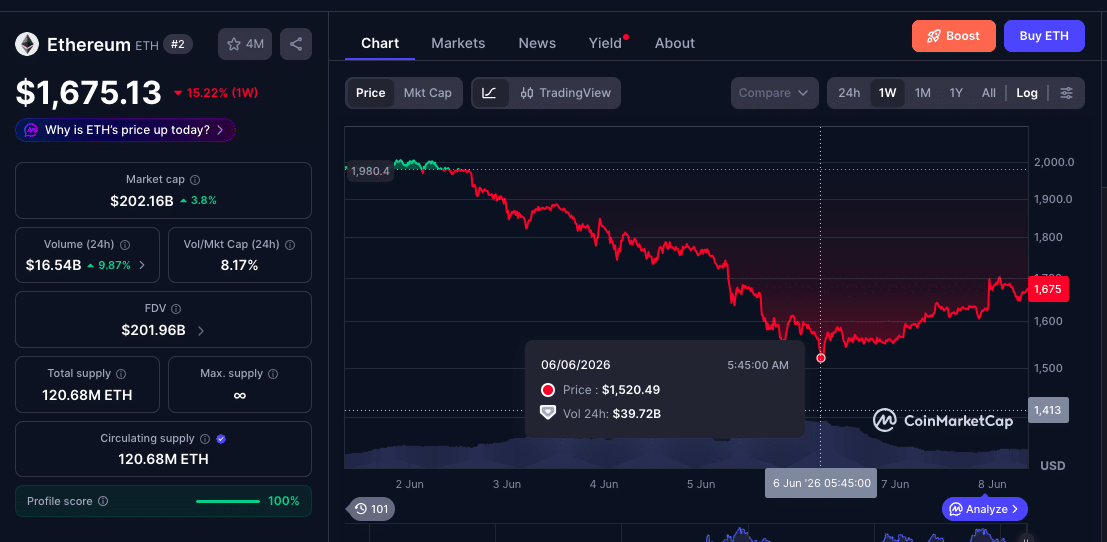
Ethereum price has hit one of its toughest spots since 2022’s bear market. After briefly touching $1,500 during the recent June crypto selloff, before retracing above $1,600, ETH is now roughly 70% below its all-time high of $4,953 hit in August 2025; making investors start to wonder if Ethereum price could fall to $1,000.
The decline has been far more pronounced than that seen in Bitcoin due to persistent outflows from ETFs, large leveraged liquidations, ongoing geopolitical uncertainty and a general shift away from risk assets. Some analysts see $1,500 as a possible capitulation low; but others argue that the forces behind the selloff have not yet run out.
Why Has Ethereum Price Fallen So Hard?
Ethereum price peaked at $4,953 in August 2025 before sliding into a prolonged downtrend. The selling got much worse in early June as crypto markets reacted to rising Treasury yields; the escalating tensions in the Middle East and a decline in institutional demand. ETH then broke through key support levels at $1,900 and $1,800 before touching $1,500.
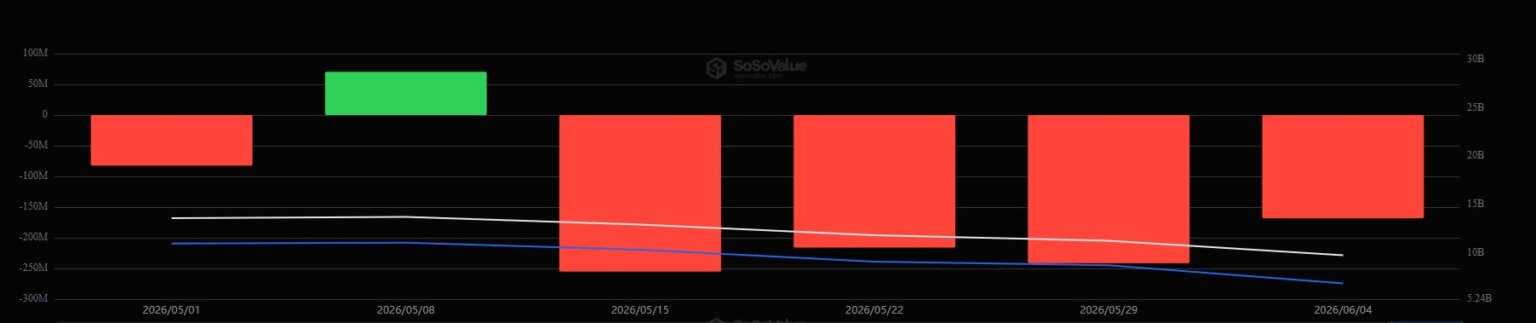
One major factor or rather one major lack, has been ETF demand.
Spot Ethereum ETFs have just gone through one of their longest spells of withdrawals since being launched. The latest data shows that roughly 17 consecutive days of net outflows have happened; stressing just how much institutional appetite for ETH has declined.
Additionally, massive amounts of leveraged crypto positions have been liquidated across the market; with Ethereum being one of the hardest hit assets because of its higher volatility profile.
Ethereum Is Falling Faster Than Bitcoin
The underperformance of Ethereum price is also relative to Bitcoin.
In past cycles, ETH has been the more volatile of the two; when the market is going up, Ethereum tends to outperform but when the market is going down, its losses tend to be much greater.
That pattern has been on full display in 2026.
While Bitcoin has certainly been through a severe correction; Ethereum’s losses have been deeper because it doesn’t have the same level of institutional support that Bitcoin has through the demand for spot ETFs, as well as its growing reputation as a safe haven asset.
The ETH/BTC ratio has also continued a multi year decline, showing that Ethereum has been losing ground against Bitcoin even before the latest crash started.
The Bear Case – Why $1,000 Can No Longer be Ruled Out
The idea that the Ethereum price could drop to $1,000 is no longer an extreme prediction.
Technically; ETH has broken below several key support zones that held strong in previous market cycles. If $1,500 fails to establish a solid floor; then traders are left wondering where else ETH has to go before it comes up against psychologically important levels closer to $1,000.
Macro conditions aren’t exactly helping.
Markets have become increasingly worried that the Federal Reserve may decide to keep interest rates higher for longer; after the strong US economic data came out. Higher interest rates usually means less demand for speculative assets like cryptocurrencies.
Meanwhile, geopolitical tensions continue to encourage a risk-off environment. Another thing to consider is the state of Bitcoin.
Many analysts believe that if Bitcoin drops toward the $50,000-$55,000 range; then Ethereum’s higher volatility could drag it much lower. In that scenario, a temporary move toward $1,000 doesn’t seem so wild after all.
The Bull Case – Why $1,500 Could be the Bottom
Despite the gloomy outlook, there’s a strong counterargument to all this bearish talk.
A 70% drawdown has historically been the kind of decline that is usually associated with major crypto bear-market lows rather than the middle of a cycle.
Long-term investors are pointing out that Ethereum is still the leading smart-contract platform; it is still dominant in decentralized finance, and it still supports a big ecosystem of Layer-2 networks and tokenized assets.
Even as the price fell, development activity across the Ethereum ecosystem kept going. A few institutional players also kept buying up ETH using treasury strategies even though they were facing some unrealized losses in the process.
But another factor that might be at work here is the state of the macro economy.
If inflation cools down a bit; or ETF flows start to stabilize, or the Federal Reserve decides to take a more relaxed approach later this year; Ethereum could benefit because it is already quite sensitive to those kinds of changes. The same characteristics that made the price fall so fast could also make it rise even faster.
Three Key Indicators to Keep an Eye on
Rather than focusing just on Ethereum price predictions, investors should pay attention to three key signals.
First, and most obviously, is Bitcoin. As long as Bitcoin is still struggling; it’s unlikely that Ethereum is going to start gaining ground anytime soon.
Second, watch the ETH/BTC ratio; if that keeps going down, it’ll suggest that Ethereum is still losing ground relative to Bitcoin. But if it starts to stabilize, that could be a sign that a change is happening.
And third, keep an eye on ETF flows; if they start coming in again in a big way, that’ll indicate that institutional investors are getting more confident in Ethereum, and that could create a stronger demand floor for the Ethereum price.
Conclusion
Ethereum price hitting $1,500 has turned a hypothetical discussion into a real; tangible market issue. The idea of falling to $1,000 is now looking possible especially if Bitcoin keeps weakening and ETF outflows keep going.
But, Ethereum’s fundamentals are still looking solid, and history suggests that deep bear-market drawdowns can often create the foundation for future recoveries.
Right now; the direction of the market is going to depend on how things turn out in the macro economy, how Bitcoin is doing, and whether institutional demand for Ethereum starts coming back.
Frequently Asked Questions About Ethereum Price
Why did Ethereum price fall to $1,500?
Ethereum fell due to a combination of factors – ETF outflows; loads of leveraged liquidations; rising Treasury yields; geopolitical tensions, and the crypto market just generally going through a tough time.
Is $1,000 a realistic Ethereum price target?
Yes, some analysts think that there could be further downside if Bitcoin falls to $50,000-$55,000; and if institutional demand for Ethereum remains weak.
Are Ethereum ETFs seeing outflows?
Yes; spot Ethereum ETFs have just hit a record streak of about 17 days in a row of straight-up net outflows.
What could help Ethereum recover?
If ETF flows start to pick up; if the macroeconomic situation starts to look better, if interest rates start to fall, or if Bitcoin starts to do better, that could all potentially help ETH.
References