




Uniswap’s leadership has tabled a sweeping “UNIfication” plan that reconnects protocol usage with token value. The proposal turns on protocol fees, routes those fees into a programmatic burn, channels Unichain sequencer revenue to the same sink, and even includes a retroactive burn of 100 million UNI from treasury.
It is a bold realignment that pushes Uniswap toward a cleaner value loop while promising better economics for liquidity providers. The protocol’s cumulative trading volume now sits near four trillion dollars, which underscores the scale of the engine being tuned.
What is changing and why it matters
The plan asks governance to flip on protocol fees across v2 and a set of high-impact v3 pools on Ethereum first, then extend to L2s, v4, UniswapX, and new hook-based features. The fees will flow into an immutable TokenJar contract and can only be released when UNI is burned through a companion Firepit contract.
Think of it as an automatic reducer of supply every time the system moves. The same design would also capture Unichain sequencer fees, after data costs and the share owed to its stack partner, and pass them into the burn circuit. Early analysis from the team adds another piece: a Protocol Fee Discount Auction that internalizes part of the MEV and returns it to the protocol, targeting a measurable lift in LP outcomes per unit of traded volume.
The retroactive burn is the headline grabber. It proposes to destroy 100 million UNI from treasury as a stand-in for what might have been burned if fees were active from the beginning. Another material change is a shift in operating focus.
Labs would turn off interface, wallet, and API fees and pivot fully to protocol growth, backed by a 20 million UNI annual growth budget that vests quarterly starting January 1, 2026, pending governance. The through line is simple. If more volume moves through Uniswap, more value is sent to the burn, and token supply tightens over time.
Market read and immediate implications
Traders responded quickly because the proposal creates a clear path from protocol activity to token scarcity. The combination of fee activation, sequencer capture, and an upfront burn is the kind of catalyst that markets understand.
With DeFi volumes recovering and Uniswap already commanding a large share of onchain trading, a structurally tighter supply can be a strong tailwind. The Uniswap price narrative now revolves around whether governance will pass the package as drafted and how quickly fee phasing rolls out to high-traffic pools.
Key indicators to watch
Investors watching the Uniswap price should keep tabs on five inputs. First, governance sequencing. The thread will move through community discussion, Snapshot, and on-chain vote. Second, fee coverage. The speed at which v2 and selected v3 pools go live with protocol fees will set the burn pace. Third, Unichain traction.
The chain’s annualized DEX volume and sequencer revenue will modulate how much additional burn arrives from L2 activity. Fourth, LP performance. If discount auctions and future hooks lift LP outcomes, deeper liquidity can lower slippage and support the Uniswap price over time. Fifth, macro flow. Risk appetite across crypto still drives beta, and UNI tends to amplify sector moves.
Technical context and structure
From a structure lens, the Uniswap price has been carving higher lows since early Q4 as sentiment swung toward fee activation. A sustained close above recent reaction highs would confirm accumulation. Momentum oscillators have reset after the initial spike, which often precedes a second leg if fundamentals continue to improve. Spot and perp open interest should be monitored to avoid overextended leverage.
A rising on-chain burn coupled with consistent DEX share can turn former resistance into support, especially if liquidity thickens on major pairs. The Uniswap price response will hinge on actual fee receipts hitting TokenJar and being retired through Firepit, which converts speculative hope into verifiable supply reduction.
Uniswap price outlook for the coming months
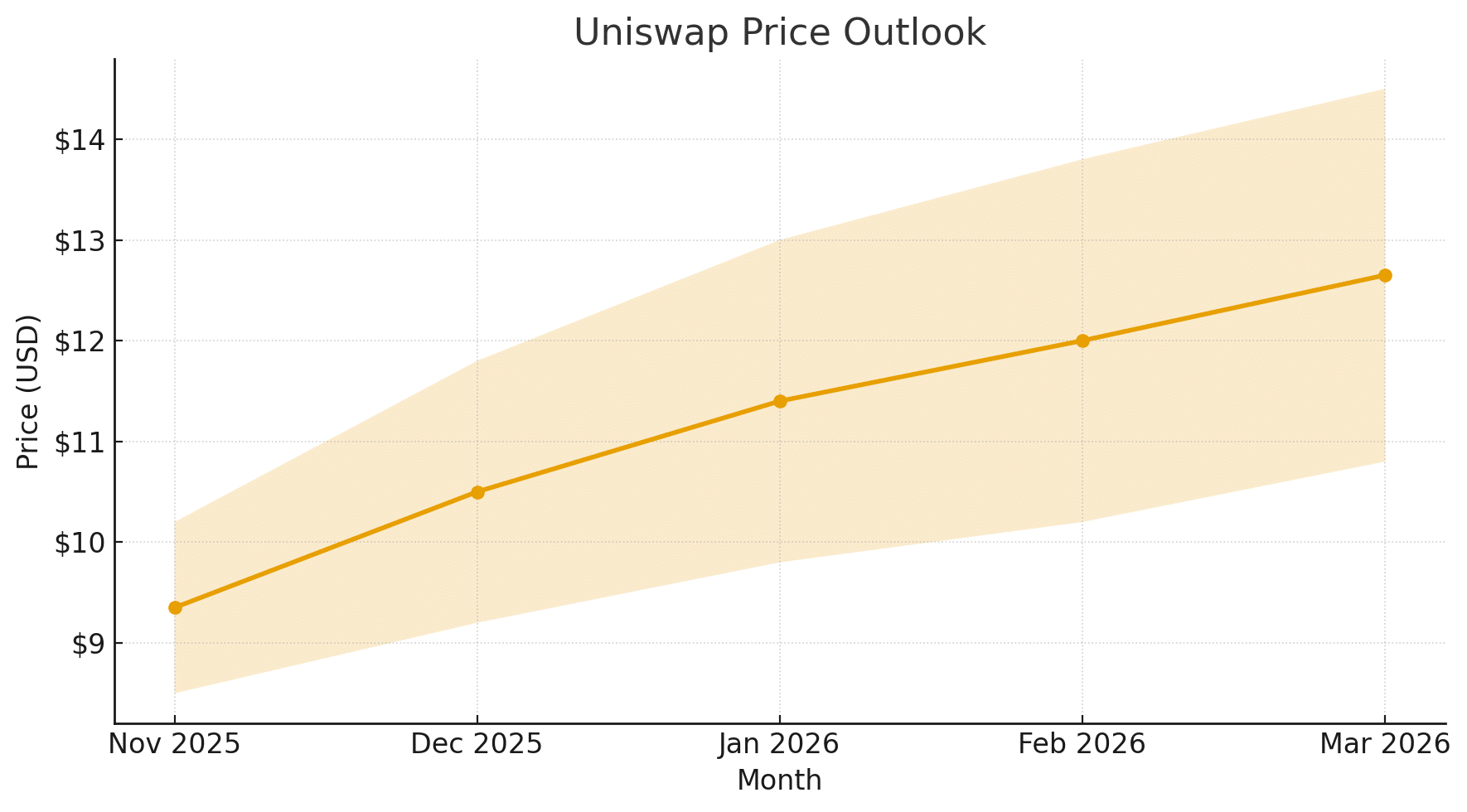
The following table sketches an evidence-based path, assuming fee activation begins with v2 and priority v3 pools in Q4 and expands gradually. Ranges reflect technical levels, liquidity depth, and conservative burn assumptions. This is not financial advice, just a grounded scenario map that will be revised as votes and deployments land.
| Month | Base case Uniswap price range | Drivers and notes |
|---|---|---|
| Nov 2025 | 8.50 to 10.20 | Governance discussion boosts sentiment. Profit taking fades as details firm up. |
| Dec 2025 | 9.20 to 11.80 | First wave of fee activation on v2 and select v3 pools increases burn visibility. |
| Jan 2026 | 9.80 to 13.00 | Year opens with growth budget framework in view. Liquidity improves on majors. |
| Feb 2026 | 10.20 to 13.80 | Broader rollout to L2 begins if approved. Early PFDA pilots support LP returns. |
| Mar 2026 | 10.80 to 14.50 | Burn pacing steadies. Market rewards clearer supply reduction and consistent volume. |
The Uniswap price table assumes a largely constructive market. A break below the lower bounds would likely require a failed vote, a delayed rollout, or broad risk-off across crypto. A break above the upper bounds would likely need faster fee expansion, heavy Unichain usage, or outsized inflows into DeFi.
A risk checklist that could sway the Uniswap price
Governance risk remains front and center. Even strong community comments are not binding until votes pass. Legal posture is improved compared with prior years, yet policy surprises are part of the landscape.
Execution risk exists around smart contract adapters, fee parameter tuning on v3 tiers, and the operational work to migrate governance-owned positions. Liquidity fragmentation across chains can also dilute early burn pacing. If LP outcomes do not improve, depth can lag and weigh on the Uniswap price despite a powerful narrative.
Bottom line
The proposal finally gives UNI a clean economic circuit. Use begets fees, fees feed TokenJar, TokenJar releases only when UNI is burned. Unichain revenue joins the same path. A retroactive burn starts the cycle with a statement. If governance moves this across the finish line, the Uniswap price gains a durable supply-side ally, and LPs get a toolkit that can lift realized results. It is not a magic wand, but it is a coherent plan that ties the protocol’s massive footprint to token mechanics at last.
Frequently Asked Questions
What exactly is being voted on
Governance will decide on activating protocol fees, establishing the UNI burn mechanism, routing Unichain sequencer fees into that burn, authorizing a 100 million UNI treasury burn, and funding a growth budget that begins vesting in 2026.
How does the burn work in practice
Fees gather in TokenJar. UNI is destroyed in the Firepit contract to release those assets. Adapters connect fee sources from v2, v3, Unichain, and later expansions.
Why could this help the Uniswap price
A running burn reduces effective supply as protocol usage grows. If volume holds or expands, fewer tokens can chase more fee value over time.
What should traders watch next
Snapshot timing, onchain vote dates, the first batch of pools with fees enabled, and any metrics that quantify burn pacing.
Glossary of key terms
Protocol fee switch
A governance-controlled setting that diverts a portion of swap fees from LPs to the protocol.
TokenJar and Firepit
Contracts that hold collected fees and release them only when UNI is burned, respectively.
PFDA
Protocol Fee Discount Auction. A mechanism that auctions temporary fee discounts to capture MEV for the burn and improve LP outcomes.
Sequencer fees
Revenue earned by an L2 chain’s sequencer. Under the proposal, Unichain sequencer fees would flow to the UNI burn after costs and a predefined share.
Retroactive burn
One-time destruction of 100 million UNI from treasury to align supply with the new fee era.
DEX market share and cumulative volume
Measures of Uniswap’s footprint, including multitrillion dollar lifetime volume that magnifies any fee-to-burn conversion.