







The development around Ethereum has taken a fresh turn as the co-founder, Vitalik Buterin pointed out how artificial intelligence could potentially fast-track the Ethereum roadmap.
This roadmap contains core upgrades that have been discussed by the community for years and could touch upon how the protocol will evolve from now until the end of this decade.
Buterin has been vocal in online conversations, singing AI’s praises for its speed while emphasizing the necessity of putting human judgment at the helm.
He cited examples of AI tools slashing development time by orders of magnitude, but also warned that developers needed to balance that speed increase with more thorough security efforts to avoid sloppy, vulnerable implementations.
How A.I. Is Altering Development on the Chain
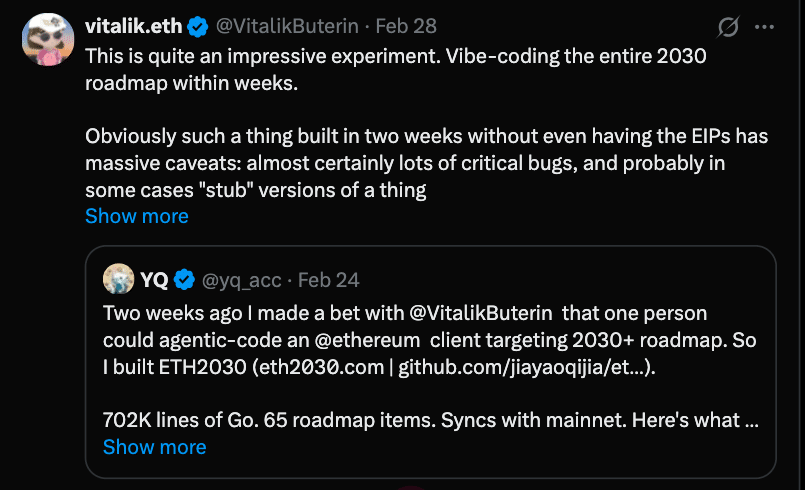
The conversation around the Ethereum roadmap gained steam after a developer created a prototype Ethereum client that aligned with the network’s long-term vision in just two weeks, by using agent-based AI coding tools to piece it together.
The prototype consisted of around 700,000 lines of code and reportedly solved up to as much as 65 discrete roadmap items with the code syncing to Ethereum mainnet despite not being production-ready.
Buterin also held this experiment up as a sign of how drastically development timelines are changing; thanks to AI, something that would have taken years using older methods.
However; Buterin also stressed that speed is not the sole consideration. He cautioned that the community should not assume that a single prompt to an AI model would yield secure, ready-to-deploy code.
Rather, he proposed that AI benefits be divided between rapid development and strong verification workflows. AI, by Buterin’s reckoning, is most effective when it produces more test cases and aids in formal verification efforts, mathematical proofs that software operates as intended.
The LeanEthereum initiative focusing on formal verification of protocol components recently leveraged AI to assist in producing a machine-verifiable proof for a theorem used by STARK cryptography that was previously considered as slow work done by specialists.
The ability to speed up this step is critical to scaling Ethereum’s security posture, Buterin said.
Buterin on What AI Will Bring to Ethereum
Speaking to the wider Ethereum community online, Buterin reacted to a unique experiment that “vibe-coded” Ethereum roadmap for 2030 in just weeks, saying the result would have been unheard of half a year ago.
He clarified that the prototype is almost certainly riddled with bugs or incomplete implementations of various features, so it’s not a production solution. The direction of progress is however more important.
Buterin went on to share his own AI experiment, in which he rebuilt a version of personal blog software that powers his blog (just in less than an hour) using a medium-sized AI model running on his laptop.
Such projects show the strides made in quickly solving coding problems that previously were weeks or months of work now compressed into hours, even on limited hardware.
But the Ethereum founder warned that making sure the code works safely, securely and super-resistant to attacks still requires lots of human-manual review.
He has asked the community to invest AI gains in both speed and security more; calling for increases in test cases, inspection, and separate implementations so that a quick output is not confused with quality.
This balance, he says, could see the Ethereum roadmap completed in substantial upgrades and under stronger safeguards than previously possible.

Account Abstraction and the Bigger Picture
Another related milestone on the Ethereum roadmap is account abstraction, which changes how wallets work on the network. This upgrade, referred to as smart accounts, will allow wallets to function more like programmable applications enabling recoverable keys, batch transactions and gas payments in tokens other than ETH.
Buterin has said that account abstraction, which has been on the table since 2016, finally has a working design because of EIP-8141. That proposal brings together the remaining pieces needed to deliver full account abstraction and could be set for inclusion in the next network upgrade of Hegota within a year.
Buterin has also covered different upgrades in that timeframe, such as privacy tooling enhancements and increased coordination with long-term objectives including quantum resistance which includes plans to guard validator signatures, stored data and zero-knowledge.
Conclusion
Ethereum roadmap is gaining real traction as talks unfold over how artificial intelligence can accelerate and improve development with higher security standards along the protocol’s long-term road map.
Vitalik Buterin’s recent public comments and experiments with AI code point to an ecosystem that is eager to embrace rapid tooling advances but still demands ample verification and testing.
Feature upgrades like account abstraction, aggregating under proposals like EIP-8141, show the fact that some of Ethereum’s most-awaited features are now a reality.
Simultaneously, the wider technical roadmap, performance enhancements and long-term security frameworks included is inspired by this new chapter of AI-assisted creation.
Glossary
Ethereum roadmap: The changing outline of how Ethereum’s protocol upgrades might be enhanced with the use of artificial intelligence tools.
Account abstraction / smart accounts: Protocol upgrades that enable wallets to act like programmable apps with advanced transaction capabilities.
EIP-8141 : An Ethereum Improvement Proposal which contains the technical parts required for full account abstraction.
Formal verification : Mathematical proof techniques used to ensure the software behaves exactly as we want it to behave.
Frequently Asked Questions About Ethereum Roadmap
Why is this Ethereum roadmap so crucial?
It focuses on how Ethereum developers are using and experimenting with artificial intelligence to accelerate the development process, create more tests, improve protocol security, and much more.
Is there really code being written in Ethereum using AI?
Yes. Ethereum co-founder Vitalik Buterin noted experiments in which AI assisted in generating extensive code prototypes and speeding up developers’ work, but all AI-outputted code still requires human review and tweaking.
When could smart accounts arrive?
According to recent statements, account abstraction commonly referred to as smart accounts could be deployed in a year’s time via the Hegota network upgrade.
Does AI replace developers?
Buterin maintains AI is a tool to aid developers, not supplant them. Human supervision is still essential for safety and accuracy.
References
Cryptonews
CoinStats
Cointelegraph