




Global trade has never been simple, but it used to be predictable as a shipment moved, documents followed, a bank confirmed payment, and the rest was paperwork and patience. In 2026, that old rhythm is breaking. Supply chains are being rebuilt after years of disruptions, compliance demands are tightening, and businesses are under pressure to prove where products come from, what they contain, and whether the data behind them can be trusted.
This is exactly where blockchain is finding its real place, not as a buzzword, but as practical infrastructure. It is helping companies track goods with more certainty, share data with fewer arguments, and run cross-border operations with less friction. It is not replacing every system overnight, but it is changing how those systems talk to each other.
At the same time, trade is facing a deeper financial problem: funding. The global trade finance gap remains a serious constraint, with the Asian Development Bank putting it at $2.5 trillion, a figure that has stayed stubbornly high into 2025. In a world where small exporters struggle to access capital, tools that reduce risk and speed up verification matter more than ever.
Why trade is finally ready for blockchain in 2026
Blockchain supply chain projects have existed for years, so what changed?
First, trade has become more compliance-heavy. Regulators increasingly demand proof, not promises. The European Union is pushing sustainability and product transparency through its Ecodesign for Sustainable Products Regulation (ESPR), which is expected to drive the rollout of Digital Product Passports across many categories. The idea is simple: products sold into major markets will need better lifecycle data, accessible and verifiable.
Second, supply chains are now treated as a security issue, not only a cost center. Companies want to know where parts and raw materials originate, and they want that information before a crisis hits.
Third, the technology around data standards is catching up. Blockchain works best when everyone agrees on the language of events and tracking. That is why global standards like GS1 EPCIS have become central to supply-chain digitization, because they let businesses share event data in a common structure across the chain.
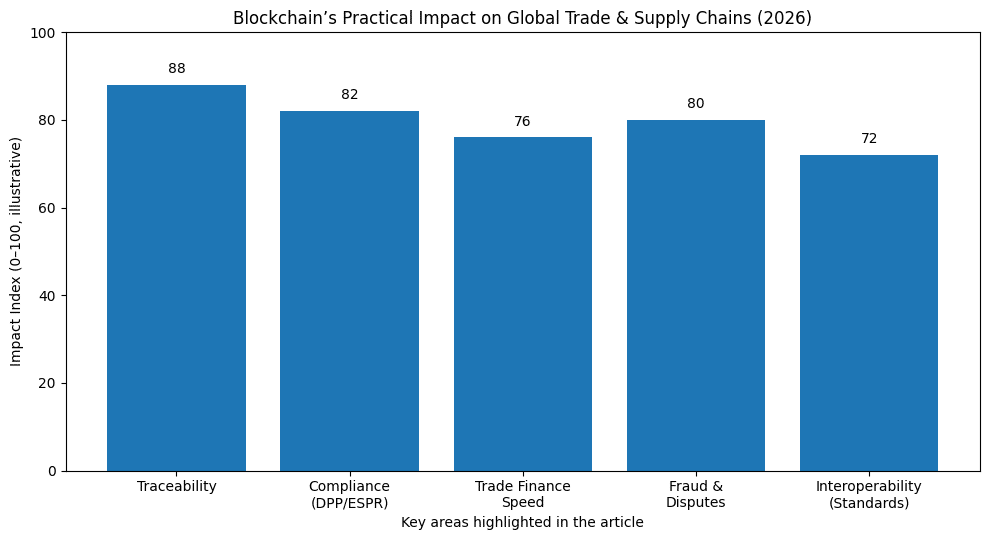
Blockchain becomes far more useful when it is paired with that kind of standardized supply chain data, because the chain is no longer a messy set of “proofs” that nobody can reconcile. It becomes a shared timeline of what happened, when it happened, and who can verify it.
From paper trails to real-time product truth
Traditional trade relies heavily on documents. Bills of lading, certificates, inspection reports, letters of credit, and customs declarations all act like puzzle pieces that must match. The problem is that documents can be delayed, duplicated, or manipulated, especially when multiple intermediaries are involved.
Blockchain changes the process by shifting trade from “document chasing” to “event confirmation.” Instead of waiting for papers to arrive and hoping they are accurate, companies can log verified supply chain events as they happen. When a container is sealed, when a shipment leaves a port, when a pallet arrives at a warehouse, the transaction can be recorded in a tamper-resistant way.
This does not mean every detail is stored on-chain forever. In many cases, sensitive data remains off-chain, while blockchain stores fingerprints, timestamps, and permissions so that the history stays verifiable without exposing everything to everyone.
In simple terms, it is like turning a supply chain into a live scoreboard instead of a pile of receipts.
The new compliance era: Digital Product Passports and traceability pressure
One of the biggest forces pushing blockchain adoption in trade is regulation, not speculation.
The EU’s ESPR is designed to improve sustainability, circularity, and product performance in the market. Digital Product Passports fit into this shift because they encourage structured data about a product’s composition and journey.
Blockchain is not mandatory for these passports, but it is increasingly considered a strong option because it helps maintain integrity in multi-party data sharing. That matters when a product’s story passes through dozens of suppliers across different countries.
This is also where counterfeit protection becomes practical. Luxury goods, specialty foods, pharmaceuticals, and electronics are all vulnerable to tampering and fake substitution. With blockchain-backed traceability, a brand can verify whether a product truly followed the path it claims.
In 2026, traceability is becoming less of a “nice-to-have” and more like seatbelts in a car. Many companies only appreciate it once a problem shows up.
Faster trade finance: where blockchain hits the balance sheet
Supply chains do not move on optimism. They move on money. big reason global trade slows down is that financing is slow and risk-heavy. Banks and insurers need proof that goods exist, that shipments are moving, and that documents are consistent. When verification is expensive, lenders pull back, which hurts smaller businesses the most.
That is part of why the trade finance gap is still measured in the trillions.
Blockchain helps trade finance in a grounded way: by reducing uncertainty. If a lender can verify shipment milestones faster, and if key documents can be validated without endless back-and-forth, capital can move with less friction.
This is especially valuable for invoice financing, supply chain finance, and trade insurance. The goal is not to “tokenize everything,” it is to shorten the time between shipment progress and financial confidence.
In many cases, blockchain acts like an audit lane that never closes. It can reduce disputes and speed up settlements because parties are not arguing over different versions of the same truth.
Shrinking fraud, disputes, and costly “data arguments”
Trade fraud is often not dramatic. It can be a duplicate invoice. A manipulated inspection record. A missing signature that delays customs clearance for days. The cost adds up in small, painful ways.
Blockchain reduces fraud by creating a shared history that is harder to alter quietly. If a transaction is time-stamped and verified across participants, it becomes much harder to slip in a changed version later without leaving a trace.
It also reduces disputes. A shipment delay might still happen, but the argument changes from “who is lying” to “what does the event trail show?” That shift alone saves time and legal headaches.
The WTO has highlighted how digital technologies can reduce paper usage and improve trade processes, and it has explored where blockchain and DLT stand across trade-related projects. The signal is clear: governments and institutions are no longer treating this as science fiction. They are treating it as a toolbox.
Interoperability: the unglamorous secret to real adoption
One hard truth about trade technology is that a single company cannot fix the whole chain.
Blockchain solutions fail when they behave like private clubs. The future is about interoperability, meaning systems that connect cleanly with customs authorities, logistics providers, suppliers, auditors, and banks.
That is why event-based standards such as GS1 EPCIS matter so much. They give everyone a shared data structure for “what happened in the supply chain,” which makes blockchain more than a fancy database.
In 2026, the winners are not necessarily the loudest platforms. They are the systems that plug into existing operations without forcing every partner to reinvent workflows.
What supply chain teams actually gain day to day
Blockchain’s impact becomes clearer when looking at operations, not headlines.
It can help reduce blind spots in multi-tier sourcing, especially for complex products built from dozens of components. It can improve recall speed by showing exactly where affected batches traveled. It can also strengthen ESG reporting by improving the credibility of upstream data.
Blockchain helps companies stop guessing and it helps them answer the questions trade is increasingly asking:
Where did this come from? Who handled it? Was it altered? Can someone prove it?
The limits in 2026: what blockchain still cannot magically fix
Blockchain is not a cure-all:
Bad data entered at the start remains bad data, even if it is stored perfectly. That is why the “last mile” connection, like IoT sensors, inspections, and reliable audits, still matters. Blockchain secures trust between parties, but it does not replace real-world verification.
There is also the issue of cost and complexity. Smaller suppliers may struggle to integrate new systems without clear incentives. Governance is another challenge, because shared networks need rules around who can write data, who can view it, and how disputes are handled.
Then there is privacy. Trade involves sensitive pricing, supplier relationships, and strategic inventory data. Any blockchain implementation that ignores confidentiality will get rejected quickly.
In 2026, the healthiest approach is hybrid: off-chain storage for sensitive information, on-chain verification for integrity and coordination.
Conclusion: the quiet shift that is reshaping trade
Blockchain is not transforming global trade by making noise. It is transforming trade by removing noise.
It is reducing the gaps between what companies say happened and what can be proven. It is improving traceability at a time when regulations and customers demand more transparency. It is helping finance move faster by lowering verification costs, a meaningful advantage in a world where trade funding is still tight.
Most importantly, blockchain is shifting trade from paper-based confidence to data-based confidence. And in 2026, that shift is not optional for many industries. It is becoming the price of staying competitive in global markets.
Frequently Asked Questions
What is the biggest advantage of blockchain in supply chains in 2026?
The biggest advantage is trusted visibility. Blockchain helps supply chain partners share verified event data, which reduces disputes, delays, and traceability gaps.
Does blockchain replace customs paperwork completely?
Not yet. Many trade systems still require traditional documentation, but blockchain can reduce duplication, speed up verification, and improve data consistency across participants.
Are Digital Product Passports forcing blockchain adoption in Europe?
Blockchain is not strictly required, but Digital Product Passports under the EU’s sustainability push increase demand for structured, verifiable product data, which blockchain can support effectively.
How does blockchain help trade finance?
It improves confidence in shipment milestones and documentation integrity, which can reduce risk for banks and insurers and speed up funding decisions.
Glossary of Key Terms
Blockchain: A tamper-resistant digital ledger that records transactions and events in a way that is hard to alter without consensus.
Distributed Ledger Technology (DLT): A broader category of shared databases where multiple parties maintain synchronized records, with blockchain being one type.
Traceability: The ability to track a product’s movement and transformation through a supply chain, from raw materials to final delivery.
Digital Product Passport (DPP): A structured digital record that stores product lifecycle and compliance data, often accessed via QR code or other identifiers, supporting transparency and sustainability goals.
ESPR: The EU Ecodesign for Sustainable Products Regulation, aimed at improving sustainability and circularity of products placed on the EU market.
GS1 EPCIS: A global standard for capturing and sharing supply chain event data using a common language, often used to support traceability and interoperability.
Trade finance gap: The shortfall between trade finance demand and what financial institutions provide, still measured at $2.5 trillion based on recent reporting.
Interoperability: The ability of different systems and organizations to exchange data smoothly without custom, manual workarounds.
References