







Ethereum speed and quantum roadmap is forming up in public as co-founder Vitalik Buterin lays out an expansive four-year technical plan to accelerate block production, slashing transaction finality times and building quantum-resistant cryptography into the network.
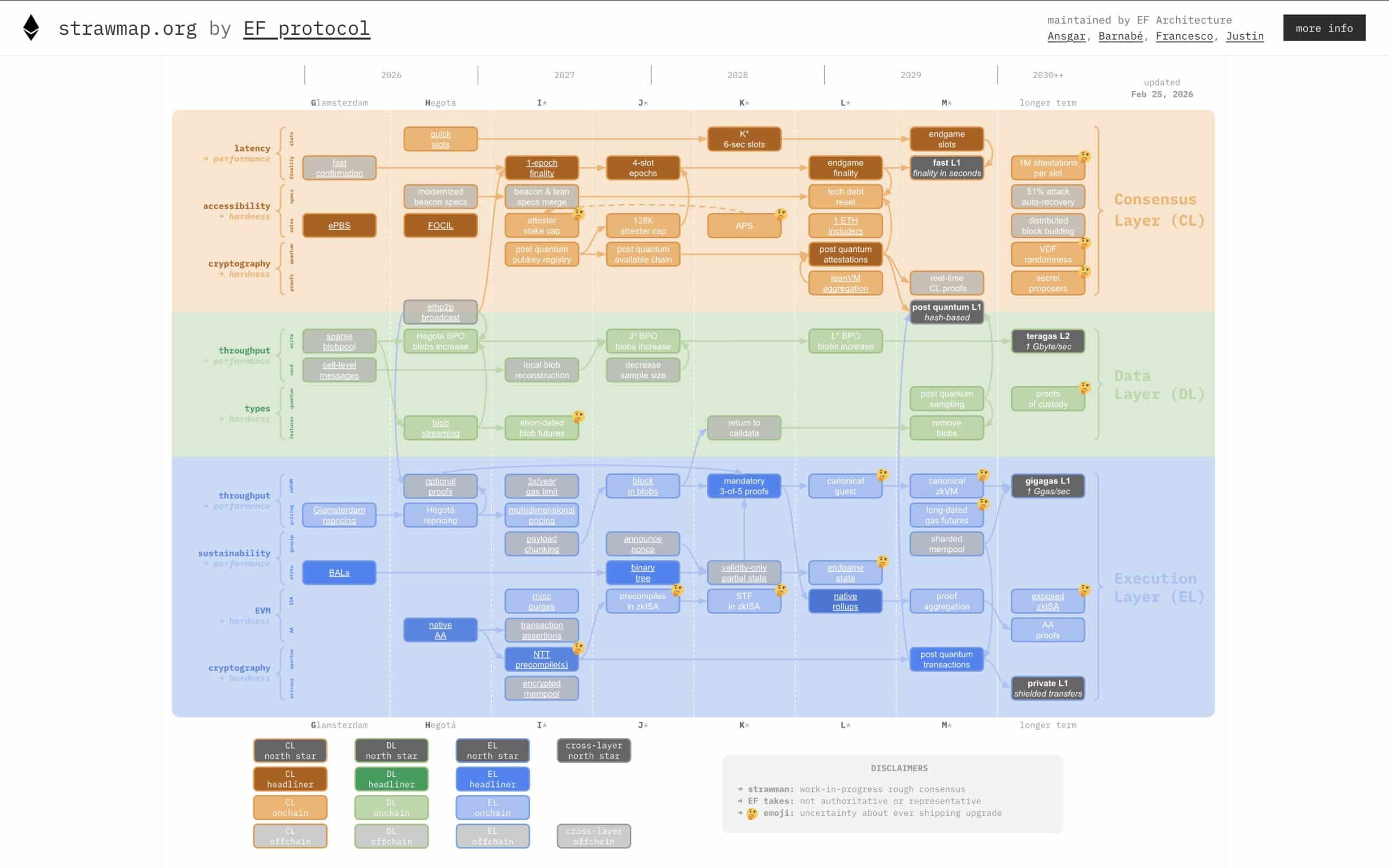
This Ethereum roadmap, dubbed the “Strawmap”, was released by the Protocol team at Ethereum Foundation and has quickly changed developer and investor expectations around Ethereum (ETH) scalability and security going forward.
The plan calls for targets like lowering block times from roughly 12 seconds today to as low as 2 seconds vertically aligning finality between both solutions in the target range of 6-16 seconds, and preparing the protocol against future quantum computing attacks.
Ethereum Speed and Quantum Roadmap
Ethereum’s current average block time, that is, how often a new block gets added to the chain; has been about 12 seconds. Vitalik and the Ethereum Foundation propose a step-by-step reduction of slot times under the new Ethereum speed and quantum roadmap.
This will take place in gradual increments, so that if a slot is 12 seconds long it will subsequently go down to eight, six, four and finally two-second slots.
At the same time, Buterin said reducing the production time of blocks is not just a matter of protocol changes but also one involving how Ethereum nodes communicate to each other.
A solution to achieve shorter slots without compromising network security will be an upgrade of peer-to-peer (p2p) communication, which should allow for enhanced block data sharing.
Faster Finality and Cryptographic Upgrades
The other major focus of the Ethereum speed and quantum road map is finality, the point when transactions are mathematically irreversible. Ethereum’s current finality times can exceed 16 minutes but the roadmap aims to reduce this to between 6 and 16 seconds.
This means that the current multi-stage confirmation system needs to be replaced with a factor-efficient and clean model designed for quantum resistance.
Buterin noted that these changes are “very invasive” because they touch the core of Ethereum’s consensus and cryptographic foundations but are necessary for enabling faster, more secure operations at scale.
The plan outlines seven planned network upgrades or “hard forks” spaced at approximately six-month intervals over the next four years.
Two of these are already set for later this year, named Glamsterdam and Hegotá.
The quantum-resistant upgrade is switching to post-quantum hash-based signatures. This, however, will occur in multiple stages, according to Buterin, where slots become quantum-resistant over time before full hardness of finality has been achieved, allowing the chain to operate normally.
Why This Ethereum Speed and Quantum Roadmap is Important for Developers and Users
Ethereum speed and quantum roadmap has more implications beyond faster block times. Reducing the slot and finality duration creates an impact on network usability.
A faster block time enhances transaction throughput and responsiveness, allowing decentralized applications (dApps) to offer a more immediate experience for users. Shorter finality time also improves coordination with layer-2 solutions, and could unlock real-world use cases like decentralized finance (DeFi) and tokenized asset markets in which the speed of settlement is critical.
Importantly, the integrated quantum resistance roadmap is designed to be proactive instead of reactive. A post-quantum threat on the base layer is rare among all blockchain projects, but Ethereum has signaled its readiness for the future with a design that manages post-quantum cryptography right at the base layer.

Milestones and Implementation Timeline
The Ethereum Speed and Quantum Roadmap lays down a series of upgrades planned over the upcoming four years. These include:
- Stages of Slot Reduction from 12 seconds to 2 seconds
- Finality upgrades tightening confirmation times to below 16 seconds
- Post-quantum cryptographic integration to future-proof the protocol
- Seven protocol forks about every six months until 2029
According to public statements and the roadmap itself, the first forks to enact incremental improvements, Glamsterdam and Hegotá; are already affirmed for implementation later in 2026.
Future upgrades will resolve more specific elements such as block propagation speeds, cryptographic signature enhancements, and simplified confirmation logic.
Building and deploying such fundamental changes is complicated, and the Ethereum Foundation says this roadmap is a living document meant to provide direction for development, not an irrefutable project timeline.
Conclusion
The Ethereum speed and quantum roadmap is one of the most ambitious protocol upgrade strategies in the network’s history.
Targeting 2-second blocks with reduced finality times and quantum-resistant cryptography, Vitalik Buterin and the Ethereum Foundation are hard at work bringing higher levels of performance and increased long-term security to the blockchain.
These changes will be implemented in a series of scheduled forks over the next four years, with various aspects rolling out gradually.
Glossary
Slot time: The length of time Ethereum takes to produce a new block.
Finality: The point when a transaction is irreversibly confirmed on the blockchain.
Quantum resistance: A cryptographic defense that is secured against even, an attack by quantum computers
Hard fork: an important network upgrade that is not backward-compatible and necessitates nodes update
Strawmap: The informal name for Ethereum’s long-term chronological upgrades.
FAQs About Ethereum Speed and Quantum Roadmap
What is the goal of the Ethereum speed and quantum roadmap?
The roadmap targets a significant decrease in Ethereum’s block production time from 12 seconds to two seconds and a scaling finality process down to mere seconds, all while implementing quantum-resistant cryptography within four years.
Who is leading this roadmap?
Ethereum co-founder Vitalik Buterin, alongside members of the Ethereum Foundation’s Protocol team, are guiding the roadmap development.
Which are the first upgrades from the roadmap?
Confirmed upgrades are Glamsterdam and Hegotá, the first set, expected in late 2026.
Is Ethereum finally going to be quantum safe?
The roadmap suggests that there might be elements for quantum-resistant block production components earlier in time than finality protections, as they would provide more security to operations even in the case that a potential threat is recognized before expected.
How long will the entire roadmap take to complete?
It spans about four years, with seven forks planned approximately every six months.
References
Cointelegraph
BingX
MEXC News
Coinotag
Ethereum Foundation Blog