





Cryptocurrency is no longer the sole development of blockchain technology. It currently runs payments, gaming, logistics, identity systems, and billions of digital products. Developers and startups are getting to know how to create and implement a working blockchain application that will perform effectively and safely.
This process begins by getting an idea of what a blockchain app is, how it operates, and what tools will simplify the process. This is a road map of education and practice. It describes the most important aspects of development, including smart contract development, deployment and scalability. Every step is a foundation to those who are willing to develop actual decentralized applications, which can be used by people.
Understanding What a Blockchain App Is
A blockchain app, commonly known as a decentralized application or dApp, is a computer program storing important activities on a distributed registry. Transactions are recorded in several computers within the network as opposed to a single company having control over user data. This brings about transparency and trust.
Every dApp is implemented using smart contracts, or code that is stored within the blockchain. They are automatic in their way of handling logic based on some conditions. To give an example, with the help of a smart contract, it is possible to transfer tokens, verify ownership, provide rewards when a user fulfills a task.
As compared to conventional apps that use centralized servers, blockchain apps has on-chain logic and off-chain infrastructure. Blockchain is used in the critical transactions whereas a blockchain apps backend is used to support faster responses and blockchain analytics, caching and notifications.
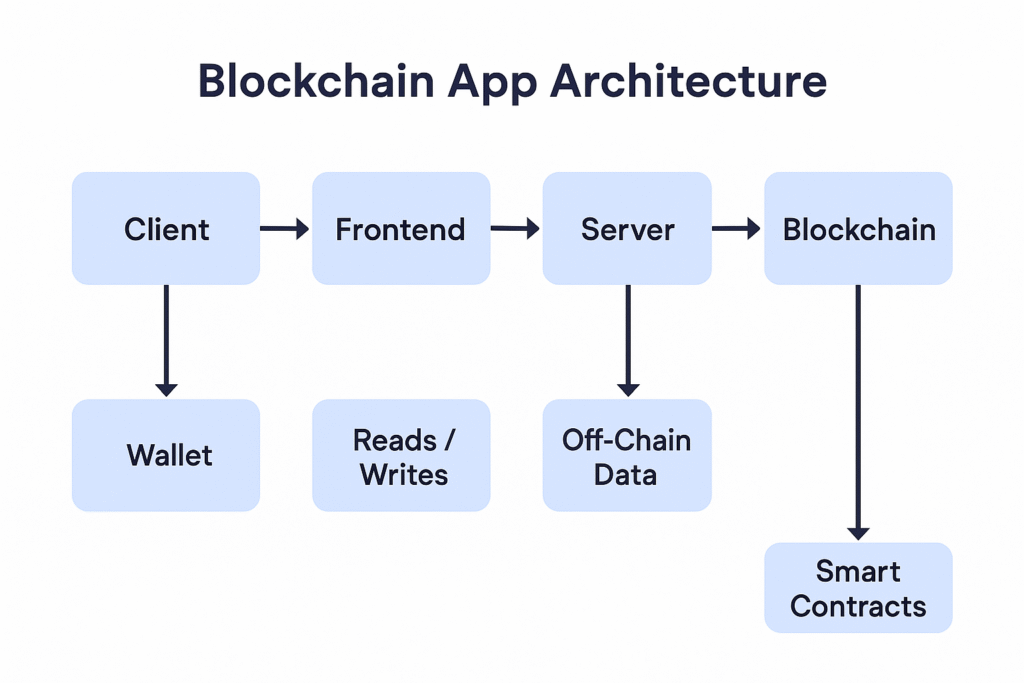
Core Structure: Blockchain App Architecture
There are four major layers of a blockchain application that collaborate with each other. The former is a user interface, which allows the user to interact via wallets such as MetaMask or Phantom. The second is the frontend which is developed using frameworks like React or Next.js and which interacts with smart contracts by integrating blockchain API.
The third layer is promoted as a backend in which the off-chain data and user activity are saved. It deals with notifications, batch jobs and indexing. Lastly, the smart contracts are stored in the blockchain layer and they capture the logic of your application. A stack of these layers will constitute a complete blockchain application infrastructure that is not too decentralized or usable.
When creating your app you will have to know what information should be stored on the blockchain, as well as what should remain off-chain. This equilibrium enhances the speed, reduces the expenses and provides privacy where it is necessary.
Choosing the Right Blockchain Platform
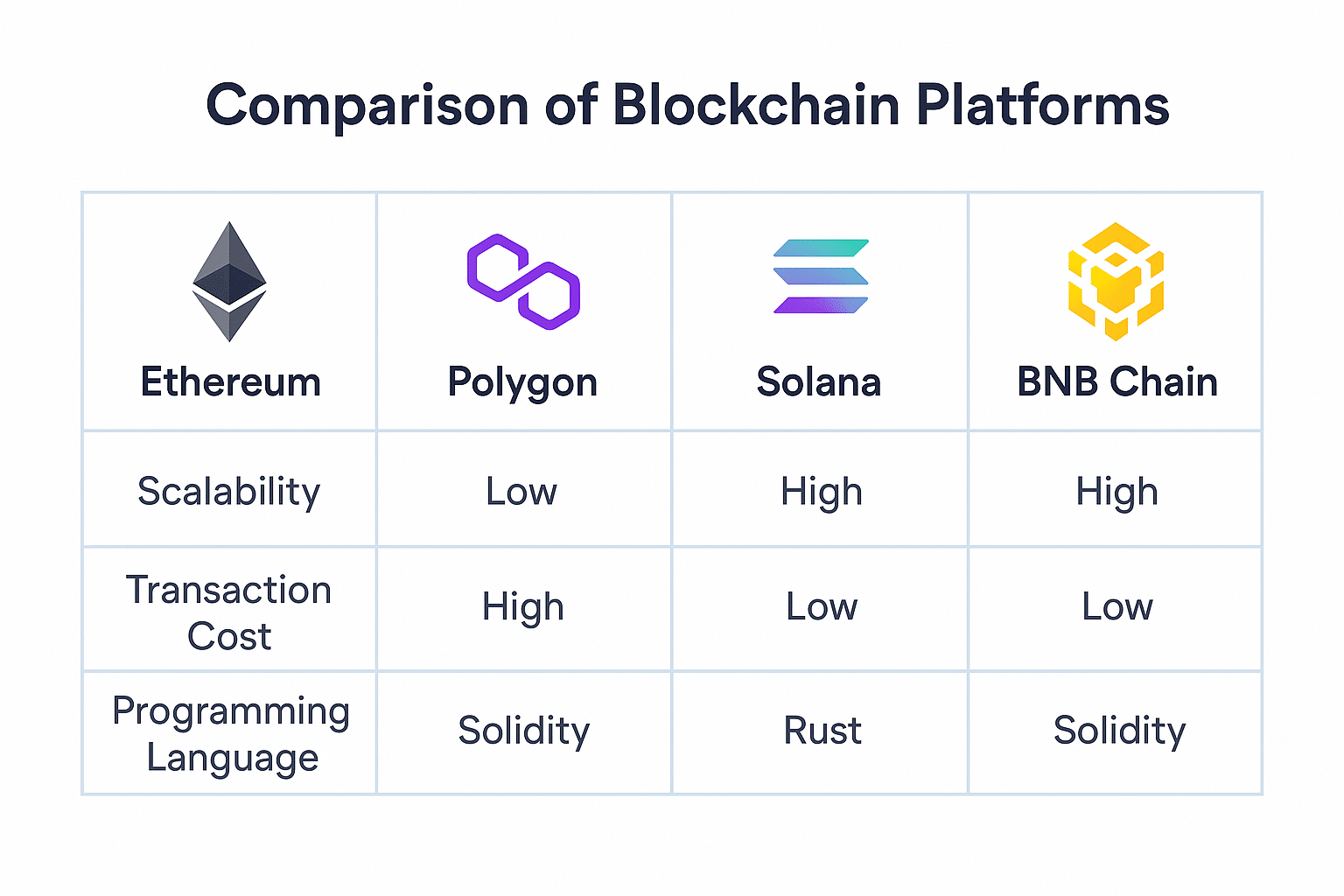
Several blockchain networks fulfill various requirements. In the case of developers, they have to choose the appropriate one based on fees, speed, and support of the ecosystem. Ethernet is the oldest one, with good security and sound tooling. Scalable projects or cost-reduction ones are likely to use Polygon or BNB Smart Chain.
Solana is characterized by its low transaction fees and high speed. The Layer-2 solutions, such as Arbitrum and Optimism, offer Ethereum security, but in a faster and cheaper manner. The appropriate option will be established based on the objectives of your app, the intended users and the stack.
In most cases, it is prudent for most early developers to begin small on Ethereum testnets. After the idea succeeds, you can reproduce or transfer your app to Ethereum and continue to develop it using Solana / Polygon / BSC to cover a broader audience.
The Tools Behind Blockchain Development
Powerful tools make blockchain development to be in control and effective. Smart contract development and testing is made easier by tools such as Hardhat, Truffle, and Foundry. They also offer trustworthy local simulated blockchain network environments.
Libraries like ethers.js and web3.js can be used to bridge the browser and smart contracts in case of frontend and Web3 applications. These libraries receive and send transactions, handle the events and communicate with wallets.
In the background, both Node.js and Python are popular to create backends to blockchain applications dealing with user information, task queues, and analytics. Services such as Infura, Alchemy, or QuickNode are also used to integrate blockchain API by developers. These tools enable the application to talk to blockchain nodes without the need to have one.
The selection of secure and well-documented blockchain development frameworks maintain projects stable and lower the risk with scale.
Planning the App and Defining Data Flow
Each blockchain application has a purpose. Establish the primary user experience that your app will accommodate, it could be a token transaction, purchase items, or asset tracking. After knowing this, draw the data flow within each layer of app.
Smart contracts should be executed using critical logic and large media or secondary information remains off-chain. Stores that do not require updating: Transfer content to decentralized storage, such as IPFS or Arweave. Quick searches and history should be done with the help of standard databases or caching systems.
One can avoid confusion in the future because of a clear plan. It is also useful in the case of auditing and makes databases easier to update, as your blockchain application scales.
Smart Contracts Writing and Testing
The key to the development of smart contracts is the writing of strong contracts. Start by drawing out all the rules in plain English. Subsequently, port them to Ethereum-based chain and Solana in Solidity and Rust respectively.
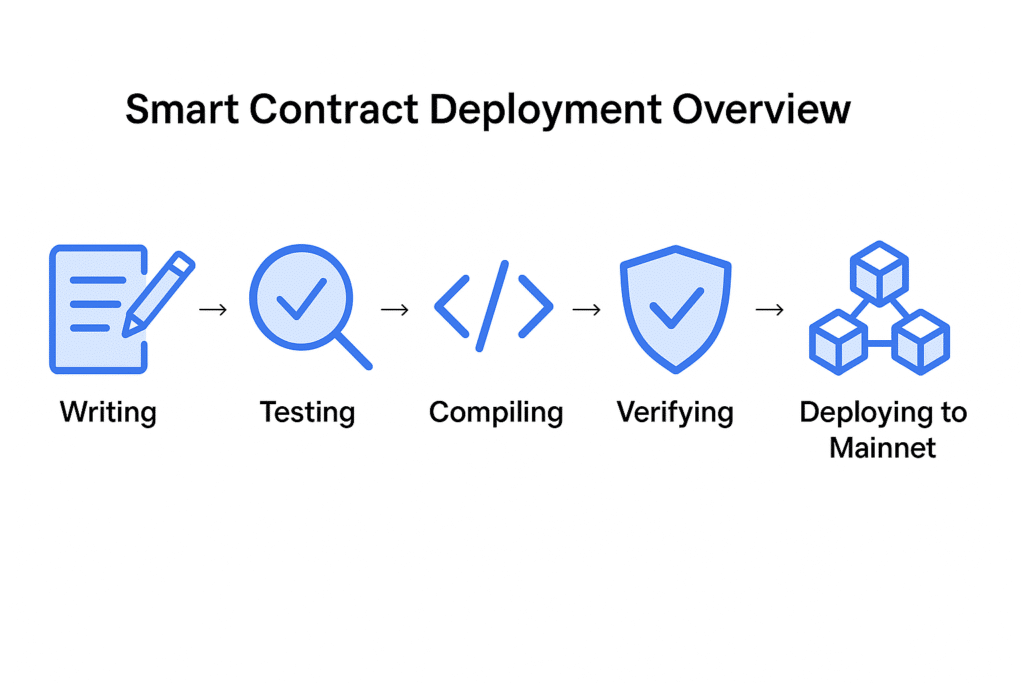
Every contract must be easy to audit and modular. Use test-driven methods where every function has a test to check its accuracy. Frameworks like Hardhat and Foundry make testing efficient.
Before deployment, always run static analysis tools to find potential bugs or vulnerabilities. Security starts in the coding stage, not after launch.
How To Deploy Smart Contracts
The point when planning is combined with execution is contract deployment. In order to execute smart contracts, one needs to connect to a test network, load a wallet, and run the deployment script.
This step confirms that the bytecode on-chain matches your source code. It also builds public trust and simplifies future integrations with wallets or dApp browsers.
Building and Integrating the Frontend
The frontend serves as the interface that allows users to interact with your blockchain application. The UI must be easy and user friendly even to non technical people. Connect Wallets button assists users to connect wallets such as MetaMask or Phantom.
In case the user initiates a transaction, show a definite loading sign until the blockchain verifies it. Quick and efficient interface creates trust and maintains the interest level.
Mobile devices also need to have optimized frontends because a larger number of people will use dApps on mobile wallets and browsers.
The Role of Backend Systems
Although blockchain apps are decentralized, they still need servers for certain operations. A backend for blockchain apps stores off-chain data such as user preferences, logs, and leaderboards. It also listens to blockchain events and triggers automated actions.
The backend helps improve performance and user experience without sacrificing decentralization. It is linked by the integration of blockchain API, which retrieves real-time information on smart contracts and provides it to the UI in a timely manner.
These bridges transform a blockchain into a dynamic and user-friendly application that is friendly and safe.
Building a dApp Step by Step
Developers who want to build a dApp can follow a structured workflow. Start by defining the problem your app will solve. Set up your environment with Node.js, Hardhat, or Foundry. Write a simple contract and test it thoroughly.
Next, create the frontend and connect it to the contract using a Web3 library. Test the complete flow on a blockchain testnet before deploying it publicly. This approach helps identify bugs early and ensures users can interact without confusion.
Learning to build a blockchain project step by step gives new developers a solid foundation for future work in Web3 app development.
Security and Testing
In blockchain development, there is no compromise on security. As early as possible, adherence to blockchain security is a way of securing the app and users.
Make contracts minimal and restrict permissions. Use proven libraries also such as OpenZeppelin rather than standard functions being recreated. Take several layers of testing, fuzz testing and static analysis.
In high value projects, it is always advisable to invest in external audits. Lock private keys in safe hardware wallets. Secrets or personal information of any sort should not be hard-coded into the application.
Good security culture creates a sense of credibility and long term reputation protection.
Scaling the Blockchain App
With an increase in traffic, performance becomes a critical factor. The scalability solutions of blockchain are utilized by teams in order to handle increased workloads. Sidechains, layer-2 rollups and batching transactions are cost-effective and do not diminish performance.
Snapshotting and off-chain caching are also useful during the process of accessing large numbers of blockchain data. This strategy mix will make your app remain fast and affordable when the user demand increases.
Monitor on-chain and off-chain components when scaling. Both may serve as a bottleneck in case they are not kept in good condition.
Choosing Blockchain Development Services
There are certain companies that contract specialists to conduct audits, optimization, or complicated integrations. These services of blockchain development introduce experience and time to market. Invariably select those vendors whose prices are transparent, open, and who retain ownership of code once delivered.
Outsourcing may speed up initial growth, yet at all times your team should have core logic that is within its reach. Such a balance maintains innovation and responsibility
Bringing It All Together
Building a blockchain app takes planning, patience, and precision. It starts with understanding architecture, selecting a platform, and mastering smart contract development. From there, teams must handle APIs, testing, and deployment with care.
A thoughtful roadmap ensures stability and trust. Whether you plan to build app on Ethereum or develop on Solana / Polygon / BSC, every step contributes to the same goal: creating a secure, scalable, and user-friendly blockchain app that people actually want to use.
Conclusion
An effective blockchain app is a combination of good design, powerful contracts, elegant front end and reliable infrastructure. Even small teams can develop high-quality decentralized apps with the help of a stable roadmap, the right tools, and regular testing.
The future of digital products will be developed by developers that learn how to integrate smart contract logic with dependable backends and usable design. Continuous learning, continuous testing and continuous building are the keys to transparency and trust.
.
FAQs About Blockchain App
What is the first step to building a blockchain app?
Define your use case clearly. Decide what problem your app will solve before writing any code.
Which blockchain is best for beginners?
Ethereum offers the most tutorials and tools. However, Polygon and BNB Smart Chain are great for cheaper experiments.
How can developers test smart contracts safely?
Use frameworks like Hardhat or Foundry on testnets such as Goerli or Sepolia to simulate real environments.
What makes dApps more secure than traditional apps?
They remove single points of failure. Transactions are verified by multiple nodes instead of one central server.
Can blockchain apps scale for millions of users?
Yes, with blockchain scalability solutions like rollups, sidechains, and efficient caching, large-scale apps are now possible.
Glossary
- Blockchain App: A computer application, which documents operations or activities on a decentralized list.
- dApp: A decentralized application, which is driven by smart contracts.
- Smart Contract: Computerized code that is executed by conditions.
- Web3: An innovative version of the internet in which users determine their data and identity.
- RPC: An endpoint node that application employees to talk to the blockchain.
- Gas Fee: This is the fee that is paid as a result of carrying out a transaction or operation within the blockchain.
- Indexing: This entails scanning and various blockchain data to achieve swift access.
- Multi Sign: A wallet that needs more than one person to sign in order to be more secure.
- Rollup: A scaling technique/ Layer-2 scaling technique that bundles various transactions together.
- Testnet: This is a test blockchain created with the aim of testing prior to deployment of the mainnet.
Summary
This guide explains how to plan, design, and deploy a complete blockchain app. It covers smart contract creation, testing, blockchain app architecture, and essential blockchain development tools. It also discusses blockchain security best practices, blockchain scalability solutions, and how to build a dApp using Web3 app development methods. The article outlines blockchain platform comparison between Ethereum, Solana, Polygon, and BSC, showing how to deploy smart contracts and handle blockchain API integration. With guidance on blockchain development frameworks, backends, and blockchain development services, readers learn how to build blockchain project step by step and develop on Solana / Polygon / BSC.