

This article was first published on The Bit Journal.
In a recent publicly made proposal, Ethereum co-founder Vitalik Buterin has proposed an update to the plans for Ethereum scaling that involves moving the community’s focus from solely relying on Layer-2 rollups toward smarter state usage and improving how the blockchain stores data.
Buterin is hoping to offer solutions that will cut costs and improve strain on the network for everyday users as well as developers and decentralized applications.
Rethinking State: The Focus of Ethereum Scaling Challenge
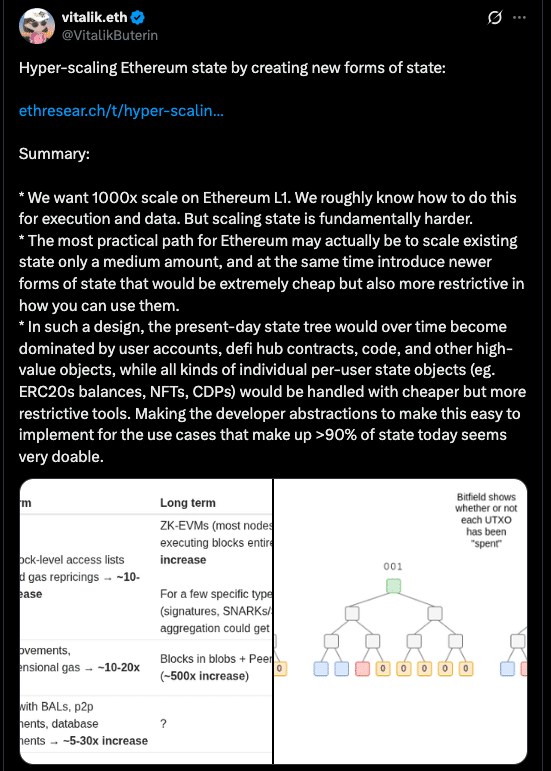
The primary focus of the Ethereum scaling strategy update is Buterin’s admission that the “state” which is the full record of all account balances, smart contracts and data, is still the hardest part of scaling to overcome.
Existing systems would require all network participants to store and synchronize the entire state, which can grow quickly as usage grows.
In a post on X, Buterin wrote that “scaling state is fundamentally harder” than other resources such as execution or data availability.
His plan is to add more, less costly state storage types along with the current model. These new storage types would still store data on the blockchain but do so in ways that lower the cost and resources needed to perform common tasks like storing balances of ERC-20 tokens or NFT ownership records.
By tailoring storage criteria to the needs of specific asset types, Ethereum could support more activity without having to burden every user with storing the entire state data.
This builds on long-standing issues: Ethereum’s state increases by roughly 100GB per year, and simply increasing the size capacity on the state might require multi-terabyte databases that would be difficult for developers and nodes to manage.
By tiering how state is stored, developers also could decide what must always remain in permanent storage and what might be moved into optimized, cheaper tiers.
Layer-2 Vision: Not Just About Scaling Costs
Another major point included in the Ethereum scaling strategy update is Buterin’s retake on Layer-2 rollups. These networks which include Arbitrum, Optimism and Base were initially pitched as extensions of Ethereum that would process the vast majority of its transactions while securing those records on the main chain.
Now Buterin contends that L2s frequently fail to truly inherit Ethereum’s security guarantees, particularly if they depend on multisig bridges or centralized sequencers.
Buterin said “L2s are no longer scaling Ethereum” and instead encouraged rethinking what purpose these networks should serve for the community.
Instead of just being cheap transaction processors, L2s should offer value-added services like privacy tools, super-fast regional sequencing, identity systems or even application-specific infrastructure.
Hence, Ethereum’s scaling strategy now is centered around increasing L1 capabilities and how L2s provide differentiable value beyond cost savings.
Realistic Gains: Lower Costs, More Accessibility
The impact of the Ethereum scaling strategy would be most pronounced for those who use the network every day. Today, data and contract storage on Ethereum can be expensive, even for basic tasks like sending tokens or minting an NFT.
Buterin’s concept of a streamlined state for common asset type operations might reduce these costs considerably, as it would use less computational and storage resources.
This is not meant to be a replacement for the system model that is already in place. Instead, assets such as ERC-20 balances and NFTs could be stored in lighter storage classes that maintain security guarantees while not bloating the main network.
The effect is that more users and developers can build on Ethereum for less while at the same time maintaining sturdy security around core functions like smart contract execution.
By cutting down hurdles to entry, Ethereum might promote faster and widespread deployment of applications on it, encouraging smaller developers to reach a larger base through wider adoption and thereby a more open playing field for the average user, inching towards a truly global inclusivity in blockchain.

Community Response and Industry Context
Some developers and community members are applauding the proposal as an act of recognizing that long held assumptions about scaling might need a rethink. As one X reader commented: Ethereum’s developers are “moving in the right direction by accepting mistakes and improving decision-making,”
Even Layer-2 enthusiasts have admitted that these networks must evolve. As market data shows, Layer-2 usage has declined sharply as Ethereum’s Base layer becomes cheaper and more scalable, with active addresses on L2s dropping by nearly 50% as of early February 2026.
Conclusion
The 2026 Ethereum scaling plan announced by Vitalik Buterin ushers in a new era for the network. Instead of hype about only Layer-2 rollups or just onboarding raw capacity, the development path is now embracing improvements in how state is stored and how different parts of the ecosystem contribute value.
By bringing in new storage types which are more cost-effective and focused, and by encouraging Layer-2s to do more than just reduce costs to prevent the need for expensive computations, Buterin is trying to ensure Ethereum will be sustainable, inclusive and efficient well into the future.
Glossary
Ethereum Scaling Strategy Update: the combination of recommendations and perspectives devised by Vitalik Buterin in 2026 which change the way Ethereum will scale: The primary emphasis moves from solely increasing capacity to state-optimization and a redefinition of Layer 2’s purpose.
State: a complete record of all accounts, data, code and balances on the Ethereum network that every node in the Ethereum network needs to compile and synchronize.
Layer-2 (L2) networks: extra protocols soundly built on top of Ethereum’s basic layer in order to scale the rate of transactions, lower transaction fees, or provide domain-specific services.
Multisig Bridges: asset transfer mechanisms between chains that require multiple signatures to operate, and in some cases can offer less security guarantees compared to Ethereum-native bridges.
Rollups: Layer-2 scaling solution, that roll up transactions into batches and put proofs of them on the Ethereum mainnet.
Frequently Asked Questions About Ethereum Scaling Strategy
What is the Ethereum scaling plan update from Vitalik Buterin?
A set of recent proposals which rethinks the way Ethereum scales by focusing on cheaper stately models and a new vision for Layer-2 networks rather than relying solely on rollups.
Why did Vitalik claim that the original rollup roadmap doesn’t make sense anymore?
He says many rollups have yet to reach full decentralization and that, additionally, Ethereum’s base layer itself has scaled, so the original rollup model is less important to growth.
How could storage changes reduce costs on Ethereum?
The introduction of restricted and cheaper state types for common identifiers such as token balances or NFT storage can relieve the network burden on nodes and lower costs per transaction.
Does this approach signal the death of Layer-2s?
No, Buterin indicates that Layer-2 is still a necessity, but it should provide something new or purpose-built instead of being just a cheaper extension.
What change is all this updating supposed to be leading toward?
The aim is to make Ethereum more efficient, scalable and easier to use, whilst maintaining security and decentralization, ultimately facilitating the spread of dApps and blockchain usage all across the board.
References
Bitget
MEXC
FX Leaders
CoinCentral
BeInCrypto