

This article was first published on The Bit Journal.
Ethereum staking mechanism saw huge growth in 2025, despite Ether (ETH) struggling to maintain an upward momentum for the majority of the year. New data from the Ethereum Staking Insights & Protocol Analysis report by Everstake shows that protocol upgrades, increased institutional demand, and increased network utility have contributed to one of the most substantial actions in the Ethereum economy since the Merge.
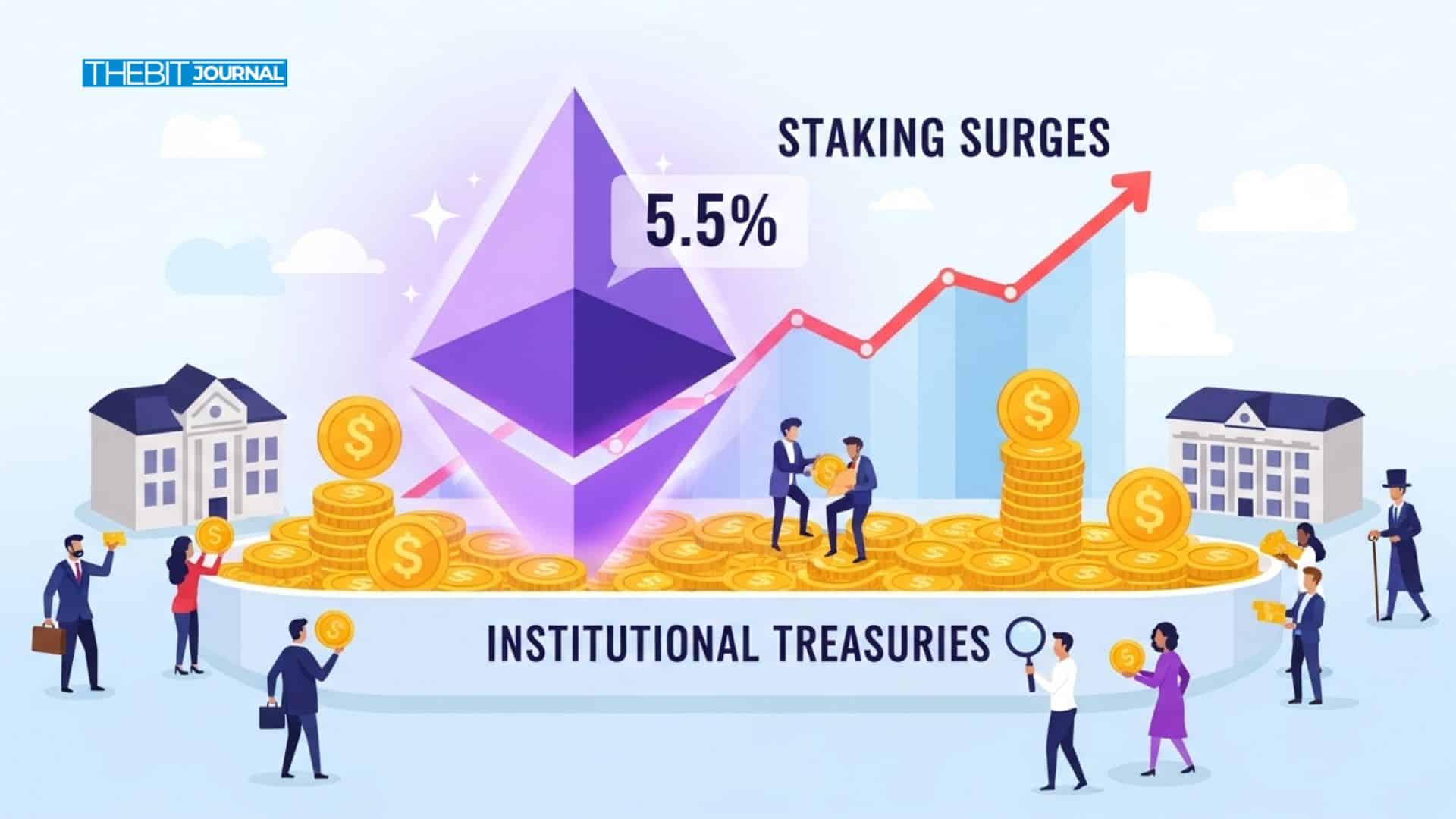
Notably, Digital Asset Treasuries (DATs) held nearly 5.5% of the entire ETH supply in staking by year end.
Ethereum Staking on the Rise Amid Network Upgrades
In 2025, two important protocol upgrades, Pectra and Fusaka, strengthened the infrastructure and scalability of Ethereum staking.
Pectra proposed an EIP-7251, which moves the maximum effective validator balance from 32 ETH to 2,048 ETH. It provides larger operators and institutions with the opportunity to stake more efficiently than having thousands of separate 32 ETH validators.
Fusaka enabled PeerDAS (EIP-7594), a data availability improvement that increased the Layer 2 throughput to be eight times higher safely, enhancing the overall network’s capacity and performance.
These enhancements led to improved validator capital efficiency and enabled increased participation from domestic and international institutional actors. And so, total staked ETH rose to 36.1 million, about 29.3% of the supply by the end of 2025. This accounts for a net growth of over 1.8 million ETH, further demonstrating the increasing use of Ethereum’s proof-of-stake security model.
Institutional Adoption and the Emergence of Digital Asset Treasuries
One of the highlights of 2025 was the aggressive ETH buys taken by Digital Asset Treasuries (DATs). By December, DATs were reported to be controlling between 6.5 million and 7 million ETH, or approximately 5.5% of supply at the time. These are companies pledging corporate treasury to earn yield and by doing so have effectively removing a significant amount of ETH from liquid markets, thus limiting the total supply in circulation.
Everstake co-founder and COO Bohdan Opryshko noted that “as infrastructure improved and fees fell, ETH increasingly functioned as working capital, securing networks and generating yield.”
He added that in 2026, “institutions will move beyond passive exposure, treating ETH as a yield-bearing asset where staking becomes a baseline requirement rather than an optional add-on.”
Ecosystem Activity and Usage Trends Beyond Price Movements
The activity on Ethereum in 2025 did not match up to its muted price action. There was lots of activity on both Layer 1 and Layer 2 infrastructure in the network. Daily Layer 1 transactions grew roughly 30% year-over-year to about 1.5 million to 1.6 million, and Layer 2 throughput surpassed more than 300 transactions per second, an essential number for decentralized application performance and support of real-world use cases.
Daily active addresses also increased sharply. Whereas it wasn’t typical retail wallets accounting for growth, but rather smart contract wallets and Ethereum ETF–based accounts, suggesting institutional and sophisticated user activity.
Growth in the network happened at a time when Ether wasn’t pumping, proving that Ethereum’s growth can happen without price pumping based on its utility and adoption.
Analysts view this as a sign that Ethereum’s role as the settlement and execution layer for decentralized finance (DeFi) and financial products is evolving independently of short-term price cycles.
The Structural Change in Staking and Market Dynamics
The speedy growth in Ethereum staking is also pointing to a deeper reorganization in how market participants are treating ETH.
Staking was once a network security layer and modest yield option for individual holders; however, it now functions as an infrastructure component for institutions and digital treasuries.
With nearly three-tenths of total supply locked up through staking, and DATs alone holding a huge share, the network is undergoing a structural remodeling that weaves together capital commitment and yield generation with security and decentralization, rather than just trading.
Institutional staking has additionally amplified the validator consolidation trend as bigger entities now make use of the Pectra upgrade to enhance capital efficiency.
This has incited debates among the community about decentralization of staking vs operating efficiency. While more ETH is secured by fewer, larger validators improves performance and security, it also raises questions about the distribution of influence in consensus.
Conclusion
New data has revealed that growth in Ethereum staking in 2025 was partially driven by notable technical advancements and institutional interest spiking
The ability to earn via staking was brought about by protocol upgrades, especially Pectra and Fusaka. Meanwhile, Digital Asset Treasuries, who are custodians of about 5.5% of all ETH in staking form, are even more evident for a transition to strategic yield-based capital deployment away from passive asset holding.
This mix of technological progression, strong usage, and institutional adoption reveals that Ethereum’s upward evolutionary trajectory is now decoupled from short-term price action and is being focused instead on pushing up its use.
Glossary
Digital Asset Treasuries (DATs): corporate entities deploying capital into digital assets such as ETH by leveraging the DeFi primitives of staking and governance to earn yield.
Pectra upgrade (EIP-7251): refers to a 2025 Ethereum protocol change, which increases the maximum effective validator balance & capital efficiency).
Fusaka upgrade (EIP-7594 PeerDAS): the term for the data availability improvements to improve Layer 2 throughput and network scalability.
Layer 2 throughput: transaction processing capabilities that are off the Ethereum base layer, and provide an efficient way of scaling decentralized applications.
Frequently Asked Questions About Ethereum Staking
What is “Ethereum staking growth”?
The increase in ETH being locked for PoS validation in order to secure the network, as well as shrinking the total liquid supply, gives holders a yield.
What portion of Ethereum is staked?
About 29.3% of the total ETH supply was staked by the end of 2025, a sizable portion of the token’s circulating supply committed to network security.
How are DATs involved in Ethereum staking?
Digital Asset Treasuries are no longer just holding passively to the rise of their coins, and instead are becoming active protocol participants, staking massive quantities of ETH and shaping markets as well as network dynamics.
Why did protocol upgrades matter?
Upgrades like Pectra and Fusaka lead to better validator efficiency, layer 2 scalability and institutional onboarding which then increased total staking participation.
Does staking affect ETH price?
Staking itself doesn’t ensure an increase in price, but locking up large amounts of ETH removes it from the liquid supply and can affect market dynamics over time.
References