




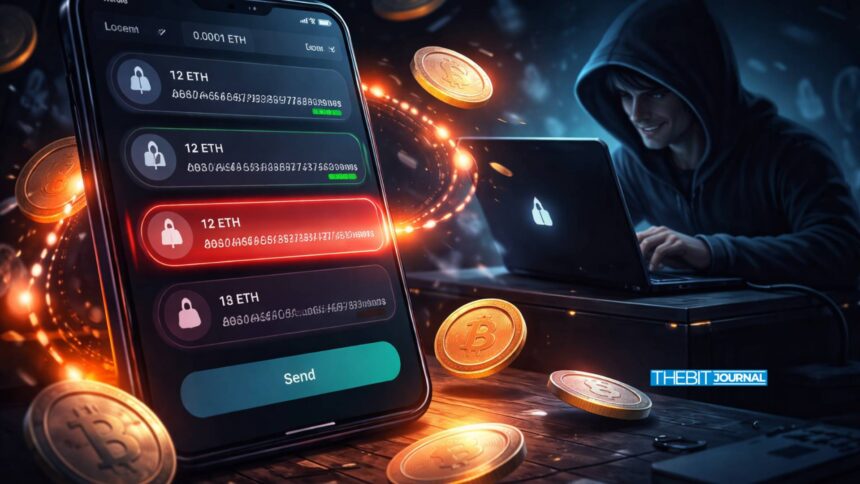

In crypto, most people picture theft as a technical break-in: a stolen seed phrase, a compromised device, a drained wallet. Yet some of the costliest losses come from something more ordinary, closer to a wrong-number wire than a sophisticated hack.
Address poisoning works by nudging users into making a bad transfer on their own, then letting the blockchain do what it always does: settle final, with no undo button. Support pages and security teams describe it as a deception pattern that relies on lookalike addresses appearing in transaction histories, not on cracking private keys.
That difference matters. When keys are not stolen, the victim’s wallet still “behaves correctly.” The signature is valid, the destination is on-chain, and the network confirms as usual. The mistake is human, but the setup is engineered.
How the trick is planted in plain sight
The mechanics are simple enough to explain to a non-technical reader, which is exactly why the fraud scales. An attacker first identifies a wallet that sends funds frequently. Next, the attacker generates a vanity address that resembles a familiar destination or resembles the victim’s own address in the places people tend to glance at, such as the first few characters and the last few. Then a tiny transfer, sometimes effectively worthless, is sent so the lookalike address appears in the victim’s recent activity. Chain analytics firms have documented how these campaigns can be run with customized infrastructure and repeated at scale across many targets.
Once the “poison” entry is in the history, the attack shifts from blockchain mechanics to interface habits. Many wallets display only a shortened form of an address. Many users copy from transaction history because it feels like a shortcut that avoids typos. In that moment, the attacker is no longer trying to beat encryption. The attacker is trying to beat attention.
Address poisoning and the psychology of copy-paste
Address poisoning
The reason address poisoning keeps working is the same reason a counterfeit email address can slip past a busy finance team: people verify what feels verifyable. On a small screen, those first and last characters become a stand-in for the whole string, especially when someone is moving fast or repeating a routine. The scam is designed to blend into that routine, so the victim does not feel like they are taking a risk at all.

Security guidance from wallet providers frames the core danger plainly: scammers send a transaction from an address that looks similar, hoping the user later copies it from history “absent-mindedly” and sends funds to the wrong place. That framing may sound almost too basic, but it fits how real losses happen. The fraudster is not fighting the protocol. The fraudster is exploiting the moment a user treats history like a contact list.
There is also a compounding factor: irreversible settlement. Traditional banking has guardrails, delays, and sometimes human review, as blockchains do not. Academic work studying these attacks emphasizes that finality and irreversibility amplify the damage from even a small decision error.
When “small” turns into $50,000,000
The past year has offered painful examples of what address poisoning looks like when it hits a high-value wallet. In December 2025, reporting around a large USDT transfer described a victim losing about $50,000,000 after a poisoned address was copied from transaction history, underscoring how a single misdirected send can outweigh months of careful key management.
That incident also undercuts a comforting myth: that test transactions always prevent catastrophe. A user can send a small test to the correct destination, then, minutes later, copy a different entry from history and send the full amount to the wrong place. The pattern is not about one careless step. It is about an interface that makes “the wrong address” look familiar enough to pass a quick glance.
This is why address poisoning has become a favorite of scammers. It can target sophisticated users, it can target institutions, and it can succeed even when hardware wallets and good key hygiene are in place. The attacker is betting on fatigue, not ignorance.
The newer twist: social features and noisy inboxes
If the big USDT loss showed scale, early 2026 headlines showed how address poisoning can mix with product design choices. In February 2026, a reported case tied to a wallet social feature drew attention after a victim transferred 3.5 wBTC, valued around $264,000, in a pattern flagged as consistent with this kind of deception.

The lesson is not that messaging features are inherently unsafe. The lesson is that any feature that increases inbound noise, adds new surfaces for impersonation, or encourages quick copying can widen the lane for scammers. This type of fraud thrives where users are encouraged to move quickly and trust what the interface presents.
Another reason the technique travels well across chains is cost. On lower-fee networks, sending many tiny transfers is inexpensive, turning the attack into a volume game. Risk research on high-throughput environments has described how micro-transactions can be used to deceive users into interacting with spoofed addresses that resemble legitimate counterparties.
What to watch for and how to reduce risk
For everyday users, address poisoning is easiest to avoid by treating addresses like bank account numbers rather than usernames. The safest habit is to reuse saved recipient entries from a trusted address book, not from recent transactions, and to verify more than a couple of characters when moving meaningful value. Wallet safety resources emphasize that dusting and lookalike history entries are common building blocks of these scams.
For builders and exchanges, the better question is not, “How can users be more careful?” It is, “Why does the product make the risky behavior feel normal?” Security firms have argued that this fraud thrives on human shortcuts and that defense requires better tooling, such as similarity warnings, spam suppression, and clearer labeling for unsolicited transfers.
The key indicators are behavioral, not purely technical. Frequent small inbound transfers from unfamiliar addresses, a transaction list filled with near-duplicates, and a tendency to copy from history during routine withdrawals are the early warning signs. Once those signs appear, slowing down becomes a security feature.
Conclusion
Crypto is often sold as a future of stronger guarantees: self-custody, cryptography, and permissionless settlement. Address poisoning is a reminder that the weakest link is still the moment a person decides where money should go.
The chain will not second-guess that decision, and the network will not reverse it out of sympathy. As losses in late 2025 and early 2026 illustrate, the scam can hit novices and veterans alike, because it attacks routine. The best defense is a mix of disciplined sending habits and wallets that stop treating transaction history like a trusted directory.
Frequently Asked Questions (FAQs)
How does address poisoning work if private keys stay safe?
In address poisoning, the attacker does not need keys because the victim signs a legitimate transaction to the wrong destination. The deception is planted by inserting a lookalike address into transaction history, then relying on copying habits rather than malware.
Why do people fall for it even when they do test transactions?
A test transfer only proves that one send went to the correct address. If the full transfer is later copied from a different history entry that looks similar, the test does not protect the final decision. Reporting on large losses has highlighted this exact pattern.
Is address poisoning more common on certain blockchains?
It can occur on any chain, but it can be cheaper to run at scale on networks where micro-transactions cost very little. Research and threat reports describe how low-cost “dust” transfers can be used to seed histories with spoofed entries.
What is the safest way to send funds to a frequent recipient?
The safest approach is to use a verified address book entry, a saved contact, or an out-of-band verification method, then confirm the full address before sending meaningful value. Treat transaction history as untrusted because it can be polluted by unsolicited transfers.
Glossary of key terms
Address poisoning: A deception technique where scammers send small transactions so a lookalike address appears in a victim’s history, increasing the chance the victim later copies and sends funds to the attacker.
Dusting transaction: A tiny transfer, often of minimal value, used to create wallet “noise” or to support scams by placing entries in transaction histories.
Vanity address: A wallet address generated to match specific patterns, such as the same opening or closing characters as a target address, making it easier to confuse at a glance.
Finality: The property of many blockchain systems where confirmed transactions are effectively irreversible, which increases the impact of misdirected sends.
Disclaimer: This article is for informational purposes only and does not constitute financial, legal, or security advice. Crypto transactions involve risk, and readers should conduct independent due diligence and consult qualified professionals where appropriate.
Sources