

Reading crypto charts begins with understanding how price behaves over time, and as per the source, this forms the backbone of informed decision-making in digital asset markets. Traders often face confusion when first encountering charts filled with red and green candles, but these visuals are structured reflections of buyer and seller activity.
With the right approach, what appears chaotic can become a reliable framework for evaluating trends, risks, and opportunities. In fast-moving crypto markets, where assets trade around the clock and react sharply to macroeconomic signals, crypto charts analysis has become an essential skill. It allows participants to interpret price data without relying solely on external developments.
What is crypto charts analysis and how does it shape market understanding?
Crypto charts analysis refers to the study of historical price movements using charts, patterns, and indicators to anticipate potential trends. It focuses on price behavior rather than external narratives.

This approach helps traders identify recurring structures in the market. It transforms raw price data into actionable insights. Analysts often stress that price reflects all known information, making chart-based evaluation a core discipline.
What is a candlestick and what does it tell you?
A candlestick represents price movement within a specific timeframe. It includes the open, close, high, and low prices. The main body of the candle shows the difference between the open and close, while the thin lines above and below (called wicks or shadows) show the extremes reached during that period.
A green (or hollow) candle means the closing price was higher than the opening price, signalling that buyers were in control for that period. A red (or filled) candle means the close was lower than the open, showing sellers won the session. Long wicks often indicate rejection at certain levels, a key insight in crypto charts analysis.
How do different timeframes work: 1H, 4H, 1D, 1W?
Timeframes are the lenses through which you view price action. A 1‑hour (1H) chart zooms in and shows every 60‑minute candle, while a 4‑hour (4H) chart aggregates four hours into one candle, a 1‑day (1D) chart rolls up a full day, and a 1‑week (1W) chart condenses seven days into one bar.
Shorter timeframes like 15M or 1H capture intraday volatility and are useful for active traders, whereas 1D and 1W smooth out the noise and help you see the broader trend more clearly.
Starting with the daily chart is often a good approach for beginners because it filters out the emotional spikes and false moves that often appear on lower timeframes. You can still zoom into 4H or 1H to fine‑tune entries, but always anchor your decisions to what the higher‑timeframe chart is saying.
If a 15‑minute chart looks bearish but the daily chart is still climbing, your job is to recognize that the short‑term dip may just be a normal pullback within a bigger uptrend rather than a full reversal. This layered approach is widely used in crypto charts analysis.
Why are support and resistance the foundation of price action?
Support and resistance define key price zones where market behavior repeats. Support acts as a floor, while resistance acts as a ceiling. When support breaks, it may turn into resistance. Conversely, when resistance is decisively broken, it can become support in a future pullback.
For example, Bitcoin’s 20,000‑dollar level once acted as resistance in 2017, then later served as critical support during the 2022 bear market. Drawing these levels on your chart helps you define where to enter, where to place stop‑losses, and where to take profit, turning guesswork into a structured plan.
Why does volume confirm or invalidate every move?
Volume helps confirm the strength behind price moves. It tells you how many units of a cryptocurrency were traded in a given period and appears on the chart as bars at the bottom. High volume around a price move usually means strong conviction from the market, while low volume suggests tepid interest and a higher chance of a fakeout or reversal.
When applying crypto charts analysis, rising price alongside increasing volume often reflects a strong and sustainable uptrend backed by genuine market participation. On the other hand, if prices continue to climb while volume begins to decline, it may indicate that the move lacks strength and could reverse more easily.
A breakout above resistance or a drop below support carries more weight when supported by a clear spike in volume, particularly when it stands well above recent averages. In contrast, weak volume during a breakout is often viewed with caution, as such moves can quickly lose momentum and reverse.
In crypto charts analysis volume divergence, where price moves higher but trading activity declines, can point to weakening momentum and a higher likelihood of reversal. This is why experienced traders rely on volume as a confirmation tool rather than treating it as a signal on its own.
How do key indicators like RSI, MACD, and Bollinger Bands work?
In crypto charts analysis, indicators are formulas based on price and volume that help you judge momentum, trend strength, and how volatile the market is. RSI, the Relative Strength Index, runs from 0 to 100. Readings above 70 are usually called overbought, and readings below 30 are called oversold. Overbought does not mean a fall is guaranteed, it often just means buying momentum is strong.
Similarly, oversold does not guarantee a bounce, but it can suggest that selling pressure is slowing down. In crypto charts analysis, RSI works better when you look at the bigger trend. In a strong uptrend, RSI can stay above 50 and even sit above 70 for a while. In a downtrend, it can stay below 50 for long periods.
MACD (Moving Average Convergence Divergence) compares short‑ and long‑term moving averages to highlight changes in momentum and trend direction. When the MACD line crosses above the signal line, it is often interpreted as a bullish shift when it crosses below, it can indicate bearish pressure.
One of the most powerful signals is divergence, where price makes a new high or low but RSI or MACD does not, often indicating weakening momentum before a reversal. Bollinger Bands track volatility by expanding and contracting around price. Analysts often combine these tools with price action. This layered method strengthens crypto chart analysis and reduces false signals.
How do chart patterns like Head & Shoulders, Double Top, and Bull Flag work?
Chart patterns are recurring shapes that traders watch because they often reflect shifts in market psychology. Reversal patterns suggest that a trend may be about to change. The Head & Shoulders pattern, for example, typically appears after an uptrend and is often read as a bearish reversal signal once the neckline breaks.
Double Top and Double Bottom patterns show repeated attempts to push past a level, and once the neckline is decisively broken they can signal a potential change in direction. However, no pattern guarantees success, and false breakouts are common, especially in volatile crypto markets.
Continuation patterns, on the other hand, suggest that the existing trend is pausing before resuming. Bull Flags suggest trend continuation after consolidation. Recognizing these formations improves accuracy in crypto charts.
What are the most common beginner mistakes when reading charts?
Beginners often trade against the trend. This increases risk significantly. Overloading charts with indicators creates confusion. Trading breakouts without volume confirmation is another classic trap.
A breakout that looks impressive on the candlestick but lacks a real volume spike can easily reverse into a fakeout. Beginners also tend to force patterns that are not clearly there, bending their analysis to fit a pre‑conceived idea rather than letting the chart speak.
Finally entering trades without a defined entry, stop‑loss, and target removes discipline and turns the process into gambling. Every setup should be treated like an experiment with clear rules, not a last‑minute hunch.
How can you practice crypto charts step by step?
To turn theory into practice, start with a live Bitcoin chart on the daily timeframe. First, check if the trend is up higher highs and higher lows or down lower highs and lower lows. Mark clear support and resistance zones and watch how price reacts there.
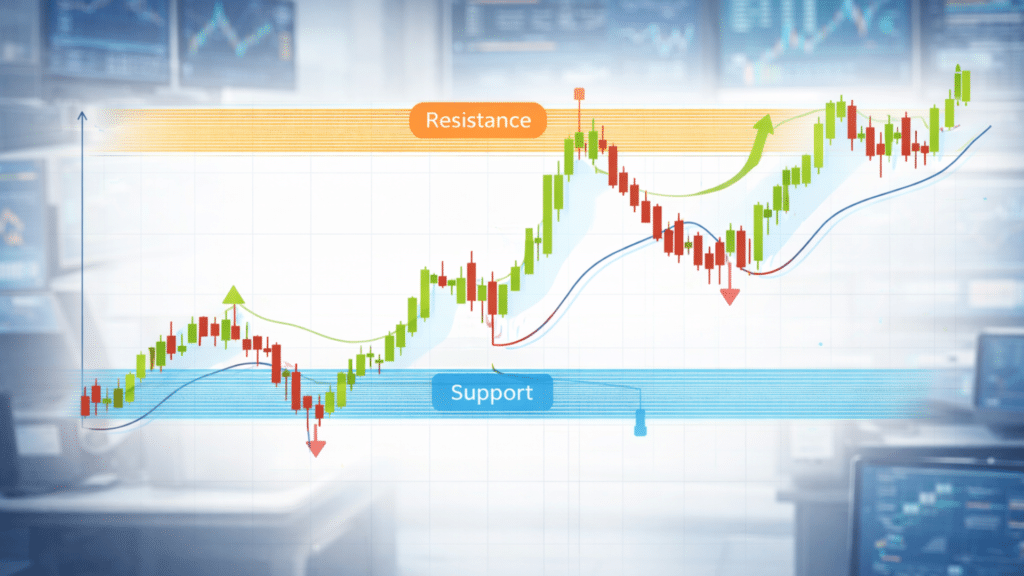
Then switch to the 4H or 1H chart to see recent swings and look for simple candlestick patterns like hammers, engulfing bars, or dojis near those levels. Once you have a bias, add one or two moving averages to show dynamic support and resistance. Check RSI or MACD to see if momentum backs the move and watch for divergences between price and the indicator.
Next, study volume does the move come with strong spikes or weak participation Mostly, the best setups appear when support, RSI, and volume all line up in the same direction. After running through each step, define your entry, stop loss, and profit target. Over time, repeating this routine will help you read Bitcoin charts more naturally and build solid crypto technical analysis habits.
Conclusion
Crypto charts are practical skills that improves with repetition and discipline. It enables traders to structure decisions based on observable data rather than speculation.
By focusing on candlesticks, support and resistance, volume, and key indicators, beginners can build a solid foundation. While charts cannot predict unexpected events, they provide a framework for managing risk and planning trades. Over time, consistent application of crypto charts analysis help turn uncertainty into a structured trading approach.
Glossary
Candlestick: Visual representation of price movement within a timeframe
Timeframe: Selected period used to view price data such as 1H or 1D
Support: Price level where buying interest prevents further decline
Resistance: Price level where selling pressure limits upward movement
Bollinger Bands: Volatility indicator using upper and lower price bands
Chart Pattern: Repeating price formation used to anticipate future moves
Frequently Asked Questions About Crypto Chart Analysis 2026
What is crypto chart analysis?
Crypto chart analysis is the study of price charts to understand how the market is moving.
How do beginners start reading crypto charts?
Beginners can start by learning candlesticks, trends, and basic support and resistance levels.
What do green and red candles mean?
A green candle means the price went up, and a red candle means the price went down.
What is the easiest indicator for beginners?
RSI is one of the easiest indicators because it shows if the market is overbought or oversold.
Do I need many indicators to trade?
No you only need a few simple indicators along with price action to make better decisions.
Sources: