














Pantera Capital has brought new life to the Solana market, saying Solana institutional inflows are about to explode once a Solana spot ETF gets approved in Q4 2025. Institutions hold less than 1% of Solana’s supply compared to 16% for Bitcoin and 7% for Ethereum.
Meanwhile, Solana’s fundamentals, such as transaction throughput, staking yield, and corporate treasury interest, are getting stronger and are being noticed.
Institutional Under-Allocation and ETF as Trigger

Pantera Capital’s recent post on X and follow-ups in media, reveal a big gap in institutional exposure. Institutions collectively hold under 1% of Solana supply, much less than 16% for Bitcoin and 7% for Ethereum. Pantera says this under-allocation is inconsistent with Solana’s growing usage metrics and can be corrected with an ETF.
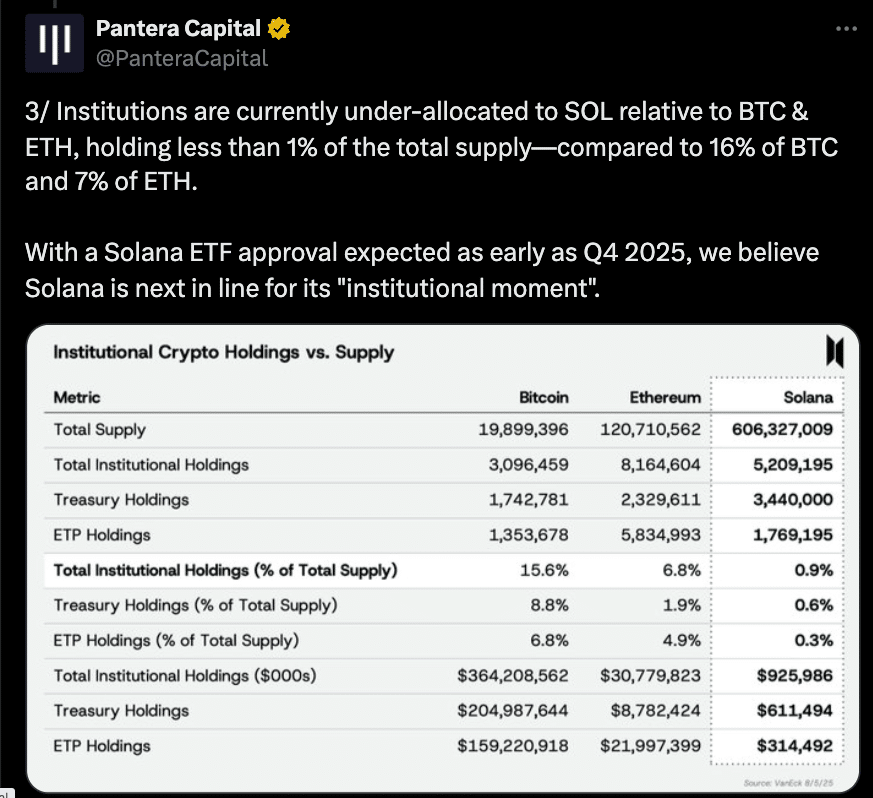
Sources confirm several spot ETF applications or proposals are in the pipeline, so regulatory approval might happen in Q4 2025. Pantera expects “a wave of demand” once ETFs are approved and institutional interest is already being shown through corporate treasury allocations.
Also read: Why Analysts Say Solana Could Explode Past $300
Recent Institutional Moves and Treasury Interest
Beyond statements, real money is being put behind Solana’s upside. Pantera’s venture arm led investments into corporate treasury strategies involving $SOL, most notably in Helius Medical Technologies which raised over $500m in a PIPE round with plans to hold $SOL as a reserve asset.
Corporate treasuries are also staking $SOL to generate 7-8% yields annually, according to recent analysis. Institutions like Forward Industries are reported to have staked millions of $SOL, moving from expectation to active capital deployment.
These moves show Solana institutional inflows are increasingly strategic. Staking yields and network activity have made holding $SOL more attractive for entities looking for income and reserve diversification.
Network Fundamentals Getting Stronger
Solana’s network metrics support the case. Transaction throughput is high, fees are low, fintechs and payment platforms are using Solana and major names like Stripe and PayPal are building on Solana, making it more real-world applicable. The recent “Alpenglow” consensus upgrade has improved stability and performance, reducing friction for institutional adoption.
Additionally, $SOL’s staking model provides yield, which is more attractive than non-yielding assets like Bitcoin. For institutions and treasuries that hold big reserves, yield is a bonus. According to recent analysis, $SOL’s staking yields are 7-8% gross vs ETH’s 3-4%.
Regulatory and Market Challenges
Despite the optimism, there are headwinds. The SEC has delayed decisions on several Solana spot ETF proposals, pushing out expected timelines to Q4 or even 2026 in some views.
Liquidity risk is another issue. Large institutional inflows or treasury accumulation reduce the floating supply, which can make markets more sensitive to big sells. $SOL’s price volatility is still high which can complicate treasury accounting and risk appetite.

Also read: Pantera Capital’s $1.1 Billion Solana Portfolio Sparks Market Attention
Conclusion
Based on the latest research, the current environment shows Solana institutional inflows are building. Institutions are under-allocated, ETFs are pending, yield is high and the network is getting stronger. But the path forward is not smooth as regulatory delay, classification uncertainty, liquidity and volatility risk remain.
If a Solana spot ETF is approved in Q4 2025, it could be the trigger for institutions to fill the allocation gap.
Stay up to date with expert analysis and price predictions by visiting our crypto news platform.
Summary
Institutions hold less than 1% of Solana supply compared to 16% for Bitcoin and 7% for Ethereum. Pantera Capital says Solana is under-allocated and a spot SOL ETF in Q4 2025 could unlock big flows. Corporate treasuries are starting to stake $SOL, earn yields (7-8%), and deploy capital strategically.
Glossary
Institutional Allocation: The amount of a digital asset held by institutions (funds; treasuries, asset managers).
Spot ETF: An exchange-traded fund backed by the actual asset; not derivatives
Staking Yield: The reward given to holders who delegate or lock their cryptocurrencies to support network consensus.
Governance Token Sale / PIPE: A Private Investment in Public Equity; used to raise funds from private investors for public companies.
Classification (Security vs Commodity): Regulatory determination that affects how a digital asset is regulated under US law; with implications for ETF and institutional use.
Frequently Asked Questions on Solana Institutional Inflows
Will Solana ETF be approved in Q4 2025?
Pantera Capital think so, but SEC postponements suggest it may still be delayed.
Does staking $SOL reduce risk for institutions?
Staking gives yield which offsets some opportunity cost and inflation risk, but staking also brings lock-up, slashing, or network risk, so it mitigates but doesn’t eliminate risk.
What are the biggest risks with this institutional shift?
Regulatory uncertainties, volatility, liquidity constraints, and delays in securing partnerships, custody or regulatory approvals are the main concerns.
Is this shift unique to $SOL or are other chains in similar positions?
Other chain tokens are also under-allocated relative to Bitcoin and Ethereum, but $SOL’s yield, developer activity, throughput and pending ETF filings make its case stronger than others.