
This article was first published on The Bit Journal.
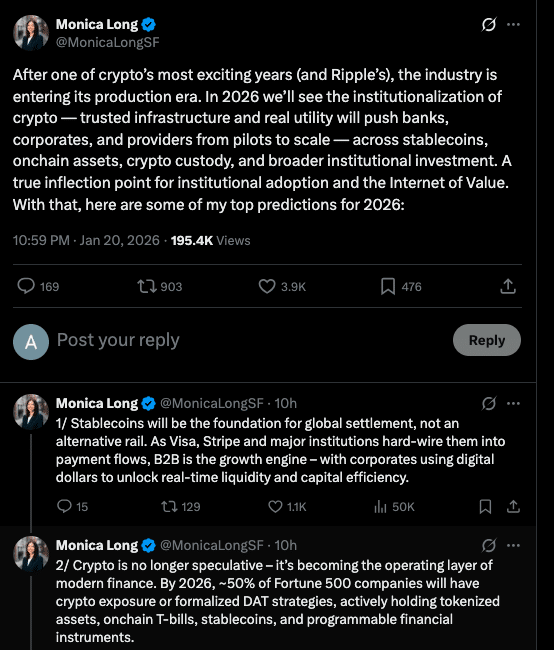
Monica Long, President of blockchain company Ripple, has stated that institutional crypto adoption will surge in 2026.
In a report published this week detailing her predictions, Long said that blockchain technology is increasingly becoming the “operating layer of modern finance” and that corporations around the world are ready to adopt digital assets in their financial activities.
She’s estimating about $1 trillion worth of digital assets on corporate balance sheets by the end of the year, with half of Fortune 500 companies holding crypto or using blockchain-based financial products.
Long’s perspective zeroes in on how mature infrastructure, regulatory headway and real-world applications are taking institutional crypto adoption beyond speculation and embedding it into the day-to-day activities of corporate treasury, payments and settlements.
“Production Era” for Crypto: Beyond Experimentation
For Long, 2026 is a time when further pilot projects give way to what she describes as “production era,” where crypto and blockchain tools are being used at scale across institutions.
Long said that blockchain has evolved and that companies can now use tokenized assets, on-chain treasury bills or stablecoins or other kinds of programmable financial instruments.
As she put it, the technology is about to leave behind its speculative reputation: “Crypto is no longer speculative, it’s becoming the operating layer of modern finance.”
Industry surveys support this trend. A 2025 Coinbase survey found that 60 percent of Fortune 500 executives said their companies were actively working on blockchain projects.
Half of Fortune 500 Companies to Hold Crypto?
By the end of 2026, Long estimates that roughly 250 of the United States’ largest companies or approximately half of the Fortune 500 will own cryptocurrencies or have official digital asset strategies on their balance sheets.
These move beyond simply holding to participating in tokenized securities, digital asset treasuries (DATs), stablecoin settlements and programmable financial products.
Long also noted that while few Fortune 500 companies hold Bitcoin directly, she noted the fact that GameStop made headlines when it bought 4,710 BTC in May of 2025.
Other public companies, including Block Inc and Tesla, are also now on the record as possessing crypto assets.
The increase in digital asset treasury (DAT) firms, from four in 2020 to over 200 across global markets today, also indicates a growing corporate appetite for blockchain tools. Nearly 100 such firms were formed in 2025 alone.
Stablecoins: From Alternative to Cornerstone of Settlement
Stablecoins are integral to Long’s vision of institutional adoption. She says that within five years, stablecoins will be thoroughly integrated into global payment systems, not as an alternative for older payment rails and cross-border payments, but inside of the existing rails as part of the core.
This perspective goes in line with leading payment networks such as Visa and Stripe who have already adopted stablecoins for payments, allowing for instant liquidity and helping reduce latency in cross-border transactions.
Long claims that stablecoins reduce friction in corporate settlement and liquidity management compared to traditional systems, especially in cross-border and B2B settings. These technologies enable companies to reconcile balances and manage working capital instantly.
Custody, Capital Markets, and On-Chain Settlements
Outside of balance sheet adoption, institution adoption of crypto assets is likely also to spill over into custody and capital markets infrastructure.
Long predicted that an influx of banks, service providers, and crypto companies would migrate to direct custody in 2026 to speed up their blockchain strategies.
She also expects some international markets settlement activity moving onto blockchains, estimating 5% to 10% of the market on-chain by 2026.
This on-chain migration is enabled by the movement of stablecoin-based collateral and tokenized securities, which are able to settle more quickly than traditional systems with less operational overhead.
The emergence of crypto ETFs and improved institutional access via regulated markets points toward this transformation, but Long adds that as ETFs currently make up a tiny portion of the total pool of market capitalization within a typical institutional investment product, there is still room for growth.

AI and Blockchain Convergence
Long’s prediction shares another factor for institutional adoption of crypto, which is how blockchain and artificial intelligence(AI) are coming together.
According to her, AI and blockchain will merge to automate treasury functions, maximize working capital, and deliver instantaneous risk assessment without human touch.
Other innovations, such as zero-knowledge proofs, would enable institutions to be able to assess creditworthiness and risk profiles but maintain data privacy, an important consideration for a regulated financial entity.
Marcin Long, for one, believes this convergence will open up greater adoption in regulated markets where firms are looking for fast and privacy-preserving technologies that can be incorporated into day-to-day operations.
Conclusion
Ripple President Monica Long’s predictions paint an eye-popping picture for institutional crypto adoption in 2026. Her prediction, supported by survey data and corporate projects in blockchain technology, is that digital assets will soon become deeply rooted in mainstream finance.
She says stablecoins, tokenized assets, on-chain settlement, and AI-driven automation are at the heart of the transition, changing how companies do liquidity management, treasury operations, and global settlements.
Glossary
Digital asset treasury (DAT): A corporate body or organization that is responsible for the holding of digital assets such as cryptocurrencies and tokenized securities, as part of its financial planning.
Stablecoins: Cryptocurrencies that are supposed to keep a stable value by being tied to some reserve asset, usually a fiat currency like the U.S. dollar.
Tokenized assets: Old-fashioned assets, like stocks or bonds, that are reimagined on a blockchain as digital tokens.
On-chain settlement: clearing financial transactions on a blockchain network without intermediaries.
Zero-knowledge proofs: Cryptographic techniques that allow one party to prove knowledge of certain information without showing the information itself, which strengthens privacy.
Frequently Asked Questions About Institutional Crypto Adoption
What is institutional crypto adoption?
Institutional crypto adoption refers to companies and financial corporations adding crypto or blockchain to their planning, balance sheets, treasury operations, or settlement systems.
Why is it important for institutions to have stablecoin integration?
Stablecoins make instant liquidity possible, no settlement friction, and interoperability with global payment and settlement systems, which are all needed for the institutional application of funds.
Which companies have already adopted cryptocurrency?
These include GameStop, which bought Bitcoin in 2025, as well as publicly listed companies such as Block Inc and Tesla, which have disclosed ownership of crypto assets to help support treasury strategies.
How does the merging of blockchain and AI drive adoption?
The combination of blockchain and AI allows for the automation of treasury management, real-time risk analysis, and privacy-preserving analytics, which in turn aids institutions to expose crypto with less operational overhead.
By 2026, will every capital market be on-chain?
Not everything, but Ripple’s projection is that a significant piece (5-10%) of capital markets settlement activity would transition to blockchain infrastructure by 2026 as tokenization and stablecoin collateral use expand.
References
Ripple
Cointelegraph
cryptobriefing