












The crypto market woke up to a harsh reminder of how quickly leverage can turn. In a single 60-minute window, forced position closures erased more than $311 million from traders across Bitcoin and large altcoins. The latest wave of crypto liquidations followed a sharp intraday drop that hit overextended long positions while spot prices barely had time to stabilize.
Derivatives dashboards showed that roughly $307.89 million of positions wiped out in that hour came from longs, with only $4.78 million from shorts, underscoring how one sided positioning had become before the move.
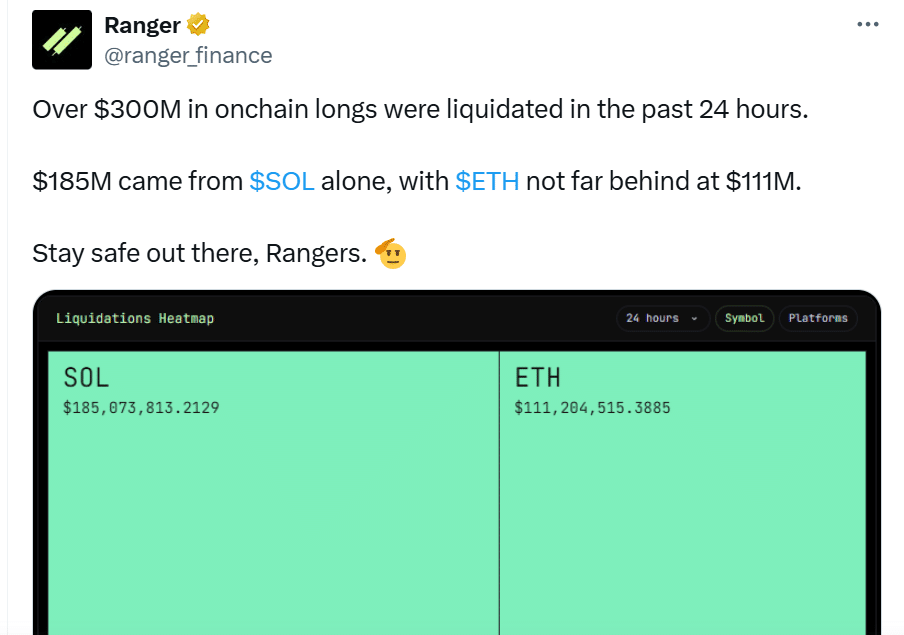
On X, on-chain analyst Ranger Finance told followers, “Over $300M in on-chain longs were liquidated in the past 24 hours,” highlighting how leverage had built up across multiple venues before the final flush. The comment echoed the mood in trading chats, where a routine pullback suddenly felt like a full-blown margin storm.
What The Liquidation Wave Says About Market Positioning
This latest cluster of crypto liquidations shows that traders were leaning aggressively so visibly to the upside. Funding rates on perpetual futures had been creeping higher, and open interest on major venues sat near recent peaks, a classic sign that speculative capital was chasing momentum rather than managing risk. When prices started to roll over, the mix of thin liquidity and crowded positioning created the kind of liquidation cascade that often defines late stages of a rally.
Bitcoin, Ethereum, and large cap altcoins such as Solana and XRP absorbed most of the hit. Their liquid derivatives markets hosted the bulk of leverage, so once liquidation engines began to trigger, bids vanished at key levels, prices slid, and more positions fell into the red. In that feedback loop, crypto liquidations were not just a side effect of volatility but the main driver of it.
How Crypto Liquidations Work Behind The Scenes
For many participants, the mechanics behind crypto liquidations feel abstract until a single candle wipes out a week of gains. On leveraged futures, traders post margin to control a position larger than their cash. When the market moves against them and the margin falls below a maintenance threshold, the exchange closes the position automatically at market prices. That process protects the venue, but it can be brutal for traders who misjudge their risk.
Analytics firms track this activity in real time, turning the notional value of forced closures into charts that show where stress is building. When crypto liquidations spike while open interest falls, it often signals a broad deleveraging event rather than calm profit taking. In this case, the numbers point toward a reset that drained short term speculative capital and left funding much closer to neutral.
Voices Across Media Call For Less Leverage And More Patience
Market commentators responded quickly. Risk analyst William Carey wrote in a recent column that “leverage is a tool, not a strategy,” and urged smaller accounts to keep high multiple futures as the exception rather than the rule. Another analyst argued that repeated waves of crypto liquidations often “clean up positioning and extend the life of a bull market, even if they feel brutal in real time,” framing these episodes as painful but necessary maintenance for an overheated market.
For long term investors, the episode reinforces how market structure shapes price more than headlines do. Crypto liquidations compress sentiment, wash out weak hands, and often reset funding and positioning to more balanced levels for long-term investors. For active traders, the message is blunt and hard to ignore. In a market that trades non stop across time zones, leverage can amplify returns for a while, then take everything back in less than an hour.
Frequently Asked Questions
What are crypto liquidations?
Crypto liquidations are forced closures of leveraged positions when margin falls below required levels and the exchange steps in to limit further losses.
Why do crypto liquidations spike during sharp moves?
Crypto liquidations rise when many traders use high leverage in the same direction and a quick price move pushes them below margin thresholds at roughly the same time.
Glossary Of Key Terms
Liquidation
The automatic closing of a position by an exchange to prevent further losses when required margin is no longer met.
Open interest
The total number of outstanding derivative contracts that have not been closed, settled, or expired, often used as a gauge of how heavily positioned the market is.