






This article was first published on The Bit Journal.
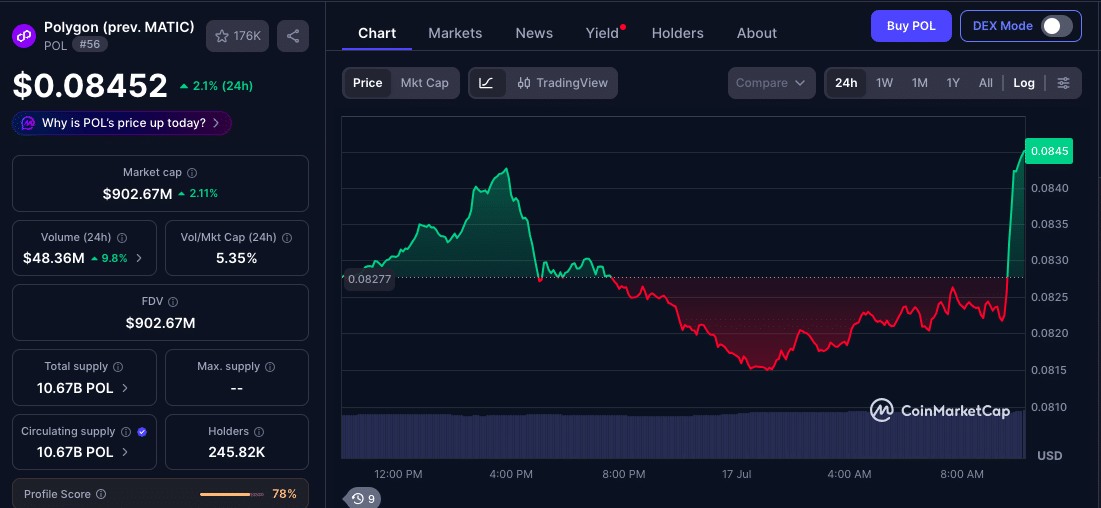
Polygon added more than 107,000 new POL holders in a single month, taking total holder count from 138,000 to 245,000, according to CoinMarketCap data. This represents a 78% increase in wallets but POL price continues to underperform most major assets during 2026.
Crypto markets spent years assuming that more users automatically meant a higher token price. Polygon however is challenging that idea in real time.
Payments are rising. Stablecoin usage is climbing. AI developers are building. Decentralized trading remains active. The token, meanwhile, continues to struggle convincing investors that growing utility should translate into higher valuations.
Polygon Is Becoming A Payments Network Than A Trading Chain
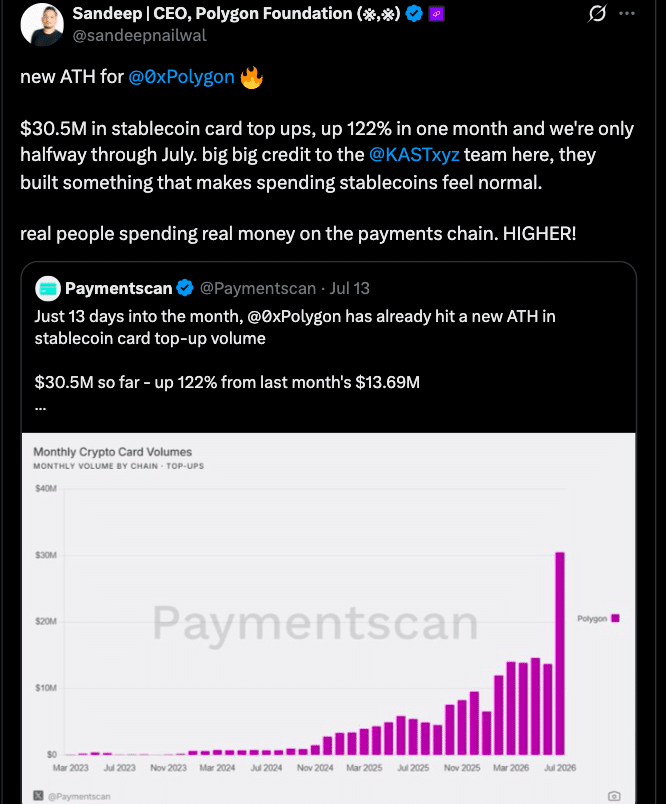
The strongest reason behind the recent surge in wallet creation is payments. Polygon’s monthly crypto card volume jumped more than 122% in July, reaching $30.5 million with half the month still remaining. June processed $13.69 million, meaning the network had already doubled the previous month’s figure before July ended.
Polygon has now settled more than $2.6 trillion in stablecoin volume since launch, exceeding the value of all physical US dollars currently in circulation. The network has become one of crypto’s largest settlement rails.
CoinGecko’s ecosystem report shows Polygon processed almost $2 billion in payment volume during February alone, while stablecoin supply on the network climbed to a record $3.28 billion earlier this year. USDC accounts for just over half that supply.
The network’s problem is that payment activity creates demand for stablecoins, not necessarily for POL itself. A business using USDC for settlement may buy only a few dollars worth of POL to pay transaction fees.
That economic model creates enormous utility while generating relatively limited buy pressure.
The AI Economy Is Creating Wallets Faster Than Investors Realize
The second contributor to the recent explosion in addresses comes from an entirely different direction.
Polygon Foundation CEO Sandeep Nailwal recently confirmed that teams built 13 AI-focused projects, with one already settling transactions across five separate blockchains.
Those figures are to be noted because AI economies behave differently from human ones. Human adoption means new users create wallets.
Agentic economies create wallets automatically. AI agents open wallets, hold balances, execute payments, interact with applications and settle transactions without direct human involvement.
This changes how investors should interpret onchain growth metrics. Not every new wallet represents a new retail investor.
Some of Polygon’s newest participants may simply be software interacting with other software. The result is still network activity, it just doesn’t guarantee token accumulation.
POL’s Tokenomics Continue Working Against POL Price Appreciation
The uncomfortable truth for investors is that Polygon’s biggest challenge may not be adoption. It may be value capture.
POL currently operates with an annual emission model of roughly 2%, distributing new tokens to validators and ecosystem growth initiatives. Validator rewards alone are funded through inflation alongside transaction fees generated by the network.
At the same time, transaction fees on Polygon remain extremely low by design. That is excellent for users but It is less helpful for token scarcity.
Ethereum often benefits from periods of high network congestion because fees increase ETH burning. Polygon’s efficiency creates the opposite: massive activity can occur without materially increasing demand for POL.
There are signs that this may eventually change. Polygon launched its native liquid staking token, sPOL, earlier this year to unlock additional utility for the approximately 3.6 billion POL currently staked across the ecosystem.
For now, however, usage growth continues to outpace value accrual.
Whale Selling And Technical Levels Are Keeping Traders Cautious
POL has been recovering steadily since early July and recently moved above the important $0.8200 resistance level.
The breakout remains fragile. Onchain data showed a whale transferring 14 million POL worth approximately $1.17 million to Binance through four separate deposits before fully exiting the position. The wallet now holds zero POL.
The selling itself may now be over but the signal it sent to the market remains.
Polygon recorded approximately $433 million in daily decentralized exchange volume, ranking sixth among all blockchain ecosystems and placing ahead of numerous competitors with larger valuations.
The market appears willing to reward revenue-generating payment infrastructure. It remains unconvinced that the benefits accrue directly to POL holders.
Support currently sits between $0.78 and $0.80, followed by $0.75 and $0.73. Losing those levels opens the possibility of a retracement toward $0.68 POL price.
Conclusion
Polygon holders growth is one of crypto’s biggest investment questions in 2026. Can a blockchain succeed while its token struggles? The network is processing trillions in stablecoins, onboarding AI applications and attracting hundreds of thousands of users. Yet much of that activity revolves around assets other than POL.
Polygon no longer needs to prove people use it. The challenge is proving that usage creates value for token holders not simply for the applications operating on top of it.
Glossary
POL: Polygon’s native token used for gas fees, staking and network security.
Stablecoin: A cryptocurrency designed to maintain a stable value relative to an asset such as the US dollar.
Agentic Economy: An ecosystem where AI agents autonomously execute financial and transactional activity.
DEX Volume: The value of assets traded through decentralized exchanges on a blockchain network.
Token Emissions: The creation and distribution of new tokens into circulation.
Frequently Asked Questions About POL Price
How Many New Holders Did Polygon Add In July 2026?
Polygon added more than 107,000 holders, increasing total wallet count from 138,000 to 245,000.
Why Is POL Underperforming Despite Growing Adoption?
Most of Polygon’s recent activity comes from stablecoins, payments and AI applications that create network usage without necessarily creating direct demand for POL.
How Much Stablecoin Activity Has Polygon Processed?
Polygon has processed more than $2.6 trillion in stablecoin transfers since launch.
Does Polygon Still Rank Among Major DeFi Networks?
Yes. Polygon recently recorded approximately $433 million in daily DEX volume, ranking sixth among blockchain ecosystems.
What Technical Levels Matter For POL price?
The most important support zones for POL price currently sit at $0.78-$0.80, $0.75, and $0.73, while maintaining levels above $0.82 remains important for bullish continuation.
References