

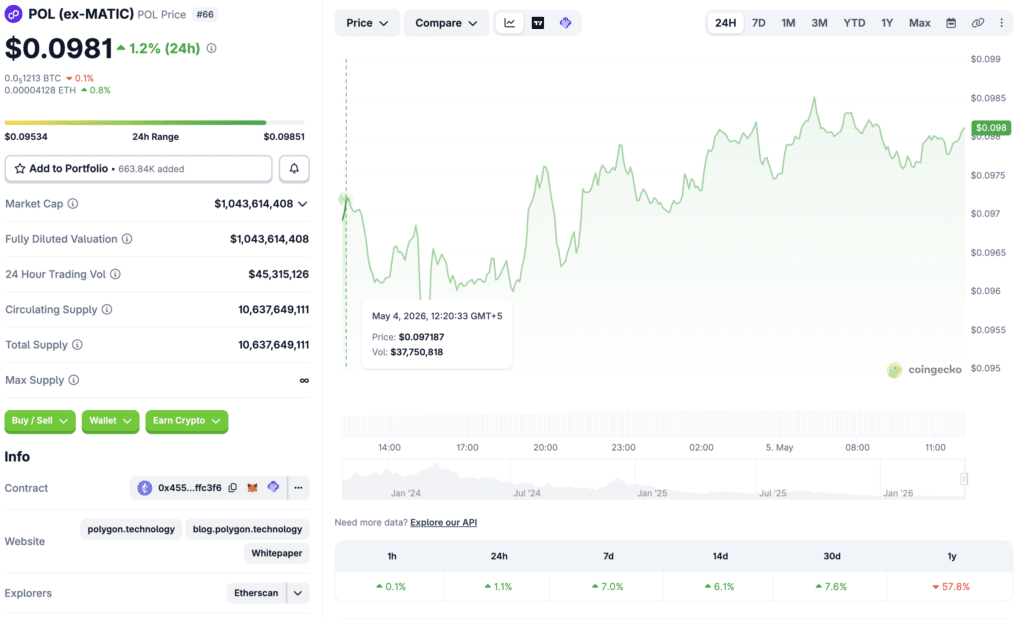
Polygon (MATIC) price today is around $0.09790800 USD with a 24-hour trading volume of $52,038,332 USD. Up against the dollar, the asset is trading up around 0.92% on a daily basis and has a market value of $1,041,511,687 USD along with a total circulating supply of 10,637,649,101 POL tokens available. Despite a choppy macro environment, these figures illustrate continued engagement in Polygon blockchain payments 2026.
The recent launch of Polygon private payments for Institutions represents a fundamental change in how we might see stablecoins move within the global finance ecosystem. Rather than full transparency for the public by default, this upgrade delivers business-to-business and institutional layers for banks, treasuries, and enterprise payment systems in a confidential transaction.
It is not secrecy from regulators; it is operational privacy in compliant frameworks. The update directly follows a directive labeling Polygon as an institutional-focused stablecoin payment platform, so its intent is obvious.
Institutional Demand Driving Polygon Private Payments for Institutions Growth
Polygon Private Payments for Institutions has found its way into the limelight as the demand for privacy-first financial infrastructure peaks. Confidential Settlement Systems: Traditional financial institutions are accustomed to systems that do not expose transaction data publicly. But this has typically been absent in on-chain systems. Part of this gap has led to lower adoption of institutional crypto payments across different BlockChain ecosystems.
Polygon institutional payments provide enterprises with access to private, yet auditable transactions. Such a balance is critical for banks and corporate treasuries managing sensitive flows of liquidity. This transition also will reinforce Polygon fintech solutions except it gives blockchain scalemodels more openers to the actual money. Because of this, the more institutions look to explore scalable blockchain rails, privacy becomes less of an option and much more a braking necessity for adoption.
Polygon Private Payments: how they work on blockchain rails for institutions
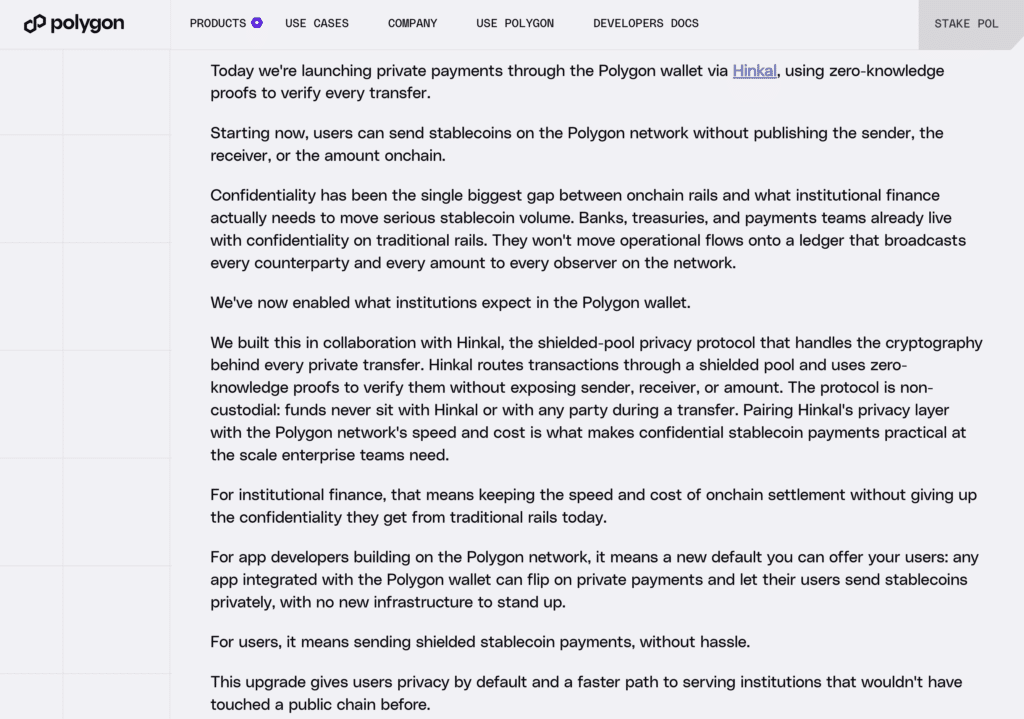
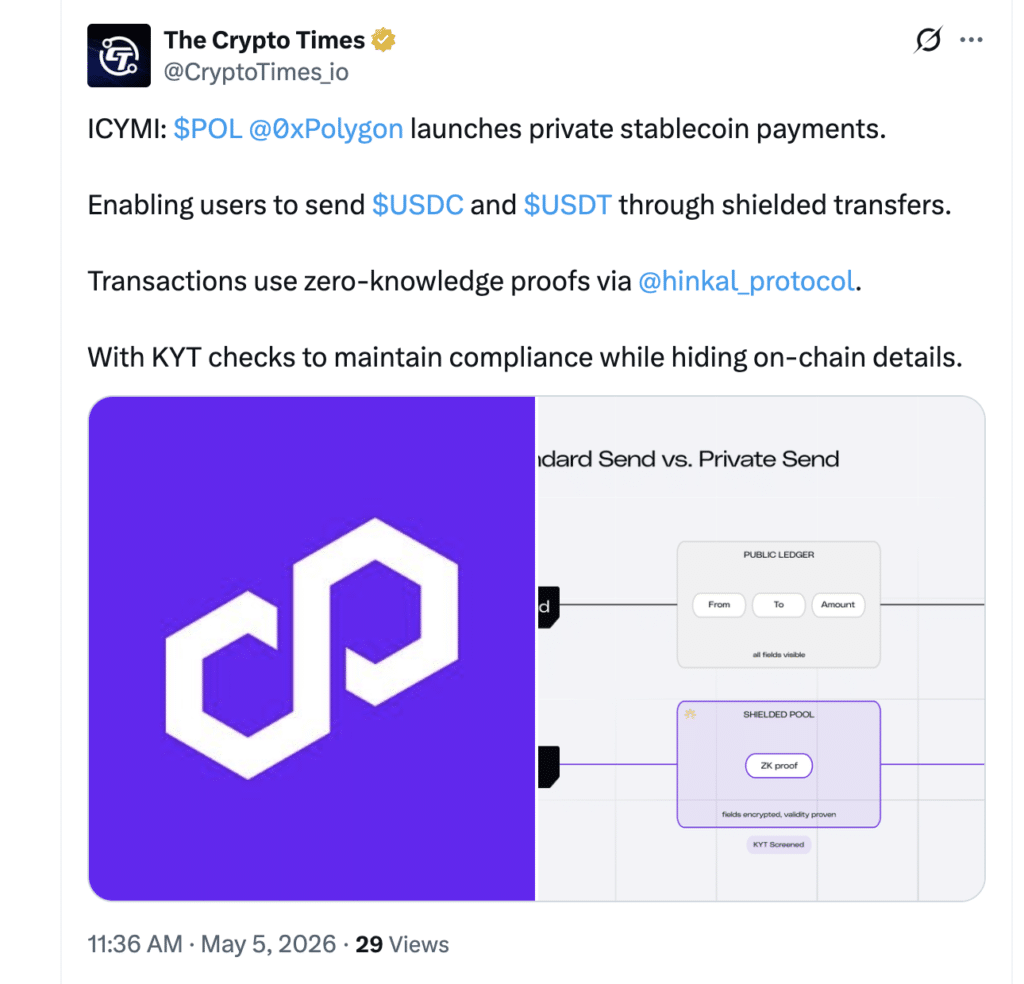
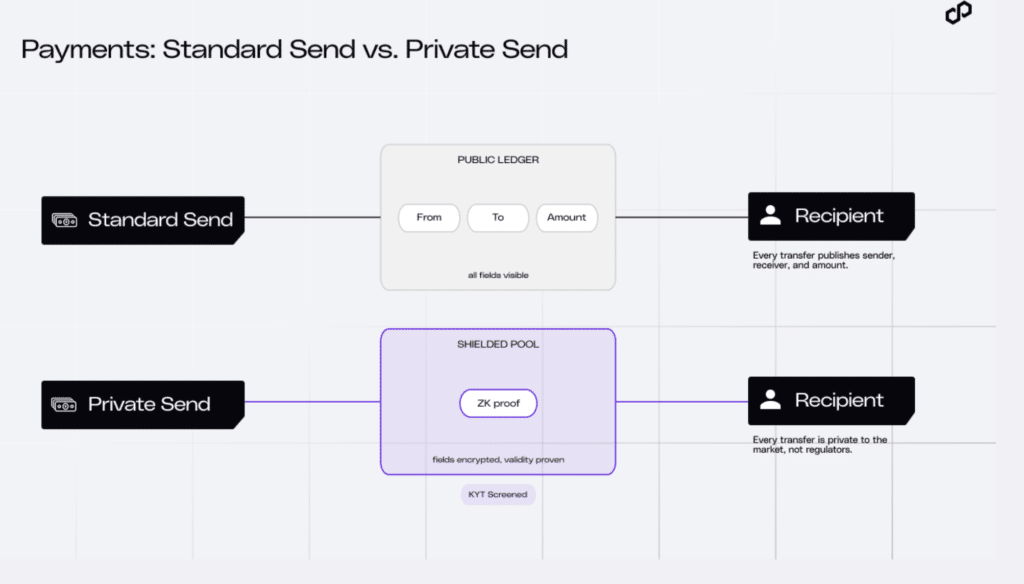
The under-the-hood of Polygon private payments for Institutions based on zero-knowledge proofs and shielded transaction pools. These tools help people to verify transactions without disclosing donor, recipient or sum on public ledgers. Meanwhile, adherence to Know Your Transaction screening is ensured prior to transaction execution.
Indeed, this system is a part of Polygon stablecoins payment integration with privacy protocol Hinkal. The tool also enables users to produce audit-ready records for regulatory reporting, providing complete transparency when needed. This structure of using two different layers facilitates the advancement of stablecoin payments infrastructure while creating a shield for highly sophisticated business data. It creates an environment for co-existing privacy and regulation, which is the next critical stage to drive private blockchain payments for scale.
Private vs Traditional Financials Token & Crypto Payments
Comparing Polygon Private Payments for Institutions against traditional payment rails produces a stark contrast and highlights your unique selling points. Legacy systems such as SWIFT or any of bank clearing networks already provide confidentiality but no real-time settlement or programmability. Blockchain systems, on the other hand, were historically fast and automatic but exposed transaction data to the public.
This is a gap like the institutional crypto payment system explained about polygon. Now you no longer need to decide between speed and privacy when it comes to crypto payments vs traditional blockchain payments, private or public? Polygon blockchain payments 2026, on the other hand, offer both through secure transactions flows and compliance-ready verification tools. This, in turn, means Polygon is fast becoming a bridge between the gaps of TradFi and decentralized systems, specifically when it comes to enterprise blockchain payments.
The Growth of Stablecoins and the Arrangement of Polygon Private Payments for Institutions
Polygon Private Payments for Institutions: Stablecoins, one of the major forces behind blockchain adoption Recently, Polygon’s stablecoin ecosystem hit $3.6 billion in market cap, making the sidechain one of the largest in the world for stablecoin activity. This growth indicates a growing interest for stablecoin payments within enterprises on Polygon.
The implementation of Polygon Open Money Stack payments cases boosts institutional adoption even more. Companies are already looking to utilize Polygon stablecoin payments for cross-border settlement, treasury management and liquidity management. It means Polygon institutional payments can be extended to more crypto payments for banks which leads faster and programmable financial flows. Specifically, this momentum indicates a structural direction towards blockchain based settlement networks
Comparative Landscape: Polygon private payments for institutions with other chains
Having privacy-enabled settlement systems, a race for institutional-focused blockchain finance is heating up with several networks in the fray now. Polygon Private Payments for Institutions comes at a time when Aptos and Ethereum scaling solutions are also looking into private transaction layers. Just recently, Aptos unveiled confidential asset mechanisms that reflect a broader industry demand for privacy infrastructure.
On the contrary, Polygon has the advantage of an established ecosystem as well as stablecoin liquidity. Polygon Letter To Investors Polygon Institutional Payments Built on existing integrations in DeFi and enterprise platforms Compared to other emerging alternatives, this makes Polygon private payment rails able to be used by financial institutions much sooner. \
Consequently, as organizations transition to a fully decentralized ecosystem that requires freedom of payment over Blockchain networks while remaining compliant with privacy regulations, we increasingly see organizations favor blockchain networks with an attractive combination of both.
Conclusion: Polygon Private Payments for Institutions in Global Finance
Polygon Private Payments for Institutions becomes a significant moment in blockchain financial infrastructure Polygon: Combining zero-knowledge privacy; compliance screening and stablecoin efficiency to emerge as the core settlement layer for institutional finance This shift in Polygon institutional crypto payments paradigms is an extension of a wider trend whereby privacy has transcended from optional to being an unmet need for mass adoption.
With the growth of stablecoin adoption into new global economies, Polygon blockchain payments 2026 may become a crucial back-end supporting enterprise-grade transactions. Long-term scalability and trust are supported with a Polygon Stablecoin payment Architecture that emphasizes privacy. Institutions that are exploring the possibility of adopting blockchain technology may have a growing perception of Polygon- Fintech solutions as a viable entry point into DeFi.
Appendix: Glossary of Key Terms
Polygon Private Payments for Institutions refers to a blockchain-based payment system that enables confidential stablecoin transfers using privacy-preserving technology while maintaining regulatory compliance.
Zero-knowledge proofs are cryptographic methods that validate transactions without revealing sensitive data.
Stablecoin payment infrastructure refers to blockchain systems designed to support digital assets pegged to fiat currencies.
Institutional crypto payments describe blockchain transactions conducted by banks, corporations, and financial institutions for operational use rather than retail trading.
Frequently Asked Questions About Polygon Private Payments for Institutions
What is Polygon Private Payments for Institutions and why is it important for finance?
It is a privacy-enabled blockchain payment system designed for institutions that require confidentiality while using stablecoins. It is important because it allows financial organizations to adopt blockchain without exposing sensitive transaction data.
How does Polygon institutional payments system maintain compliance?
It uses Know Your Transaction screening and audit file generation, ensuring regulators can review transactions when necessary without exposing data publicly.
Are Polygon stablecoin payments replacing traditional banking systems?
They are not replacing banks but enhancing them by offering faster settlement and programmable payment infrastructure for enterprise use.
Is Polygon targeting institutional finance in 2026?
Yes, Polygon is clearly focusing on institutional adoption through Polygon Open Money Stack payments use cases and private blockchain payment solutions.
What are the benefits of Polygon private payment rails?
They include transaction privacy, regulatory compliance, faster settlement, and improved efficiency for cross-border enterprise payments.
References