




Shiba Inu whale activity has jumped to its highest level in months, putting the meme coin at an important turning point as big investors adjust their positions and traders wait for clear confirmation near a key breakout area.
Recent on-chain and market signals show strong movement across whale transfers, momentum indicators, supply changes, and derivatives sentiment.
Still, even with all this activity building up, the price remains stuck in a tight range, suggesting that the next move is likely to be sharp and decisive rather than slow. Behind the calm price movement, buyers and sellers are quietly testing each other’s strength.
What are the latest whale moves really showing?
It points to a clear change in how large investors are behaving, instead of random buying and selling. On-chain data shows 406 whale transfers above $100,000, the strongest wave of such activity since June 6.
Along with this, exchanges recorded a net inflow of more than 1.06 trillion $SHIB, showing that big traders are actively shifting their positions rather than staying on the sidelines.
This type of Shiba Inu whale activity often shows up when the market is quietly preparing for a bigger move. While heavy inflows can sometimes create uncertainty, $SHIB’s price structure has stayed stable and has not shown the kind of sharp breakdown usually linked to heavy selling.
Market analysts say that when large holders move together without causing an immediate price drop, it usually signals careful planning and strategic positioning rather than fear-driven selling.
Why is the breakout retest now the market’s decision point?
$SHIB is currently sitting at a level that will decide whether the recent move turns into a real trend or fades out. The token recently broke out of its long-term falling wedge, a pattern that usually signals a shift toward bullish momentum after a long period of tight trading.
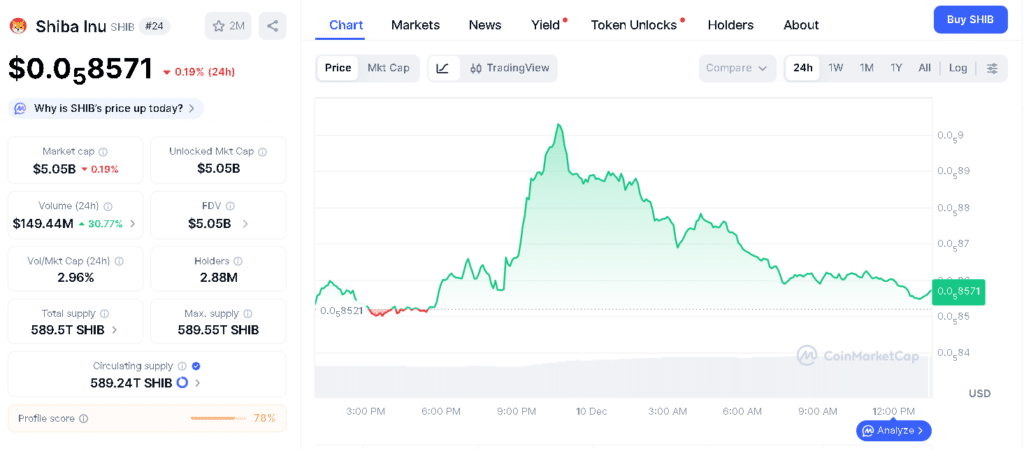
$SHIB is trading around $0.000008553, keeping the market in a cautious wait-and-watch phase. After the breakout, the price moved back to test the top of that pattern, which is a normal step traders watch for confirmation.
Price has reacted several times near $0.00000883, which now acts as the main level for buyers. If this level holds, the breakout remains valid. If it breaks, the setup could fail. Momentum indicators are also improving.
The daily MACD has turned upward, and the histogram is moving away from its flat phase. This shows that buying strength is slowly building, even though the price is still moving in a tight range. In this situation, Shiba Inu whale activity helps signal what direction the market may take next.
How does buy-side CVD confirm accumulation beneath the surface?
It shows that buyers are steadily taking in selling pressure instead of pulling back from the market. The Taker Buy Cumulative Volume Delta has stayed strong across the entire 90-day window, showing that buyers have remained in control through several tests of support.
Each price dip has been met with buying interest instead of sharp sell-offs, helping form a short-term base even during intraday pressure. When this pattern appears alongside rising Shiba Inu whale activity, it often points to the early stages of accumulation rather than the final phase of selling.
This suggests that large traders are slowly building positions instead of rushing to exit. Market observers note that when buy-side demand stays positive while whales remain active, it usually means the market is being strengthened quietly from the ground up.
Does the massive burn-rate surge meaningfully tighten supply?
It helps price react faster in the short term, even though it does not guarantee an upward move by itself. Over the past 24 hours, $SHIB’s burn rate jumped by more than 1,244%, which reduced the number of tokens in circulation.
While burning tokens does not automatically push the price higher, a sharp increase like this can strengthen the impact of existing buying demand. The timing also matters.
The burns are happening alongside strong Shiba Inu whale activity and steady buy-side pressure. Together, these factors create a supply-tightening setup. With fewer tokens available during a bullish structure, price often becomes more responsive to new demand.
The long-term effect still depends on whether the trend continues. However, in the short term, the drop in supply adds extra support to the current consolidation phase.
Why is positive funding changing trader psychology?
It shows that sentiment in the derivatives market has clearly shifted toward a bullish outlook. Funding Rates on CoinGlass have turned positive, which means long traders are willing to pay to keep their positions open. This signals growing confidence.
Earlier hesitation has eased as the OI-Weighted Funding Rate moved higher while $SHIB continued to hold its breakout structure. At the same time, liquidation heatmap clusters have developed near $0.0000084 and $0.00000886.
These price areas often see sharp volatility as traders get forced out of positions during sudden moves. Even though higher funding can increase risk, the current setup shows that both spot and derivatives traders are aligned in their market view rather than acting on short-term speculation.
In this environment, Shiba Inu whale activity is not creating instability. Instead, it is helping confirm that large-scale positioning is moving in the same direction as the broader market trend.
Can these combined signals realistically extend SHIB’s momentum?
Yes, but only if the retest zone continues to hold. $SHIB is currently supported by a strong mix of technical and on-chain signals.
The successful wedge breakout, steady buy-side CVD, 1.06 trillion SHIB in exchange inflows, a sharp 1,244% jump in the burn rate, and positive funding together create one of the strongest setups the token has seen in recent weeks.
This does not mean a price rise is guaranteed. It simply means that an upward move is now possible as long as buyers continue to defend the breakout retest area. In this phase, Shiba Inu whale activity is helping guide market direction while also boosting confidence among traders.
Conclusion
Shiba Inu whale activity is shaping a market that is stabilizing with intent rather than hesitation. The latest on-chain metrics suggest that the market is finding its footing under steady pressure from large traders instead of breaking down beneath it.
The strong wave of Shiba Inu whale activity, marked by 406 large whale transfers, combined with consistent buy-side absorption and tightening supply, points to growing structural strength within this trading zone. For now, momentum remains conditional.
As long as buyers continue to defend the retest boundary, the possibility of continuation stays open. If that support gives way, expectations could shift just as quickly. Until clear confirmation arrives, $SHIB remains caught between consolidation and expansion, closely watched by traders, analysts, and whales alike.
Glossary
Breakout Retest: When the price goes above the resistance and comes back to check it as support.
Burn Rate: The speed at which tokens are removed from circulation, reducing supply.
Positive Funding Rate: When long traders pay shorts, it shows bullish market sentiment.
Accumulation: Steady buying of a coin by large holders without big price moves.
Taker Buy CVD: A measure of how buyers absorb selling pressure over time.
Frequently Asked Questions About Shiba Inu Whale Activity
Why did Shiba Inu whale activity surge recently?
It surged because 406 transfers of over $100,000 each happened, showing big holders are moving their SHIB.
How much SHIB moved to exchanges recently?
Over 1.06 trillion SHIB was sent to exchanges during this wave of whale activity.
Why is $0.00000883 an important level?
This level is the main support for buyers, and holding it keeps the recent breakout valid.
How does the burn rate affect SHIB supply?
A 1,244% increase in burn rate reduces SHIB supply, which can help price if demand stays strong.
Is SHIB likely to move higher soon?
If buyers defend the support at $0.00000883, SHIB may rise, but breaking it could reverse the trend.
Sources