






This article was first published on The Bit Journal.
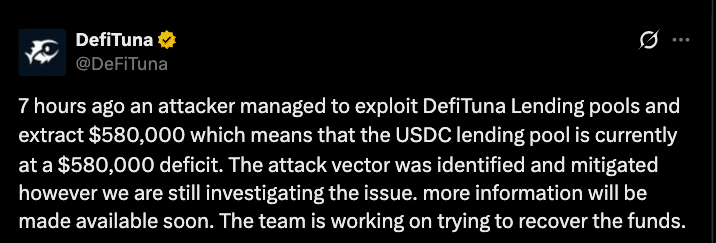
A DeFiTuna exploit struck the Solana-based leverage protocol on July 16 removing approximately $580,000 from its lending infrastructure. By crypto standards in 2026, that number barely qualifies as headline material.
The missing money is not even causing much ruckus compared to where the funds came from.
According to the protocol, the attacker exploited a flaw in its lending pools, creating a $580,000 deficit in DeFiTuna’s USDC pool. The team said the attack vector has been identified and patched, investigations remain ongoing, and recovery efforts are underway.
What has not been clarified is whether users will be repaid if those recovery efforts fail.
What The USDC Deficit Actually Means For Users
Crypto protocols frequently announce that funds were “lost” or “drained.” A deficit is more specific. In DeFiTuna exploit case, the liabilities owed to USDC depositors are now larger than the assets remaining inside the pool.
The missing $580,000 was not taken from a company treasury account or reserve fund. It came from liquidity supplied by users who deposited USDC expecting to earn yield through lending activity. This creates bad debt.
As long as withdrawal requests remain manageable, the system can continue operating normally. Problems come up if depositors rush to remove funds simultaneously because somebody eventually reaches an empty pool.
In traditional finance terms, this is called a bank run.
The unanswered question is if DeFiTuna intends to absorb the shortfall using treasury funds, insurance reserves, future revenue or external financing.
So far, the protocol has committed only to recovering the stolen assets. It has not committed to covering user losses if recovery efforts fail.
DeFiTuna’s Design Makes Efficiency And Complexity Intersect
DeFiTuna built its reputation by combining multiple services that many protocols prefer to separate.
The platform offers concentrated liquidity provisioning similar to Uniswap v3, lending markets, leveraged trading positions and borrowing functionality within a single ecosystem. Users can take long, short or delta-neutral positions with leverage reaching five times collateral value while lenders supply capital to support those strategies.
The model improves capital efficiency. It also increases technical complexity.
An attacker does not necessarily need to compromise the lending engine or automated market maker independently. Exploits often happen where multiple systems interact and calculate asset values differently.
DeFiTuna has not yet released a post-mortem or technical explanation of the vulnerability, leaving security researchers unable to determine whether pricing logic, collateral accounting or leverage calculations were involved.
Until that report arrives, speculation serves little purpose. Users however need transparency.
The Solana Ecosystem Is Facing A Security Credibility Problem
The year itself has been uncomfortable for decentralized finance security.
According to DefiLlama, more than 140 exploits have already been recorded across DeFi in 2026, with losses exceeding $1 billion globally. Q2 alone became the most hacked quarter ever documented by the platform with 99 separate incidents.
CertiK’s latest Hack3D report estimates more than $1.31 billion in losses across 344 incidents during the first half of the year.
The Solana network was still recovering from the approximately $285 million Drift Protocol exploit earlier this year, while other projects across the ecosystem faced treasury breaches and protocol failures.
The DeFiTuna exploit incident is considerably smaller, but smaller hacks often reveal more about accountability because the financial stakes are low enough for protocols to make users whole if they choose to do so.
History suggests that recovery rates across DeFi exploits remain poor and reputational damage often exceeds the value stolen. DefiLlama research found that most hacked protocols retain less than 10% of their pre-hack TVL within thirty days of an incident regardless of the amount lost.

The Next Few Days Matter More Than The Attack Itself
The exploit itself is largely over but the response phase has only begun.
Users still do not know:
- whether depositors will be reimbursed;
- whether an insurance mechanism exists;
- whether treasury capital will cover the deficit;
- whether the attacker can be identified;
- whether third-party security firms have validated the findings;
- whether additional vulnerabilities remain undiscovered.
Those answers will determine whether DeFiTuna survives the incident or joins the growing list of protocols that never recovered user confidence after an exploit.
Conclusion
The DeFiTuna exploit is unlikely to threaten Solana’s overall DeFi ecosystem or destabilize the network’s liquidity position. A $580,000 loss is manageable in a market that secures billions in assets. The larger issue is accountability.
If protocols distribute revenue to token holders during profitable periods, users naturally expect losses to be absorbed somewhere other than customer deposits when things go wrong.
DeFiTuna’s response over the coming days may ultimately matter more than the exploit itself.
Glossary
DeFiTuna: A Solana-based protocol offering leveraged liquidity provision, lending and trading products.
USDC: A dollar-pegged stablecoin issued by Circle and widely used across decentralized finance applications.
Bad Debt: Liabilities that exceed the assets available to satisfy them within a lending protocol.
TVL (Total Value Locked): The total value of assets deposited inside a decentralized finance protocol.
Concentrated Liquidity: A liquidity model that allows providers to allocate capital within selected price ranges for higher efficiency.
Frequently Asked Questions About DeFiTuna Exploit
Was The DeFiTuna Exploit Fixed?
The protocol says it identified and mitigated the attack vector shortly after discovering the exploit and investigations are ongoing.
Did The Attacker Steal Treasury Funds?
No. According to the protocol disclosure, the deficit affected the USDC lending pool funded by depositors.
Will Users Get Their Money Back?
DeFiTuna has not yet announced a reimbursement plan if recovery efforts fail.
How Large Was The Exploit?
The attacker extracted approximately $580,000, creating an equivalent shortfall in the USDC pool.
Does This DeFiTuna exploit Threaten Solana DeFi?
The exploit is too small to create systemic risk for Solana, but it adds to growing concerns around application-layer security across the ecosystem.
References