





This article was first published on The Bit Journal.
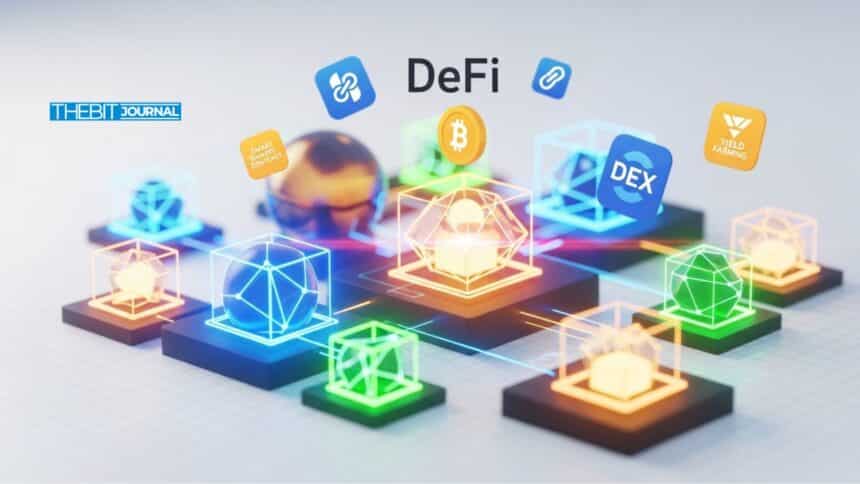
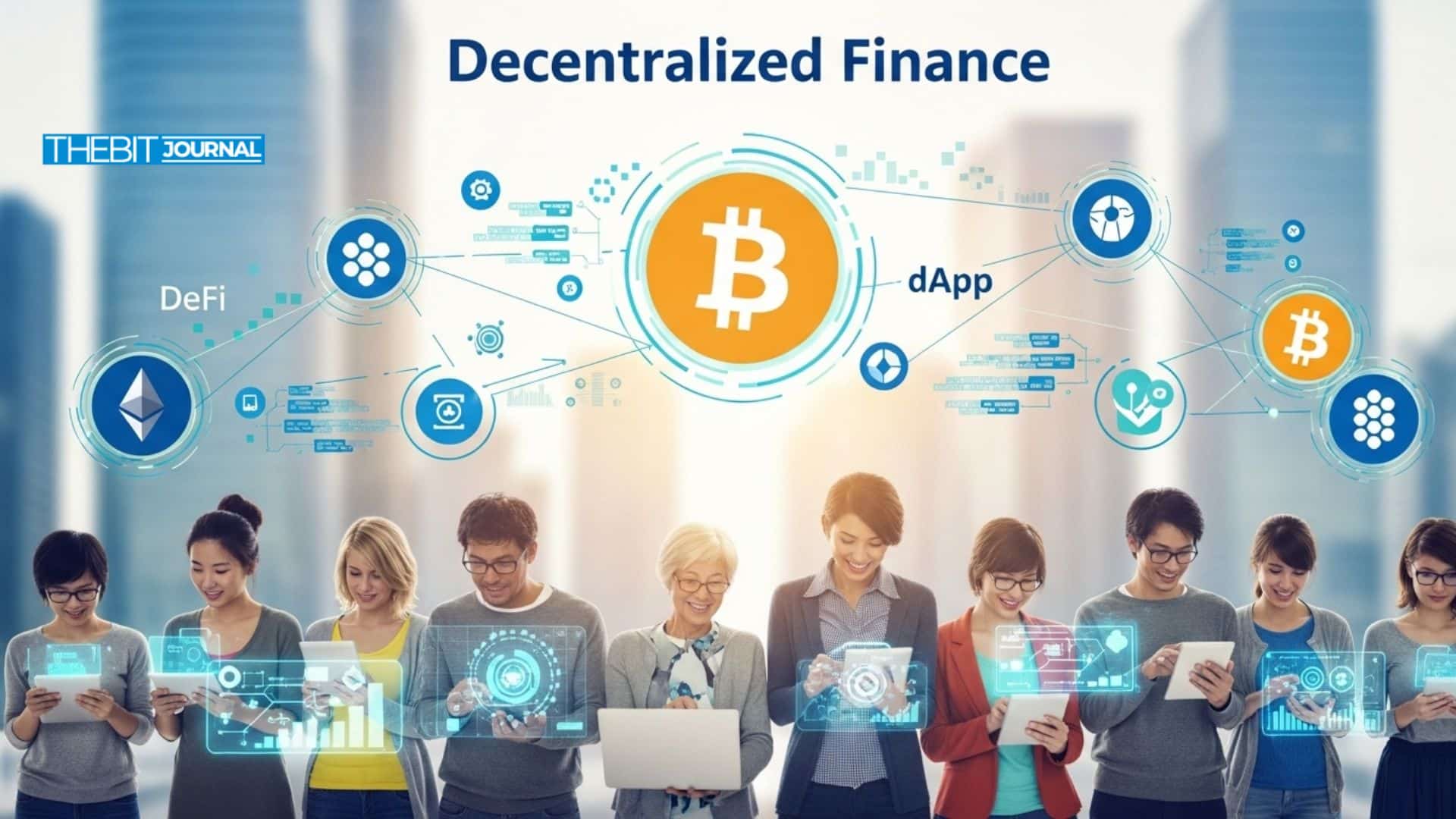
DeFi (decentralized finance) is a blockchain-based ecosystem of financial apps (dApps) that allows individuals to transact directly without needing banks or brokers as intermediaries. It employs smart contracts to automate services such as lending, trading or insurance; allowing a peer-to-peer finance system worldwide.
DeFi is changing the way that financial services are offered. By utilizing blockchain and peer-to-peer technology to eliminate intermediaries, decentralized finance differs from conventional banking.
DeFi vs Traditional Finance: The Core Difference
The main difference between decentralized finance (DeFi) and traditional finance (TradFi); is the removal of intermediaries. DeFi is simply defined as a peer-to-peer system that eliminates third parties and centralized institutions from financial transactions.
In TradFi; custodians of assets are banks; brokerages and clearinghouses that enforce rules and process payments. In DeFi; this is all done via smart contracts on a blockchain so rather than having to interact with a company you will interact with code.
DeFi users can hold their own private keys and transact directly through dApps while in TradFi; it’s the customers who rely on banks to custody funds. Some important differences are captured in the table below:
| Feature | Traditional Finance | Decentralized Finance (DeFi) |
| Custody | Assets held by banks or brokerages | Users hold keys; assets in smart contracts |
| Intermediaries | Banks; brokers; payment processors | None; transactions are peer-to-peer via code |
| Accessibility | Limited by bank hours; borders | 24/7 global access via internet and smartphones |
| Transparency | Private ledgers; regulated | Public, verifiable blockchain records |
| Collateral | Fiat currency (USD; EU;, etc.) | Crypto assets (ETH, stablecoins, tokenized assets) |
| Yield Source | Bank interest; dividends, credit markets | Trading fees; protocol rewards (e.g. yield farming) |
Traditional finance relies on trust in centralized authorities and legacy infrastructure. Decentralized finance; on the other hand, utilizes smart contracts to automate and enforce financial agreements; which may reduce fees and enhance accessibility.
DeFi lending protocols, for example; enable anyone to lend or borrow crypto without credit checks or bank approvals.
How Smart Contracts Power the Entire DeFi Ecosystem
Smart contracts are the engines of decentralized finance. A Smart contract is a program on a blockchain that uses code to automatically carry out the terms of an agreement.
It can be likened to a vending machine; once the required input is provided, the contract executes the programmed outcome.
Smart contracts replace banks and intermediaries in DeFi. For instance, a DeFi lending platform uses smart contracts to lock collateral and track interest accrual. When you deposit crypto to earn yield; the smart contract securely locks your funds away and disburses interest automatically according to code.
When you borrow crypto; a smart contract enforces collateral and liquidations if required.
In short; smart contracts are self-executing contracts with the terms and conditions directly written into code on the blockchain.
They guarantee that, once deployed, rules can’t be changed by any one party; keeping with DeFi’s stated objective of censorship-resistant finance. This advancement is what allows DeFi to provide fully on-chain loans; exchanges, insurance, and more.
Key DeFi Protocols: Uniswap, Aave, Compound, MakerDAO
A few major protocols; each fulfilling different functions, fundamentally structure the Decentralized Finance ecosystem:
Uniswap (DEX): This is the first AMM-based decentralized exchange. Instead of using order books, Uniswap lets anyone swap tokens around the clock using liquidity pools. Its most recent version, Uniswap V3, added concentrated liquidity, allowing providers to concentrate their capital on price ranges for more efficiency. Uniswap still remains the largest DEX by volume.
Aave (Lending/Borrowing): This is a top lending protocol to which users can deposit crypto in order to earn interest or borrow against the collateral. Aave first introduced flash loans (instant, uncollateralized loans); taking advantage of the atomic capabilities of blockchain transactions to perform arbitrage and other more complex strategies. Aave supports many assets on multiple chains.
Compound (Lending/Borrowing): Compound provides algorithmic interest rates like Aave that adjusts based on supply and demand. In exchange, lenders receive cTokens in return, which accrue interest and can be used elsewhere in Decentralized finance. Compound’s smart contracts are transparent and set loan terms automatically, without the help of an intermediary.
MakerDAO (Stablecoin Issuance): The protocol behind DAI; the largest decentralized stablecoin. MakerDAO allows users to create DAI by locking crypto collateral (i.e.ETH) in smart contracts. The system pegs DAI to $1 through over-collateralization and automatic liquidation if a collateral drops too low. Maker’s governance token (MKR) is used to vote on risk parameters, making DAI truly community-governed and censorship-resistant.
These protocols oversee tens of billions of dollars worth of crypto assets. They represent the essentials of DeFi’s primary services: trading (via Uniswap), earn/borrow (Aave & Compound) and stablecoin issuance (MakerDAO).
Other notable mentions are Curve (stablecoin swaps), PancakeSwap (Binance Smart Chain DEX), and newer ones like EigenLayer (restaking).
Liquidity Pools and How They Generate Yield
Liquidity pool is one of the main DeFi terms. It is simply a smart contract that holds and locks a pair (or group) of tokens users deposit in order to provide liquidity.
For example, an ETH/USDC pool contains ETH and USDC. When you deposit into this pool (making you an LP or liquidity provider), you enable others to trade against it.
Here’s how it operates and makes yields:
The pool is controlled by Automated Market Makers (AMMs). They price trades according to formulas (such as Uniswap’s xy=k*). Traders exchange tokens by interacting with the pool, which helps to maintain price equilibrium.
Liquidity Providers or LPs deposit an equal dollar value of each token into the pool. The LPs do so in exchange for pool tokens that track their share. LPs earn a share of the trading fees, whenever trades happen. For example, Uniswap imposes a swap fee ( e.g. 0.3%) on all swaps and shares it with LPs pro rata
Yield Farming: Several DeFi platforms take it a step further and reward LPs through the distribution of their native governance tokens. This practice known as yield farming or liquidity mining; can boost returns. LPs can receive fees and bonus tokens (like extra UNI or SUSHI) for added liquidity.
For example: an LP might deposit $10,000 of ETH and $10,000 of USDC on Uniswap V3. So if the pool accrues $1,000 of fees over time, LP gets their portion of fees (about $500) and potentially additional compensation in UNI tokens because it was provided. LPs in general earn fees the more volume goes through a pool.
However, liquidity pools can be risky . Still, they are central to DeFi’s model. Anybody can contribute, and in return receive passive income from fees and token incentives. This democratization of the process of market making is a quality of decentralized finance.
What Is TVL (Total Value Locked) and Why It Matters
Total Value Locked (TVL) is one of the main metrics in Decentralized finance, it is defined as how much value in crypto has been deposited by users within a protocol’s smart contracts.
More specifically, it is the total U.S. dollar value of assets staked on a blockchain or decentralized application. So, if a lending platform has $1B in ETH locked, and $500M in stablecoins, they’d have a TVL of $1.5B.
It serves as a gauge of investor interest and usage on the platform. A high TVL usually means that many users have staked their assets there, which is generally a sign of credibility and liquidity. It’s akin to the amount someone has deposited in a bank; it represents how “big” the protocol is.
Trends in TVL also gauge market growth. With TVL peaking around $120 – 140 billion in 2020-2022, DeFi boomed. Despite swings, billions are locked across dozens of platforms. TVL can also be used to compare protocols (Aave vs. Compound, Uniswap vs. Curve, etc.) and spot the next rising star. For example, analytics sites report that Aave and Compound consistently hold tens of billions in TVL, while Uniswap V3 pools house tens of billions more.
In short, TVL is the crypto version of a dashboard. It shows how much value there is at stake in decentralized finance and helps assess a project’s size and stability.
But TVL is just a number, users need to consider other factors alongside it, such as security, liquidity sources and actual usage.
DeFi Risks: Rug Pulls, Smart Contract Exploits, Impermanent Loss
Although innovative; decentralized finance is also highly risky. It is important to know what the most common hazards are:
Smart Contract Exploits: Code bugs or flaws can be attacked. Hackers may drain funds if a contract is vulnerable. For example, in 2025; major exploits (e.g. Hyperliquid, Typus Finance) resulted in millions stolen. Complex DeFi projects often contain vulnerabilities that can be exploited to trigger losses through flash loans, oracle manipulation, or permission misuse; as shown by hack reports. Audits and vigilance are necessary because any deployed code can always be exploited.
Rug Pulls and Exit Scams: Malicious developers could create a new token or pool, then withdraw all liquidity; causing the price to plummet. Rug pulls are schemes in which creators drain liquidity and disappear; resulting in investor losses. This risk is illustrated in notorious cases like the 2021 AnubisDAO scam which saw almost $60M lost. To avoid this, beginners should use well-governed, verified platforms and be wary of yields that sound too good to be true.
Impermanent Loss: This is a risk for the liquidity providers. If you’ve deposited two tokens in a pool, and their respective market prices diverge significantly, one may end up with less value than just holding the two tokens separately. So; say for example ETH’s price doubles with respect to USDC whilst you are in an ETH/USDC pool; you’ll emerge with more USDC and less ETH. So the difference compared to simply holding, is the impermanent loss. According to empirical studies, impermanent loss is a distinct risk that could lower LP returns.
Other Risks: High volatility in crypto can downgrade or lead to liquidations on lending platforms if collateral falls. DeFi platforms could be subject to regulatory crackdowns. And because users have custody of their own funds; things like losing private keys or sending the wrong address are irrevocable.
While they offer high yields and innovation; users should still exercise caution. The technology is still maturing. Older protocols with meaningful TVL like Uniswap, Aave; MakerDAO have more established track records but nothing is hack-proof. Educate yourself; start with a small amount, and only use money you can afford to lose.
DeFi in 2026: Real-World Asset (RWA) Tokenization Trend
In 2026, one of the biggest trends is the tokenization of real-world assets (RWAs) on DeFi. RWAs are physical, or traditional financial assets tokenized on a blockchain. This can mean things like stock, bond, real estate or commodity.
Tokenized RWAs grew from $5billion in 2023 to over $25billion in early 2026 according to reports. That represents a 5× increase since 2023, and the pace is growing.
Why does RWA matter for DeFi? It connects traditional and crypto finance, injecting new capital into decentralized ecosystems. These tokenized equity can trade or be used as collateral in DeFi protocols, increasing both TVL and utility. A tokenized real estate fund could be used as collateral for loans on Aave, or a blockchain bond token could be deposited into a liquidity pool.
Due to regulatory clarity and institutional support, RWAs can become the foundation upon which DeFi’s next phase builds. Analysts predict tens of trillions in RWA tokenization by 2030.
How to Get Started: Step-by-Step for Beginners
Decentralized finance can seem intimidating, but it’s really just a few steps. Here’s a beginner’s guide:
Create a Crypto Wallet: First you need to use a Web3 wallet which is usable in the DeFi like MetaMask; Coinbase Wallet. This wallet will store your crypto keys and connect to dApps. Make sure to back up your seed phrase securely.
Get Some Crypto: To use decentralized finance; you need crypto (ETH, stablecoins, etc.). You can purchase crypto on centralized exchange (Coinbase, Binance etc.) and transfer it to your wallet. For example; connect your exchange account to your wallet or use the address of your wallet when sending funds.
Pick a Network and Gas Token: The bulk of decentralized finance is on Ethereum; but there are also other chains (Avalanche, Polygon, Arbitrum, etc); that host DeFi apps. Decide where to start. You might need ETH (or the chain’s native token) for fees.
Connect with a DeFi App: Access a DeFi platform via your wallet. This can be done through the wallet’s internal browser or by navigating to the site and connecting your wallet address. Common first apps are Uniswap (for trading); Aave or Compound (for interest-earning) or Curve (for stablecoin swaps).
Do a Simple Transaction: Keep it basic. For example; use Uniswap to trade a small amount of ETH in exchange for stablecoin. Approve your wallet when asked (the smart contract must be able to use your tokens). It is always great to double-check the URL and interact only with audited platforms.
Liquidity Providing or Staking: After getting comfortable; you can explore providing liquidity in pools or staking your assets. Deposit equal parts ETH and USDC into a Uniswap pool; thus becoming a liquidity provider (so you earn fees). Or provide an asset for Aave to borrow, and receive interest for doing so.
Learn and iterate: DeFi is huge. Leverage on-chain dashboards (DeFiLlama, Dune) for metric tracking. Be alert to risks. Only approach more advanced techniques such as yield farming or tokenized assets once you’re comfortable with the basic functions.
As Coinbase’s guide notes; users only need some cryptocurrencies and a crypto wallet to use decentralized finance services. It is best to try on testnets, or just small amounts until one gets the feel of it.
Conclusion
DeFi’s most important characteristic is eliminating gatekeepers through smart contracts. Protocols such as Uniswap; Aave; Compound and MakerDAO show how DeFi can recreate exchanges; lending and stablecoins without needing banks.
TVL and liquidity pools show how billions are now locked into these networks; which fuels activity. The space isn’t without risk; from exploits to impermanent loss, but the sector is also innovating protections and accountability.
Trends like real-world asset tokenization indicate that the next version of decentralized finance will see even deeper integration between crypto and traditional markets.
In a nutshell; Decentralized finance is an unstoppable force that provides powerful new tools which supplement (and compete with) conventional systems. As security and regulation continue to make strides, DeFi may very well be a mainstream pillar of global finance in the coming years.
Glossary
DeFi: Financial services (lending, trading, etc.) on blockchain without intermediaries. Users communicate through smart contracts directly.
Smart Contract: A self-executing piece of code running on a blockchain that automatically ensures both parties are abiding with the terms of agreement.
Liquidity Pool: A smart contract that houses user-provided pairs of tokens for trading or lending.
Impermanent Loss: The decrease in an LP’s value compared to holding the tokens themselves due to relative price movements within a liquidity pool.
TVL (Total Value Locked): Total USD value of crypto assets locked inside a DeFi protocols smart contracts. It signals a platform’s size and user trust.
Rug Pull: A type of scam in which developers pull liquidity or funds from the project, causing its token price to crash.
RWA (Real-World asset): Physical or traditional financial assets (stocks, bonds, real estate) that are tokenized on a blockchain.
Frequently Asked Questions About Decentralized Finance
What is decentralized finance (DeFi)?
DeFi is a blockchain-based ecosystem of financial apps (dApps) that allows individuals to transact directly without needing banks or brokers as intermediaries. It employs smart contracts to automate services such as lending, trading or insurance, allowing a peer-to-peer finance system worldwide.
What distinguishes Decentralized finance from traditional finance?
In DeFi, users control their own assets and transact using smart contracts while in traditional finance, assets are held by banks and settled through intermediaries. DeFi operates continuously on public blockchains, providing transparency and international reach. There are no opening hours or borders.
What are Liquidity Pools and how do they earn yield?
A liquidity pool is a smart contract that contains pairs of tokens such as ETH/USDC, these tokens are supplied by users. The pool allows trading, lending when users deposit (provide liquidity). Users receive a portion of the trading fees that are paid on each pair traded in that pool, and sometimes also bonus token rewards (yield farming).
What is TVL (Total Value Locked)?
It is the USD-equivalent value of cryptocurrency held in a DeFi protocol. It indicates the amount of value users have put in or staked there. Higher TVL means generally more user confidence and liquidity in the protocol.
References
Disclaimer: This article is solely for informational purposes and should not be considered investment advice. The DeFi markets are volatile and risky. Disclaimer: Always do your own research before engaging.