







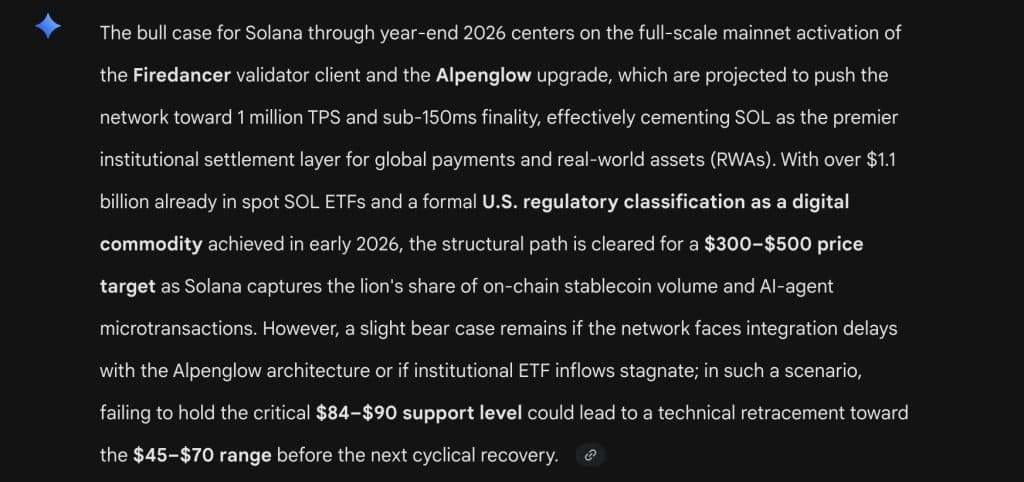
Google’s Gemini AI has predicted that Solana could potentially end up between $300 to $500 by the end of 2026.
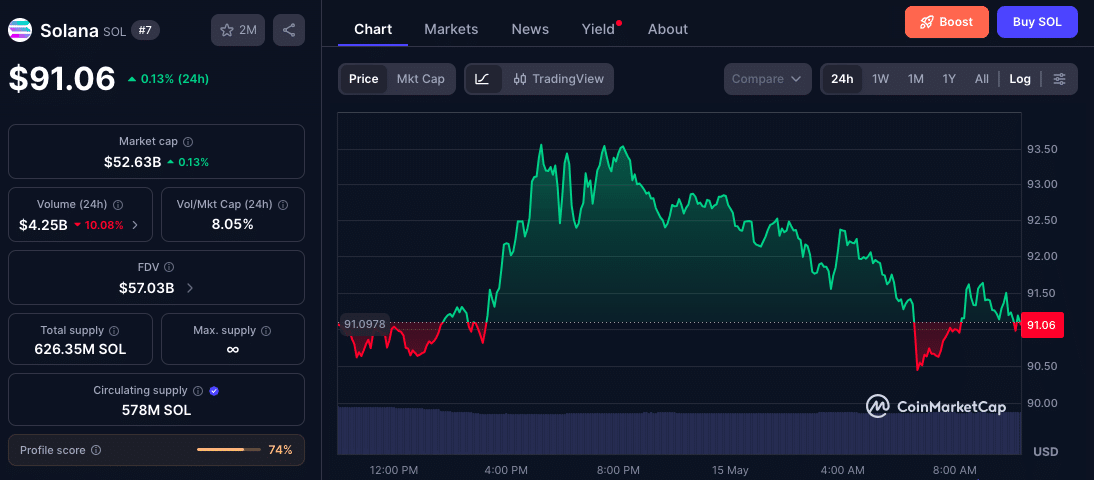
SOL has been trading around the $90 range, rebounding from the brutal correction earlier in the year that saw the token plummet from over $250 down to nearly $70.
Despite the rough ride, analysts and some models are starting to say that Solana’s upgrades are the main reason the asset could regain its footing over the next few months.
The latest Solana price prediction from Gemini AI is closely tied to two major upgrades: Firedancer and Alpenglow. These two upgrades are designed to make Solana’s network faster, more efficient and more stable; areas that have been problems in the past.
Firedancer and Alpenglow Are Behind the Bullish Narrative for Solana
The strongest argument behind the current Solana price prediction revolves around scalability.
Firedancer, which was developed by Jump Crypto, is expected to make Solana’s network a lot faster, by introducing a second validator client that can handle more transactions and reducing the risk of network outages.
Alpenglow, on the other hand, is being designed to cut the time it takes for a transaction to go through from 12 seconds down to 150 milliseconds; a pace that has already been tested in a community trial cluster. News surrounding this is that Alpenglow is already active, ahead of the wider rollout.
This is important because Solana’s whole investment case has changed from being meme coins and retail trading to something more serious. Institutional firms are starting to look at blockchains that can actually handle tokenized assets, stablecoin transfers and real-time settlement.
A lot of analysts now think Solana could be a big beneficiary of this, if the upgrades get rolled out without a hitch.
The regulatory environment has also improved for SOL in 2026. Multiple spot Solana ETF products have attracted fresh inflows this year, while institutional participation continues to rise across the ecosystem.
SOL Price Structure is Getting a Bit Better
Looking at the charts, it is clear that Solana price prediction models have become more optimistic.
SOL spent nearly four months trapped between $75 and $95 after the February collapse. That consolidation phase now appears to be turning into a recovery structure, with higher lows forming consistently since March.
The immediate resistance zone still sits between $95 and $100. Analysts say a clean break above that range could open the door toward $120 and eventually $150; where heavier selling pressure previously emerged during the 2025 distribution phase.
On the downside, if SOL loses that $80 to $84 region, the whole bullish structure gets weakened and could raise concerns again about a deeper retrace to the $45 – $70 zone that has been seen in some bearish models.
Some market observers also point to improving institutional positioning. Reports published this week noted weekly spot SOL ETF inflows of roughly $33 million alongside renewed whale accumulation.
Experts’ Latest Solana Price Prediction for 2026
| Source | 2026 Solana Price Prediction | Key Reasoning |
| Google Gemini AI | $300-$500 | Firedancer, Alpenglow, ETF inflows, institutional settlement use |
| CoinCodex | $87-$132 | Neutral technical structure with moderate upside potential |
| Coinpedia | $75-$200 | ETF demand and scalability upgrades could support recovery |
| Phemex Research | $220+ | Faster transaction finality and institutional adoption |
While forecasts vary widely, most Bullish predictions for Solana depend on one thing which is execution; that the network actually delivers. If Firedancer and Alpenglow come off without a hitch, and ETF money keeps flowing in, then Solana could get back its spot as one of the market’s strongest Layer-1 assets.
Institutional Cash Is Stepping Up the Game
One major difference between Solana’s current recovery and previous rallies is the level of institutional involvement.
Spot SOL ETFs, tokenized asset initiatives, and growing stablecoin activity have started replacing pure speculative demand as the dominant narrative.
Several firms are now considering Solana for their payment infrastructure and settling real-world assets, primarily because it is faster and cheaper than some of its competitors.
Analysts argue that if Solana becomes the preferred place for settling tokenized financial products, the network’s addressable market expands far beyond crypto trading activity.
Still; there’s a lot of risks. Solana is still up against Ethereum, Layer-2 systems and the newer; high-speed blockchains. Network reliability also remains under scrutiny after past outages damaged investor confidence.
Conclusion
The latest Google Gemini AI Solana price prediction is looking more optimistic for the long-term infrastructure than any old short-term speculation.
Firedancer and Alpenglow are major reference points to the bullish predictions, while ETF inflows and growing institutional involvement are keeping sentiment high.
Solana still needs to get back to the $100 mark decisively before traders will start talking about a breakout; but the market structure doesn’t look as bad as it did earlier this year.
Whether Solana hits that $300 to $500 mark is really going to depend on a lot of things: can they get Firedancer and Alpenglow up and running smoothly, will institutions keep on investing, and what happens to the overall crypto market as time goes?
Glossary
Firedancer: A new validator client for Solana designed to improve speed and make the network more reliable.
Alpenglow: A Solana upgrade focused on reducing transaction finality times.
Spot ETF: An exchange-traded fund that directly holds the underlying cryptocurrency.
Transaction Finality: The time required for a blockchain transaction to become irreversible.
Layer-1 Blockchain: The base network that handles the transactions directly.
Frequently Asked Questions About Solana Price Prediction
What’s the latest Solana price prediction for 2026?
Google Gemini AI reckons SOL could be trading between $300 and $500 at the end of 2026 if everything goes right.
Why are Firedancer and Alpenglow important?
They’re both trying to make Solana scale better; faster and become more reliable, which should help attract more institutional investment.
What’s the key resistance level for SOL right now?
Analysts are keeping a close eye on the $95 to $100 zone as the next big place for a breakout.
Can Solana really fall lower in 2026?
Yes, if the support level between $80 and $84 fails; bearish scenarios could send SOL plummeting back to the $45-$70 zone.
References