













This article was first published on The Bit Journal.
Coinbase has officially added Solana to the list of eligible collateral for its crypto-backed loan product placing SOL alongside Bitcoin and Ethereum in one of the exchange’s biggest lending expansions yet.
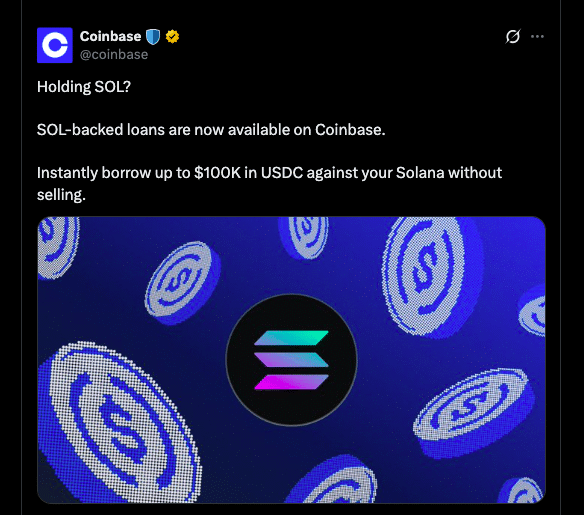
The recently announced Solana loan collateral update lets eligible US users borrow up to $100,000 in USDC against their Solana holdings using Coinbase’s integration of the Morpho protocol on Base.

Solana has been one of the strongest performers among large-cap assets this month, bouncing back sharply from lows in January and is now trading close to the $100 barrier that has held it back for months
Coinbase Expands Utility for SOL Holders
The new Solana loan collateral feature lets users get the much needed liquidity without having to sell their Solana.
The way it works is that users lock up their SOL in on-chain smart contracts powered by Morpho and in return get loans in USDC. Coinbase says there’s no strict repayment deadline though positions face liquidation if loan-to-value ratios rise above allowed thresholds.
For Solana holders, the biggest win here is recognition.
Until recently, Bitcoin and Ethereum were the default go to choice for institutional lenders , because of their liquidity and lower volatility. However, now that Solana has been added to the mix, it’s a clear sign that the network is maturing fast with increased liquidity.
Based on recent reports, Coinbase’s lending business has already surpassed over $2.3 billion in cumulative loan originations
SOL Price Keeps on Building
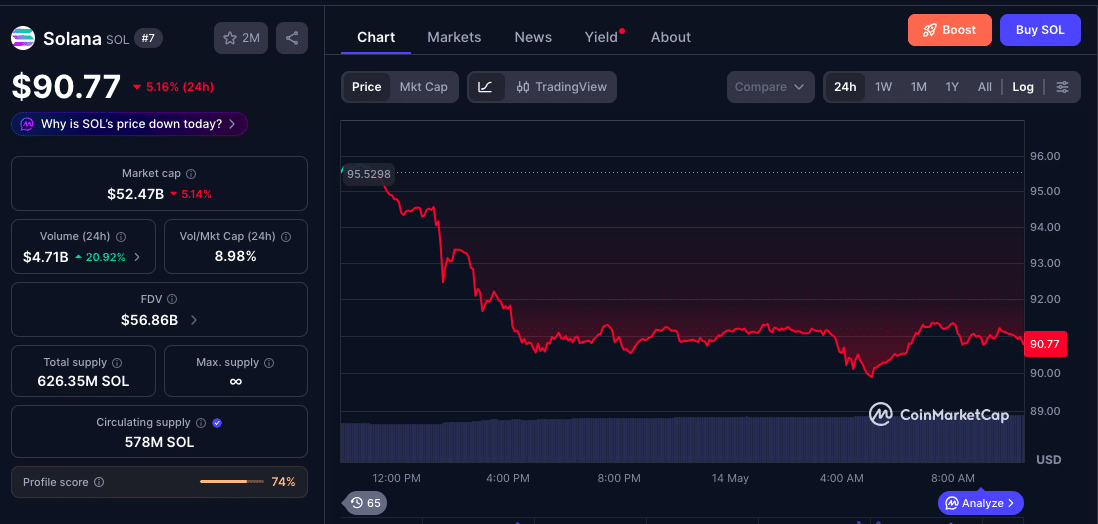
Solana’s price had previously broken past the $92 resistance zone after being stuck below $92 for weeks. This pushed SOL price outlook towards that $98-$100 region that has been holding it back since January. However, due to general market decline over the last 24hrs, SOL has now dropped back to $90.77 as at press time.
Analysts are keeping a close eye on the $94 level as the immediate support. Holding above that level will determine if this price action continues.
If SOL can pick up and stay above $94, the next major resistance zones would be $100; $106 and possibly $110.
The price recovery also looks a lot cleaner than earlier attempts this year. Since hitting a low of $77 back in February, Solana has consistently formed higher lows across March, April, and May.
Why the Coinbase Solana Loan Collateral is Important
The Solana loan collateral update changes the way the market views SOL.
When investors can borrow against their SOL instead of having to sell it, it removes immediate sell pressure from the market. In past cycles, this has benefited Bitcoin and Ethereum during bull runs
The integration also expands Solana’s role within decentralized finance.
Morpho, the protocol at the heart of Coinbase’s lending product, is one of the fastest-growing on-chain credit systems and Coinbase choosing to use it for their lending business will only speed up Base’s growth in the space.
For Solana in particular, this development adds another really useful function on top of payments, trading and all the other functions.
Institutional and retail investors can now: Hold SOL for themselves, take out a loan in stablecoins using SOL as collateral, keep their exposure to the market, avoid triggering taxable sales in certain jurisdictions.
All that flexibility makes SOL a more viable competitor to Ethereum in crypto lending markets.
Risks Still Linger
Despite momentum picking up, Solana still has a lot of risks to deal with.
SOL remains below its longer-term 200-day moving average, meaning the recovery is not fully confirmed yet. Crypto backed loans are also high risk when the market experiences volatility.
Coinbase says that if any loan exceeds liquidation limit, they can automatically trigger collateral sales as well as penalties. To add to this, the DeFi sector is still facing security problems tied to smart contracts and vulnerabilities in the protocols themselves.
So, while the Coinbase integration has definitely improved the utility of SOL, it doesn’t eliminate the market risks tied to leverage and volatility.
Conclusion
The addition of Solana loan collateral on Coinbase is one of the biggest institutional approvals SOL has gotten this year.
By letting users borrow against their SOL holdings through Morpho on Base, Coinbase has basically elevated Solana to the same level as Bitcoin and Ethereum in the exchange’s lending system.
At the same time, SOL’s technicals are looking a lot better with the token closing in on the critical $100 resistance zone.
If momentum holds and the overall crypto market stays stable, Solana might just be entering a phase where utility and institutional adoption start to boost price together.
Glossary
Loan to Value Ratio: The percentage of a loan compared to the value of the collateral being used.
USD: A stablecoin backed by dollars issued by Circle.
Morpho Protocol: The decentralized lending protocol powering Coinbase’s on chain lending services.
Crypto-Backed Loan: A loan where one uses crypto as collateral instead of traditional assets.
Frequently Asked Questions About Solana Loan Collateral
What is Solana loan collateral on Coinbase?
In simple terms, the Solana loan collateral lets eligible users borrow USDC using SOL holdings as collateral through Coinbase’s Morpho integration.
How much can users borrow against SOL?
Eligible users can borrow up to $100,000 in USDC depending on the collateral value and loan to value ratio.
Is Solana now treated like Bitcoin and Ethereum on Coinbase?
SOL has joined the ranks of BTC and ETH as one of the supported collateral assets for crypto-backed loans on Coinbase.
What happens if SOL price drops sharply?
If the loan-to-value ratio reaches liquidation thresholds, collateral can be automatically sold.
References