



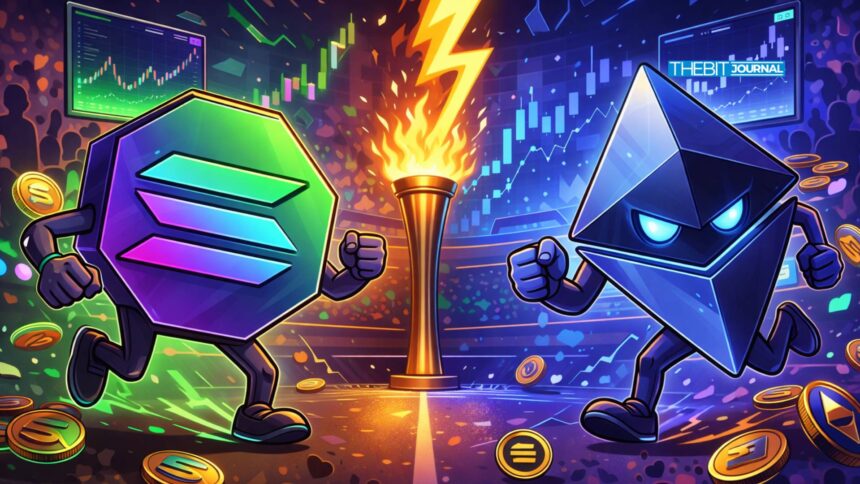

For a market that loves clear winners, perpetual futures data rarely offers neat headlines, but it does leave fingerprints. Solana’s perpetual futures volume narrowly moved ahead of Ethereum’s on one widely tracked market snapshot, with Solana around $1.548B versus Ethereum near $1.523B.
In isolation, that gap is not huge, and nobody serious should treat it like a permanent power shift. Still, it matters because perp volume is where fast money speaks plainly, and it usually shows where traders feel they can get in and out without too much friction. When Solana tops Ethereum on a 24-hour read, it hints at a simple truth: in that moment, leverage traders preferred Solana as the vehicle for short-term risk.
The story gets more interesting when the numbers are placed side by side with the broader tape. Over a 30-day window, Ethereum remains larger in perp activity, with roughly $49.849B to $50.863B compared to Solana around $31.613B to $32.357B, depending on the exact refresh. That longer horizon is the reminder label on the bottle, because it shows Ethereum still hosts deeper and steadier derivatives demand over time, even if Solana wins specific sprints.

Why the flip matters even when the month still favors Ethereum
Perpetual futures volume is not a trophy, it is a temperature check. High volume can mean conviction, but it can also mean churn, hedging, or crowded positioning that is about to unwind. The signal becomes clearer when volume is paired with open interest, because open interest reflects how much money is still sitting in the market after the trades are done.
On the same derivatives dashboard that tracks perps by chain, Solana’s 24-hour open interest was shown above Ethereum’s at the time of capture, roughly $360.81M versus $279.84M. That does not mean Solana has a bigger derivatives market overall, but it does suggest that the Solana trade, at least in that window, had more positions staying open rather than just passing through.
That is the kind of mix that can lead to sharp follow-through, or sharp pain, depending on which side gets trapped first. It also explains why traders keep circling a familiar technical area around $144, because a market loaded with leverage tends to respect obvious levels until it suddenly does not.

The $144 zone: not magic, just crowded
The price area near $144 has been repeatedly framed as a decision point in recent Solana market commentary, not because it is mystical, but because it is where sellers and cautious profit-takers have shown up before. One market note from late 2025, for example, highlighted a breakout above about $144.65 as a level that could open a path toward higher resistance zones, while failure to clear it keeps the door open for a pullback into nearby support ranges.
When derivatives activity surges while price compresses under a widely watched level, traders usually read it one of two ways. Either the market is coiling for a clean breakout, or it is building a springboard for liquidations if price flicks the wrong direction and forces leveraged positions to unwind.
The indicators that actually matter here: volume, open interest, liquidations, and funding
To understand whether this is a healthy rotation or a shaky leverage pile, the key indicators are straightforward, and they are the same ones professionals watch across every liquid market.
First comes the relationship between futures volume and open interest. A major derivatives analytics page showed Solana futures volume around $20.93B over 24 hours with open interest around $8.75B, and it also tracked roughly $32.86M in Solana futures liquidations over that same period. That combination suggests active leverage, plus enough forced exits to prove that positioning is not perfectly balanced.
Second comes funding. Perpetual contracts use funding payments to anchor prices to the spot market, and when funding becomes persistently positive, it often signals that longs are paying up to stay in, which can work until it becomes too popular. When funding turns sharply negative, it can reflect fear, hedging pressure, or aggressive short demand. The exact funding number changes quickly across venues, but the point remains constant: a market with elevated open interest and emotional funding is more fragile than it looks.
Third comes liquidations. Liquidations are not just drama, they are market structure events, because they create forced buying or forced selling that can push price into thin zones. The presence of meaningful 24-hour liquidations alongside rising activity tells traders that leverage is already being tested, not just added.

Finally comes context. If Solana is seeing high derivatives engagement while its on-chain activity remains strong, that can support a thesis that the market is not purely speculation. A chain metrics dashboard showed Solana with notable 24-hour decentralized exchange volume around $4.693B, plus high counts of transactions and active addresses in the same window, which points to heavy usage alongside the trading narrative.
Ethereum, meanwhile, continues to post deep stablecoin mass and steady activity across apps, while also registering meaningful perp and spot ecosystem flows. On the same style of chain dashboard, Ethereum’s stablecoin market cap was shown around $163.59B, which is a reminder that its liquidity base still dwarfs most networks even when daily trading attention drifts elsewhere.
What the “$190 move” idea is really saying
The phrase “$190 move” is less a promise and more a way traders summarize the next obvious upside checkpoint if the $144 ceiling breaks cleanly and momentum feeds on itself. Markets often travel between liquid zones, and round-number targets like $190 become popular because they are easy to anchor to, not because they are guaranteed.
There is also a pragmatic reason traders talk this way. If leverage is building and the market clears a crowded level, short sellers can be forced to buy back positions, late longs can pile in, and market makers can widen spreads as volatility picks up. In that kind of tape, price can travel farther than fundamentals justify in the short run, and then it can correct just as quickly once the squeeze energy fades.
That is why the same indicators that look bullish at first glance can also be warning signs. Rising open interest is supportive until it becomes overcrowded, rising volume is constructive until it becomes frantic, and strong spot participation is helpful until it gets replaced by purely leveraged churn.
What to watch next, without the hype
If Solana continues to lead Ethereum on 24-hour perp volume while open interest remains elevated, traders will watch for confirmation that the move is not just a one-day rotation. That confirmation usually looks like sustained volume on breakouts, funding that stays reasonable rather than euphoric, and liquidations that do not cascade into disorder.
If the market fails to clear resistance and funding remains aggressive, the more likely path is a sweep lower that flushes leverage, followed by a calmer attempt higher later. In plain terms, leverage can push a market upward, but it also makes the floor slippery when sentiment changes.
Either way, the broader takeaway is not that Solana has “beaten” Ethereum. The takeaway is that Solana is currently the chain where traders are most willing to express short-term risk in size, while Ethereum remains the deeper long-horizon derivatives and liquidity venue. The tape can support both truths at once.
Conclusion
Solana edging Ethereum in 24-hour perpetual futures volume is a small numerical flip with an outsized narrative effect, because it reveals where leveraged traders are placing their attention right now. The more important story sits under the headline: open interest is elevated, liquidations are active, and funding dynamics can turn quickly, which means the next move will likely be sharp and emotionally loud on both sides.
With $144 acting as a crowded line in the sand, the path toward $190 is plausible only if the breakout is supported by healthy participation rather than a fragile leverage stack, and the data will show which it is long before social media does.
Frequently Asked Questions
What does it mean when Solana “flips” Ethereum in perps volume?
It means that, over a specific time window like 24 hours, more perpetual futures trading volume was recorded on Solana markets than on Ethereum markets. It is a snapshot of trader activity, not a permanent ranking, and it can change quickly as volatility shifts.
Is higher perp volume bullish for SOL price?
Higher perp volume can be bullish if it comes with healthy spot participation and controlled funding, because it suggests demand rather than desperation. It can be bearish if it reflects overcrowded leverage that is vulnerable to liquidations, especially near major resistance levels.
Why does open interest matter more than volume alone?
Volume measures how much trading happened, while open interest measures how much risk remains in open positions. When open interest rises alongside strong volume, it suggests traders are building positions and staying in the market, which can amplify both rallies and sell-offs.
What role do liquidations play in big price swings?
Liquidations are forced position closures that create automatic buying or selling. In leveraged markets, liquidation cascades can accelerate moves, turning a normal dip into a fast flush, or a breakout into a squeeze that overshoots.
Glossary of Key Terms
Perpetual futures (perps): A type of futures contract with no expiry date, commonly used in crypto for leveraged trading, and kept near spot price through funding payments.
Perps volume: The total value of perpetual futures traded over a given period, often used as a proxy for speculative activity and trader attention.
Open interest: The total value of outstanding derivatives positions that remain open, used to gauge how much leverage is currently sitting in the market.
Funding rate: A periodic payment between longs and shorts in perpetual futures that helps keep perp prices aligned with spot prices, and often reflects market positioning.
Liquidations: Forced closures of leveraged positions when margin requirements are not met, often accelerating price moves during volatility.
References