






Standard Chartered is leaning back into Ethereum, arguing that the next cycle will reward networks that settle real financial flow, not just narratives. In a digital assets note dated January 12, 2026, the bank’s Geoffrey Kendrick described 2026 as “the year of Ethereum,” saying Ether is set up to outperform Bitcoin as stablecoins, tokenized assets, and decentralized finance keep expanding.
The bank updated its target path at the same time. It lowered its end-2026 target for Ether to $7,500 from $12,000, while laying out a longer trajectory of $15,000 for end-2027, $22,000 for end-2028, $30,000 for end-2029, and $40,000 for end-2030. The bank’s Ethereum price forecast is, in effect, a timing reset that still keeps the long-term adoption thesis intact.
Ethereum price forecast: what the bank is really buying
The thesis is not that Bitcoin loses its place as the market’s anchor. It is that Ethereum can gain share because a growing chunk of crypto’s everyday utility runs through Ethereum-based rails. Standard Chartered highlighted Ethereum’s leading position in stablecoins, tokenized real-world assets, and DeFi, arguing that these sectors can drive sustained demand for block space and fees and, over time, improve Ethereum’s standing versus Bitcoin.
Stablecoins and tokenization: the demand side of Ether
The bank argued that a large share of stablecoins and tokenized assets already settle on Ethereum and that the share can grow as institutions keep testing on-chain issuance and settlement. It also tied that story to activity, citing stablecoin usage as a major driver of transactions and placing stablecoin activity at roughly 35% to 40% of Ethereum transactions.

When traffic looks like payments and settlement, the Ethereum price forecast becomes less about mood swings and more about repeat usage that can be measured.
Fusaka and the capacity question
Ethereum’s Fusaka upgrade was scheduled for mainnet activation on December 3, 2025, and several research briefs described it as a step toward higher efficiency and throughput. Standard Chartered’s logic is pragmatic: more capacity makes it easier for apps, stablecoins, and tokenized products to stay on Ethereum instead of routing elsewhere, which becomes an input into any Ethereum price forecast that claims to be grounded in fundamentals.
The “walkaway test” and why resilience is part of the pitch
Vitalik Buterin echoed the infrastructure theme on January 12, 2026, saying Ethereum should pass a “walkaway test,” meaning it should remain secure and useful even if core development slowed sharply, with attention to long-term security and future risks such as quantum resistance.
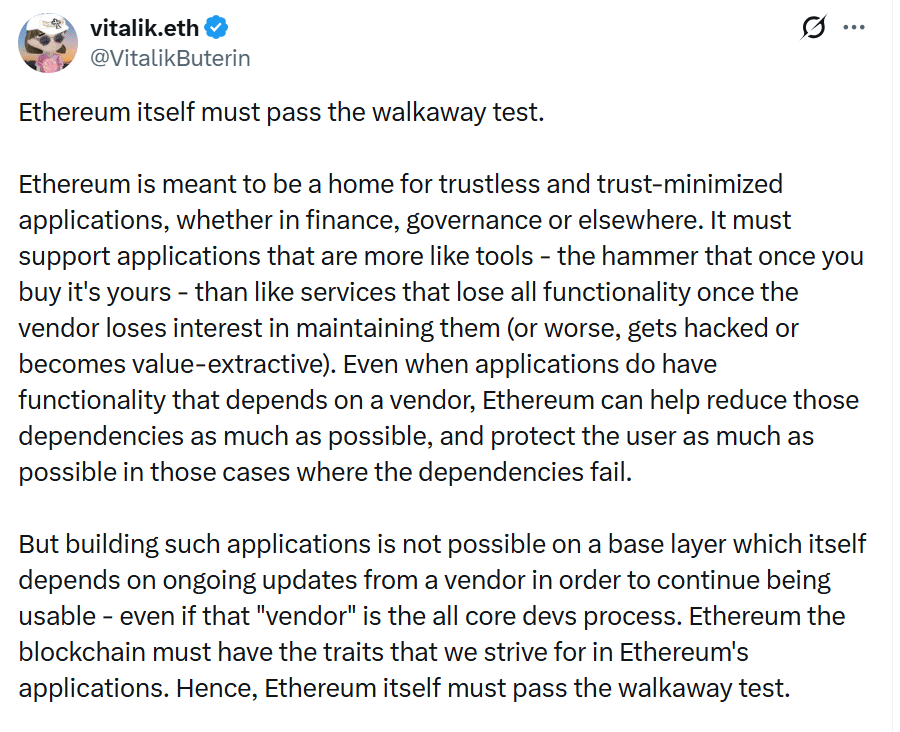
That framing is not about headlines. It is about whether the network can keep settling value like public infrastructure, which is the kind of durability institutions want to see behind a long-range Ethereum price forecast.
Regulation and the CLARITY Act angle
Standard Chartered also pointed to regulatory clarity as a possible tailwind. The Digital Asset Market Clarity Act of 2025, also referred to as the CLARITY Act, lays out definitions and a proposed framework for parts of the digital asset market, and its text and versions are published by Congress.
The bank’s view is that clearer rules can reduce institutional hesitation and lower the compliance uncertainty premium that has kept some large allocators cautious. In that setup, an Ethereum price forecast is not only about adoption, it is also about risk being priced more cleanly.
Conclusion
Standard Chartered’s updated Ethereum price forecast is best read as a bet that crypto’s next expansion looks like finance migrating on-chain, not just traders chasing momentum. The bank cut the end-2026 target to $7,500, but it kept the long-term arc steep because it expects stablecoins, tokenization, and DeFi to deepen Ethereum’s settlement advantage over the years ahead.
Around the time the note was discussed publicly, Ether was trading near $3,118 with a market capitalization around $376 billion, a reminder that the bank is projecting a large move in a market that still swings hard.
Frequently Asked Questions
What is Standard Chartered’s updated Ethereum price forecast?
The bank listed $7,500 for end-2026, $15,000 for end-2027, $22,000 for end-2028, $30,000 for end-2029, and $40,000 for end-2030.
Why does the bank think Ethereum can outperform Bitcoin?
The note points to Ethereum’s role in stablecoins, tokenized assets, and DeFi, suggesting these areas can keep demand for block space and fees rising over time.
What does the CLARITY Act change for the market conversation?
It is a U.S. market structure proposal with public text on the official congressional site, and the bank suggested clearer rules could support broader institutional participation over time.
Glossary of key terms
Ethereum price forecast: A forward-looking estimate for Ether’s price over a defined period, based on adoption assumptions and network fundamentals.
Stablecoin: A crypto asset designed to track a reference value, usually the U.S. dollar, used for payments and settlement.
Tokenized asset: A blockchain-based representation of an off-chain asset or traditional financial instrument.
DeFi: Decentralized finance, blockchain applications that provide services such as lending and trading without traditional intermediaries.
References