







Mysten Labs confirmed plans to make stablecoin transfers private by default on the network.
The update, which was revealed by Adeniyi Abiodun, one of the co-founders of Mysten Labs, is meant to tackle one of blockchain’s biggest headaches for enterprise users: the fact that public transaction histories are fully public.
Under the upcoming Sui Stablecoin Privacy system, only the sender and the receiver will get to see the details of a transfer. Regulators and approved issuers, on the other hand, can still see what’s going on as and when they need to, creating what Mysten Labs describes as compliance-friendly privacy.
Sui Wants Privacy Without Losing Compliance
With most public blockchains, one can see balances, transaction history and wallet activity permanently on-chain.
But, according to Mysten Labs, this is a major barrier to mainstream adoption. Abiodun reckons that companies wanting to issue tokenized bonds, stocks, and real assets need more control over what is visible than just a fully transparent ledger.
The Sui stablecoin privacy system tries to find a balance to both sides.

Rather than making transactions completely anonymous , the network plans to limit visibility to approved regulators, issuers, senders, and receivers.
Institutions are getting increasingly keen on blockchain efficiency without exposing every detail of their operations.
Traditional financial systems do not allow competitors to monitor treasury balances or payment flows in real time but public blockchain infrastructure does just that.
Sui is trying to take away that hurdle at the protocol level.
Based on reports, the feature is being tested already and will later be rolled out to stocks, bonds, tokenized assets, and other crypto transfers, according to Mysten Labs.
Zero-Fee Stablecoin Transfers Add Another Layer
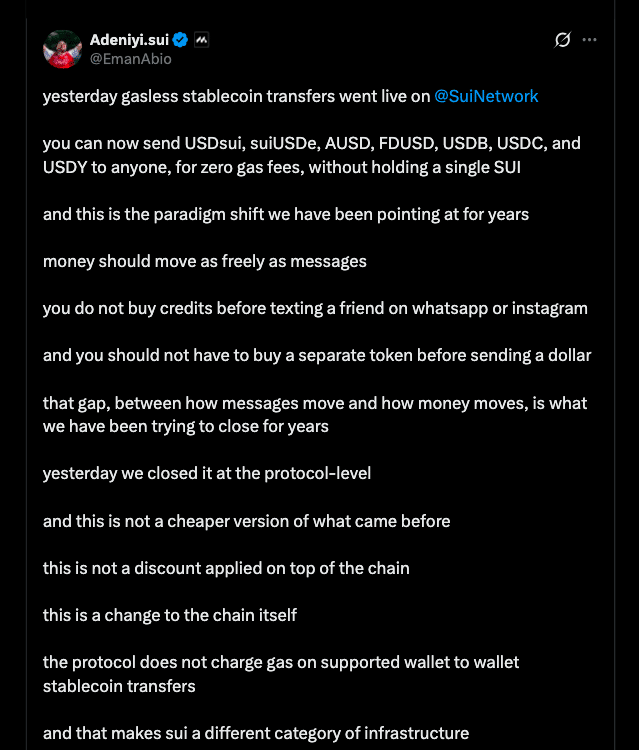
Sui Stablecoin privacy isn’t the only plan on the agenda for Sui. Last week, Sui introduced gassless stablecoin transfers, which lets users send stablecoins without having to pay SUI transaction fees.
The system removes one of crypto payments’ biggest usability problems which involves requiring users to maintain separate gas-token balances before making transfers. Supported stablecoin payments can now be processed with zero fees.
Based on reports, Fireblocks is already supporting the infrastructure for treasury operations, payroll systems, settlements, and institutional transfers.
At Consensus this year, Abiodun revealed that Sui had processed over $1 trillion in stablecoin volume since August 2025.
Mysten Labs people have often said that Sui is drawing inspiration from the likes of Meta’s Libra and Diem payment initiatives, where several company founders used to work.
Institutions Are Watching the Privacy Rollout Closely
Institutional blockchain adoption is happening fast in tokenized finance but the privacy concerns are holding so many back.
Banks, payment providers and asset managers often steer clear of public settlement systems because they worry about being watched by their competitors. Sui stablecoin privacy directly addresses that issue.
The Network’s selective visibility structure is a plus for new tokenized asset issuance strategies or enterprise payment systems and institutional settlements compared to fully transparent systems
The market reacted quickly to earlier Sui stablecoin privacy announcements. SUI shot up by over 20% earlier this month, when Mysten Labs first teased about the idea of confidential transactions and no-fee stablecoin transfers.
Analysts have pointed out that since privacy infrastructure is rapidly becoming a competitive advantage for Layer-1 networks especially as tokenized finance starts taking off around the world; projects are starting to include it right into the core of the blockchain architecture.
Sui’s Bigger Goal Goes Beyond Stablecoins
The Sui stablecoin privacy rollout looks to be the first phase of what Mysten Labs is planning. Abiodun confirmed that future versions of the system will also support stocks, bonds, tokenized real-world assets and other crypto assets beyond just stablecoins.
The company is in effect building three things all at once: private transactions, zero-fee payments and institutional settlement infrastructure.
Competition from Ethereum Layer-2 ecosystems, Solana, Avalanche, and other institutional blockchain platforms is still intense.
But Sui’s privacy-first payment strategy does stand out more clearly now.
Conclusion
If the rollout succeeds, Sui stablecoin privacy could end up being one of the network’s most important feature for institutional users.
By combining private-by-default transactions with zero-fee transfers and some level of controlled visibility, Mysten Labs is going after a major problem that has held back enterprise blockchain adoption for ages.
The feature is already being tested and later on will expand into tokenized assets and other crypto markets.
As institutions start demanding blockchain infrastructure that strikes the right balance between regulation and privacy, Sui is putting itself right in the middle of that whole opportunity.
Glossary
Stablecoin: A cryptocurrency that is pegged to stable assets like the US dollar.
Mysten Labs: The company behind the Sui blockchain network.
Tokenized Assets: Traditional assets that are represented digitally on blockchain networks.
Gas Fees: Blockchain transaction processing fees.
Frequently Asked Questions About Sui Stablecoin Privacy
What is Sui stablecoin privacy?
It is Sui’s new feature that’s going to make stablecoin transfers private as a default while still keeping the visibility controls tight and regulated.
Will Sui stablecoin transfers stay free?
Yes. Sui launched zero-fee stablecoin transfers for supported assets recently.
Why are institutions interested in blockchain privacy?
Institutions want to be able to have confidential settlements without having to expose balances and treasury activities publicly.
Which assets will get privacy support later on?
Mysten Labs is planning to expand the support for privacy to stocks, bonds, tokenized assets and other crypto transfers down the line.
References