













Last updated on 3rd Feburary, 2026
Bitcoin’s bounce back above $75,000 has grabbed attention everywhere. After a sharp 12% slide that dragged BTC toward key support areas, the speed of the recovery caught plenty of seasoned watchers off guard. Now, with Bitcoin trading around $75,710.32, the big question is pretty simple: was this just a reflex bounce after an overdone dip, or the early signs of something more durable?
The whiplash from fear to relief is a familiar part of the crypto playbook. Bitcoin’s cycles still tend to rhyme, especially when volatility is high and confidence is thin. Traders are watching charts tick by tick, while conversations keep circling the same pressure points: shallow liquidity in certain venues, the odd way weekend order books behave, and the role short liquidations can play in pushing price higher faster than fundamentals alone might justify.
Market snapshot: price and key trading signals
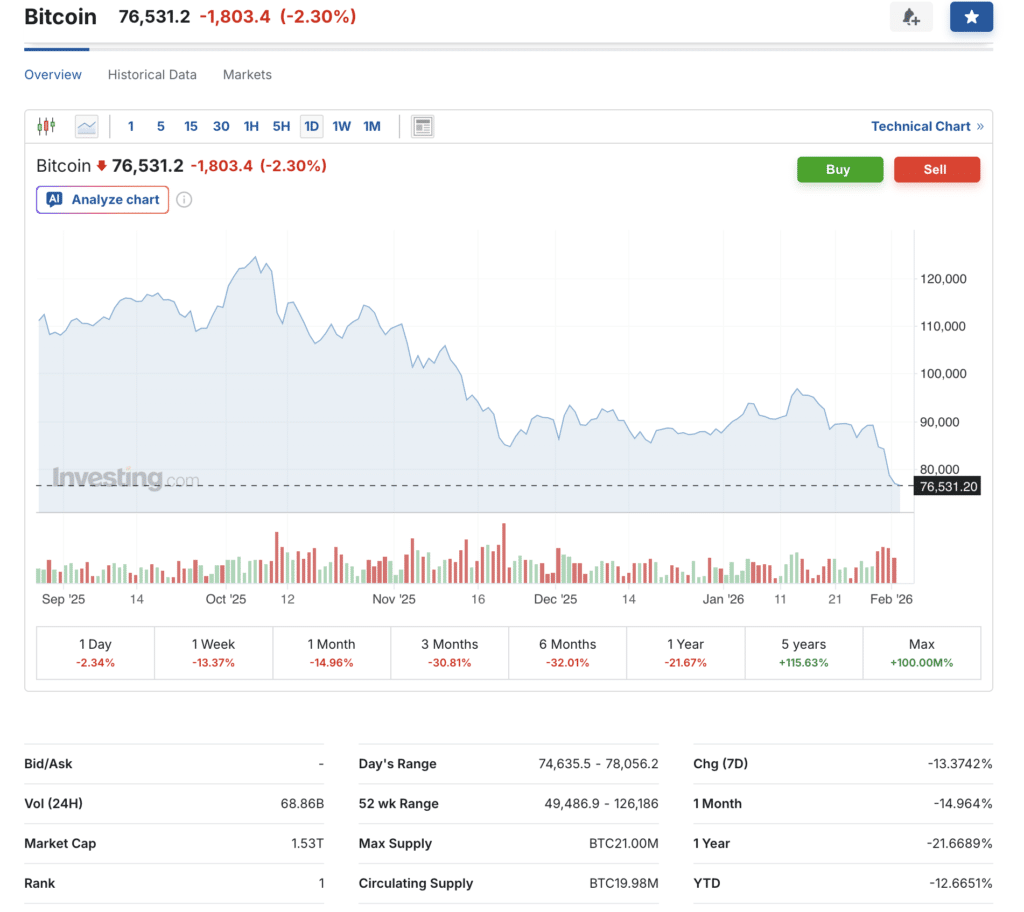
Right now, the market feels stuck between caution and renewed risk appetite. At roughly $75,710.32, BTC is hovering near major resistance zones, with a market cap around $1.51 trillion. Meanwhile, 24-hour trading volume near $66.6 billion suggests activity hasn’t dried up, even after the recent turbulence. The move above $75,000 is encouraging on the surface, but the backdrop still matters: liquidity is uneven, sentiment flips quickly, and it doesn’t take much to spark another sharp swing.
Bitcoin is also down about 3.79% over the past 24 hours, which is a useful reminder that recoveries in this market rarely travel in a straight line. Supply dynamics continue to support long-term narratives, with circulating supply around 19.98 million BTC against a hard cap of 21 million. Still, in the short term, thin liquidity can warp price discovery, especially during quieter hours when fewer bids and offers are sitting on the book and a relatively modest burst of buying or selling can move the market more than it “should.”
What triggered the 12% price drop?
To make sense of why Bitcoin can fall hard and then snap back, you have to look at both the plumbing of the market and the mood of the crowd. In this case, the initial hit looked heavily derivatives-driven. When leverage is stacked up, it only takes one strong push lower to set off a chain reaction: positions get trimmed, margin gets called, and forced closures start doing the selling for traders.
Add weekend conditions to that mix, when order books can be noticeably thinner, and the slide can look sharper than it would on a normal weekday session. What followed was a familiar cascade where liquidations and forced unwinds fed into more downside, not because everyone suddenly “changed their mind,” but because the market mechanics demanded it.
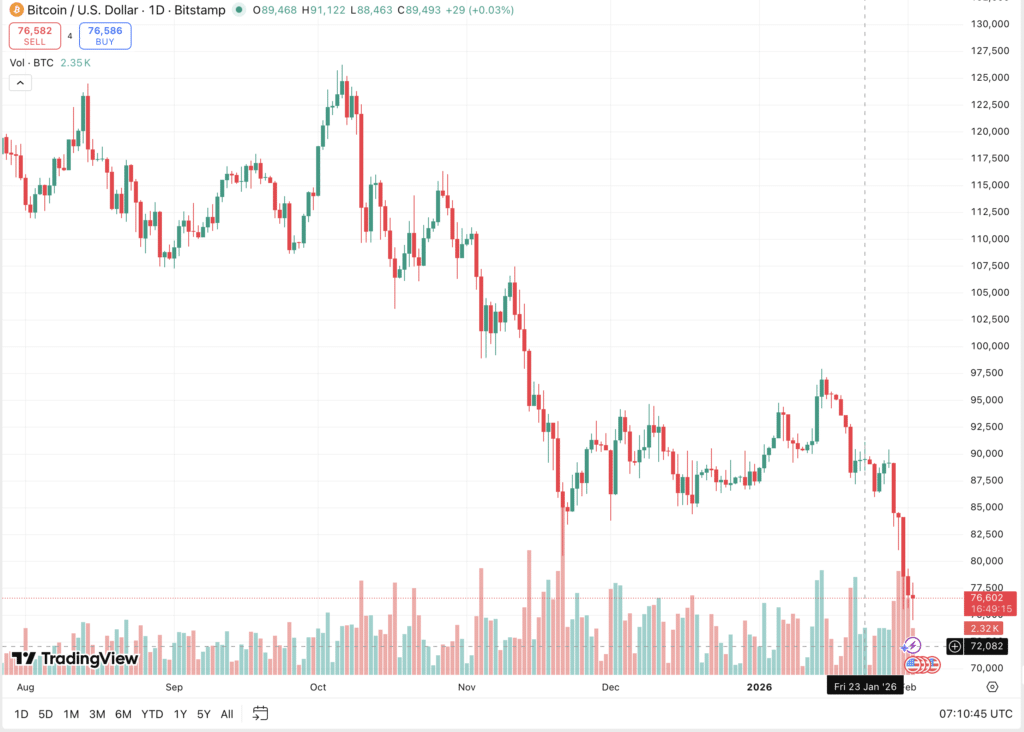
Macro nerves helped keep the pressure on. When traders are already anxious about where interest rates might go, how geopolitical risks are evolving, or whether markets are slipping into a risk-off posture, crypto often gets treated like the first thing to cut. That backdrop makes technical levels more fragile than usual, because fewer participants are willing to step in early. Around the low $72,000 area, automated sell triggers and momentum systems likely did their job, accelerating the move before discretionary buyers finally showed up.
Bitcoin rebounds above $75,000: anatomy of the recovery
The rebound above $75,000 didn’t happen slowly, and that speed is part of the story. Once BTC printed local lows and selling pressure started to cool, bigger players moved in quickly, the kind of buying that tightens the order book and flips the tone from “get me out” to “maybe this was overdone.” High-frequency activity can amplify that reversal too, because when the market stops falling, the same systems that chased downside can start chasing the bounce.
Spot demand also appeared to do some of the heavy lifting. When inflows return to the spot side, especially alongside ETF-related buying interest, it gives the rebound more structure than a pure short-covering pop. On-chain and flow signals often help explain the difference: wallet accumulation, steady stablecoin inflows, and signs of repositioning can point to strategic buying rather than a brief speculative rush.
And then there’s the human factor: $75,000 matters. It’s a clean, widely watched number that acts like a mental checkpoint for traders and a technical reference on charts. When price reclaims it, even temporarily, it can shift behavior fast, with sidelined buyers feeling safer stepping in and shorts getting less comfortable holding their positions.
Thin liquidity and why it makes moves look “louder” than they really are
Thin liquidity is one of those quiet forces that doesn’t get headlines, yet it shapes the headlines. When participation drops, the order book loses depth, meaning there are fewer real bids sitting underneath price and fewer offers above it. In that kind of environment, a sell wave that would normally look “manageable” can suddenly feel like a cliff because there simply isn’t enough resting demand to absorb it smoothly. This is how you get outsized candles that look dramatic even when the underlying flow isn’t historic.
The same logic works in reverse. When Bitcoin rebounds above $75,000 while liquidity is patchy, the bounce can look almost engineered because price is climbing through a thinner layer of resistance. Professional desks and market makers often step in when spreads widen and inefficiencies pop up, taking the other side of panic flow and nudging the book back toward balance.
The catch is obvious: the thinner the market, the easier it is for sharp wicks, sudden air pockets, and those blink-and-you-miss-it “flash” moves to happen. It’s not always manipulation, but thin books do make the market more vulnerable to it, and that reality is hard to ignore.
Trader psychology: why the mood flips in a heartbeat
Crypto sentiment is emotional, and it’s fast. During the sell-off, fear narratives travel quicker than facts, so the timeline fills with doom posts, liquidation screenshots, and confident predictions of “the real crash.” Then price reclaims a clean level like $75,000 and suddenly the same crowd talks like the bottom is in. It’s not hypocrisy, it’s reflex. People anchor to round numbers, and they take confidence from price action because it’s the most visible signal in the room.
Once BTC moved back above $75,000, a lot of traders interpreted that as a sign that bigger money was defending the area. That belief, even when it’s partly guesswork, becomes fuel. Momentum funds get braver, swing traders step back in, shorts get uneasy, and the rebound feeds itself.
Volatility and risk management: the part that decides who survives the next swing
Bitcoin’s volatility is structural. It trades 24/7, it’s globally distributed, and it still mixes deep spot demand with leverage-heavy derivatives. That combination practically guarantees sudden drops and fast recoveries.
The traders who handle this best usually do the boring things: they size positions based on volatility, keep liquidity buffers, hedge when conditions demand it, and avoid building a portfolio that only works if price goes up every day. The people who get hurt are typically the ones who confuse a bounce with certainty, or who keep leverage high because “it worked last month.”
Technical picture: key levels to watch without getting married to them
From a chart perspective, $75,000 is doing double duty as a psychological anchor and a technical pivot. Holding above it on daily closes tends to support the bullish structure, while slipping back below it reopens the door for another squeeze lower.
Right now, traders are watching resistance around $78,000 and support around $72,500 as the practical boundaries. Momentum indicators sitting closer to neutral usually imply consolidation rather than instant continuation, which fits the typical post-washout rhythm. In plain terms: the market may need to cool off before it picks a clean direction again.
Long-term fundamentals that keep showing up underneath the noise
Even when the short-term move is driven by leverage and liquidity, Bitcoin’s longer-term floor is still tied to fundamentals: network security, maturing custody and infrastructure, and clearer regulatory frameworks in key jurisdictions. Scarcity remains the core narrative too, especially in a post-halving world where new supply growth is structurally lower.
That’s why rebounds like this often attract “strategic” buying. Some players aren’t trading the next 12 hours, they’re building exposure during stress because the structure of supply and adoption still points in one long-term direction, even if the path is messy.
BTC price outlook after the rebound: the debate that never ends
The market’s split, as usual. One camp expects consolidation between roughly $75,000 and $80,000 before the next push higher. The other camp warns that if macro conditions sour, Bitcoin could retrace again, especially if leverage starts building too quickly on the way up.
If you’re looking for cleaner confirmation signals, two tend to matter more than predictions: expanding spot volume during up moves, and funding rates that cool off instead of overheating. When price rises while leverage stays disciplined, it’s a sturdier climb. When price rises because leverage is piling back in, it’s often fragile.
Conclusion
This rebound above $75,000 after a 12% slide is a good snapshot of how Bitcoin behaves in 2026: resilient, fast-moving, and still heavily shaped by liquidity and leverage. The recovery restored short-term confidence, but it also highlighted the same ongoing realities, thin books can exaggerate both fear and relief, psychology can flip faster than fundamentals, and risk management remains the difference between a clean trade and a forced liquidation.
What happens next likely depends on whether BTC can hold structure above $75,000, whether spot demand remains steady, and whether derivatives markets stay disciplined. If those pieces line up, the rebound has room to mature into something more. If not, the market may simply repeat the cycle, another sharp swing, another lesson.
FAQs about the Bitcoin rebound
Why did Bitcoin rebound above $75,000?
The bounce was helped by leverage getting flushed, shorts being forced to cover, and buyers stepping in around widely watched levels. Thin liquidity also made the rebound look faster and sharper.
What does BTC price recovery mean for traders?
It suggests the market found near-term support, but it doesn’t guarantee a new trend. Traders often use recoveries to reassess risk, identify key levels, and watch whether follow-through buying shows up.
How does thin liquidity affect Bitcoin price?
When order book depth is low, even moderate buying or selling can move price more than normal. That’s why drops and rebounds can look extreme during weekends or quiet sessions.
Appendix: Glossary of key terms
BTC short liquidation
When traders who bet on Bitcoin falling (short positions) are forced to close because price moves up fast. Since closing a short usually requires buying BTC back, liquidations can add sudden upward pressure.
Market capitalisation (market cap)
A rough measure of a crypto asset’s total value in circulation. It’s typically calculated as current price multiplied by circulating supply, so it moves with both price changes and supply updates.
Thin liquidity
A market condition where the order book has limited depth, meaning there aren’t many buy and sell orders stacked across price levels. In thin liquidity, relatively small trades can cause outsized moves, making volatility feel sharper.
Support level
A price zone where buying interest has historically been strong enough to slow or stop a decline. Support isn’t a single perfect number, it’s usually a range, and it can fail if selling pressure overwhelms bids.
Resistance level
A price zone where selling interest has historically been strong enough to slow or cap a rise. Like support, resistance often behaves as a band rather than a precise line, and it can break if demand stays persistent.
Derivatives market
Markets where traders buy and sell contracts linked to an asset’s price, such as futures and options, rather than trading the asset directly. Derivatives can amplify moves because leverage and margin mechanics can trigger forced buying or selling.
References