






As per recent reports, Solana treasury holdings have crossed the billion-dollar mark as firms increasingly place SOL on their balance sheets. Public companies are not only holding Solana but also building entire treasury programs around it.
This shift signals that institutions now see blockchain assets as more than speculative bets. They see them as yield-producing reserves with long-term potential.
Why Companies Are Building Solana Treasuries
Corporate treasuries now hold over 8.27 million SOL, worth about $1.72 billion, making up nearly 1.44% of the total circulating supply. Companies are attracted by Solana’s low costs, high throughput, and staking income. Unlike cash reserves, a Solana treasury generates yield, with average staking rewards ranging between 7–8% annually.
Leah Wald, CEO of SOL Strategies, noted that their Nasdaq listing was a clear “validation of the Solana treasury and the entire Solana ecosystem”.
Read more: Solana vs BNB: U.S. Institutions Clash With Asian Capital in Market Battle

Institutional Adoption of Solana
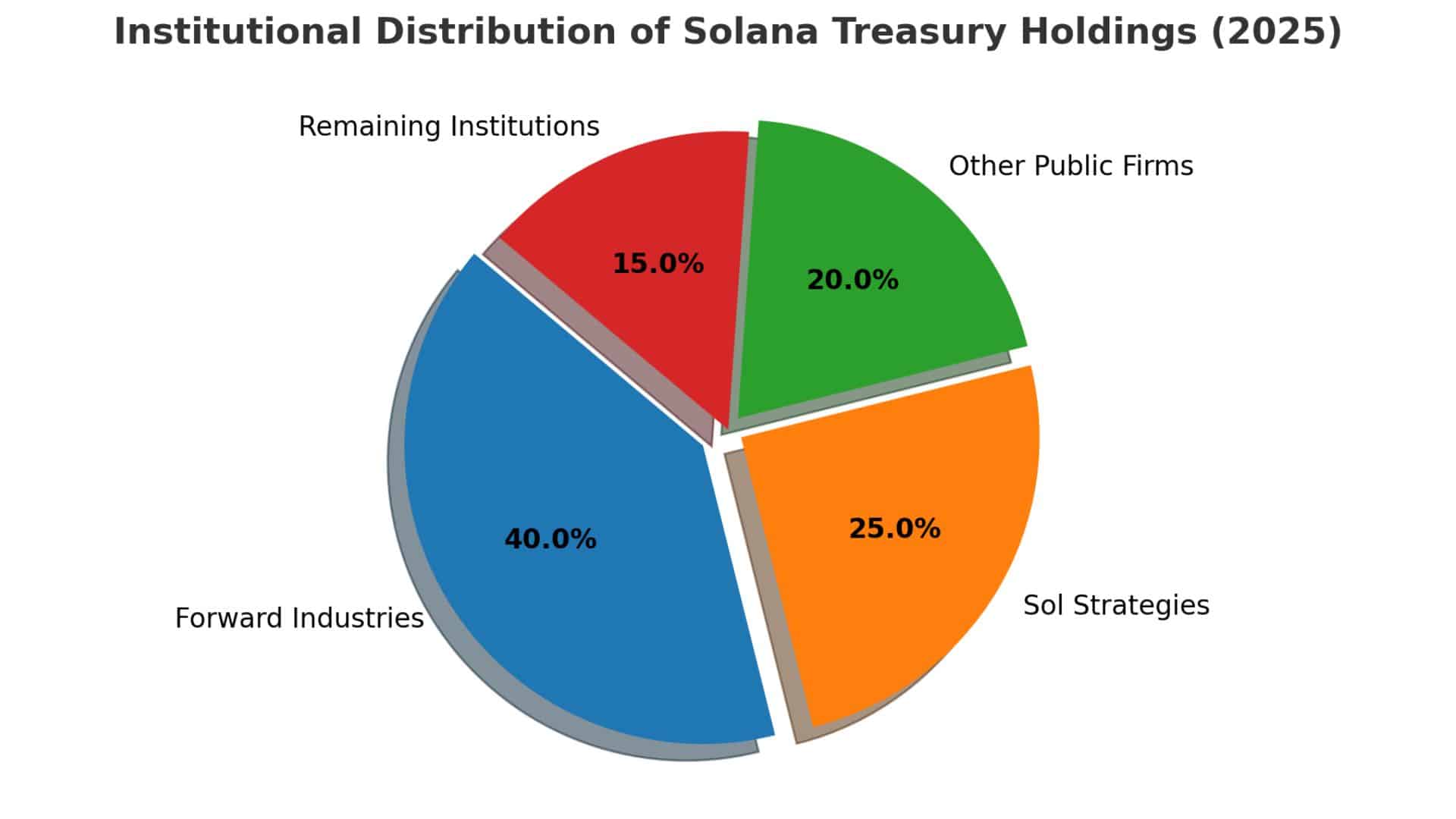
The momentum of Solana institutional adoption has been rapid. SOL Strategies now holds about 420,355 SOL in its treasury, equal to roughly $77.72 million. At the same time, Forward Industries secured $1.65 billion in commitments from major crypto players to develop its own Solana treasury program.
Kyle Samani of Multicoin Capital argued that “building an institutional-scale treasury can increase SOL per share at a faster rate than simply being a passive holder” .
This shows how institutions view treasury participation as a growth strategy rather than just a defensive move.
Risks and Challenges Ahead
Despite growth, risks remain. A Solana treasury exposes firms to volatility, and regulation still varies by region. Some critics warn of over-reliance on a single digital asset. While diversified strategies exist, the bulk of corporate activity currently clusters around a handful of players like SOL Strategies and Forward Industries.
Analysts also caution that sudden downturns could challenge firms that hold a large share of their liquid assets in SOL. Still, the yield opportunity and increasing regulatory acceptance are keeping adoption strong.
Price Action and Market Sentiment
SOL has traded with greater stability compared to other altcoins, supported by institutional inflows. Analysts believe that locking up SOL in treasuries reduces liquid supply, adding support to the price.
Corporate holdings worth over $1.7 billion reflect this strengthening confidence, and many see treasury strategies as a stabilizing factor for long-term growth.
Conclusion
Based on the latest research, Solana treasury strategies are shaping a new chapter in corporate finance. Institutions are no longer passive observers of crypto; they are active participants, staking and running validators to earn yield.
While challenges around regulation and volatility exist, the scale of investment shows that Solana has moved beyond hype. For many companies, the Solana treasury is not just a reserve; it is a growth engine.
Read more: Will SOL Break the $208 Barrier? Key Levels Driving Solana Price Prediction
Summary
Solana treasury adoption has surged in 2025, with institutions holding over $1.7 billion worth of SOL. Firms like SOL Strategies and Forward Industries are leading the trend by staking assets and integrating Solana into their financial strategies.
With Nasdaq listings and billion-dollar commitments, Solana is becoming a key treasury asset. While risks remain, the shift shows companies now see Solana as both a reserve and an engine for growth.
Glossary of Key Terms
Treasury: Company reserves held in cash, assets, or investments.
Staking: Locking tokens in a network to earn rewards while supporting its security.
Institutional adoption: Firms, funds, or corporations integrating crypto into balance sheets and operations.
Validator: A participant in a blockchain network that verifies transactions and helps maintain network security, often earning rewards.
FAQs for Solana Treasury
Q1: Why are companies choosing a Solana treasury instead of Bitcoin?
A: Solana offers staking rewards and utility, while Bitcoin is primarily a store of value.
Q2: How much Solana is in corporate treasuries today?
A: Over 8.27 million SOL worth $1.72 billion is in corporate treasuries.
Q3: Which companies hold the largest Solana treasuries?
A: Forward Industries, SOL Strategies, and other listed firms.
Q4: What benefits do companies get from staking Solana?
A: They earn 7–8% annually while supporting network security.