






The European cryptocurrency industry is entering a new phase as regulatory clarity becomes a key driver of institutional adoption. Reed Smith has responded to this shift by introducing a new MiCA compliance platform designed to simplify regulatory obligations for businesses operating across the European Union. The launch arrives at a crucial time, as regulators move beyond licensing requirements and begin supervising firms under the full Markets in Crypto-Assets (MiCA) framework. The platform reflects a growing demand for automation, legal certainty, and scalable compliance solutions across the digital asset industry.
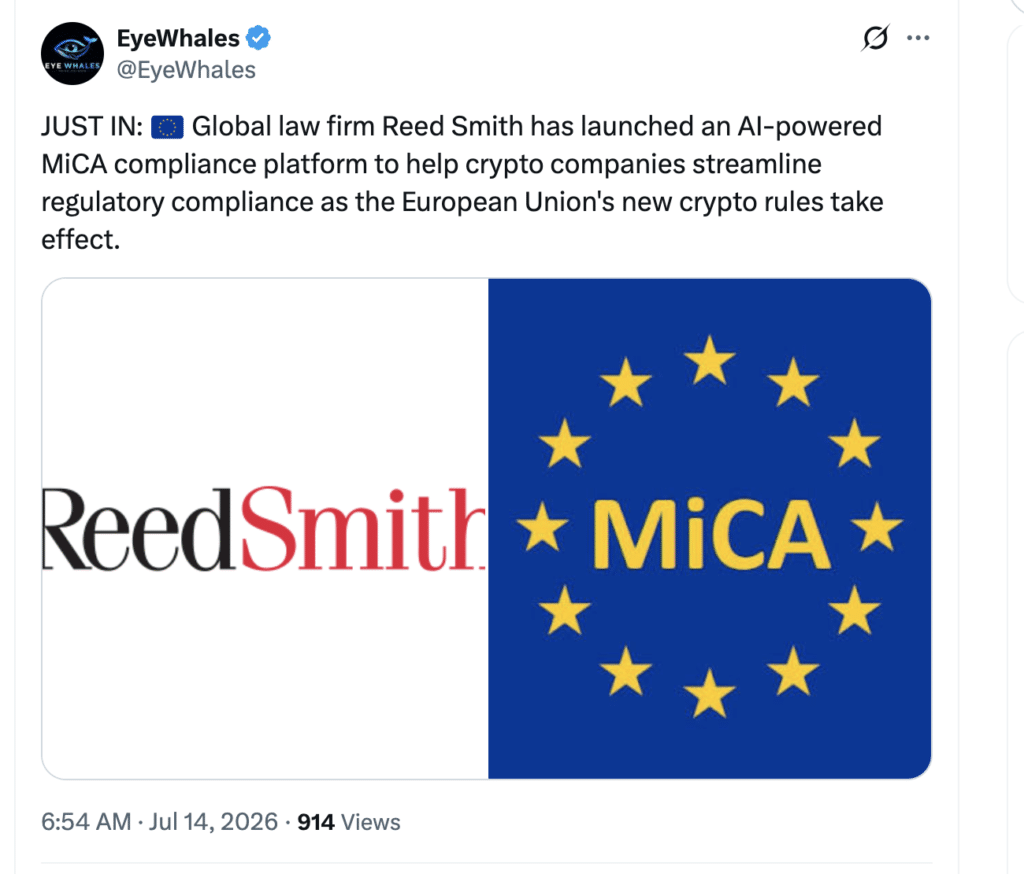
Reed Smith Introduces an Automated Compliance Solution
Global law firm Reed Smith unveiled its Aquarius platform to help digital asset businesses navigate the increasingly complex European regulatory landscape. The MiCA compliance platform automates crypto asset classification, regulatory filings, due diligence processes, ESG reporting, and documentation required for market entry.
Rather than forcing compliance teams to manage thousands of pages of legal guidance manually, the platform converts regulatory requirements into structured digital workflows. This reduces operational friction while improving consistency across compliance functions. As crypto businesses expand internationally, automation has become more than a convenience, it is rapidly becoming a competitive necessity.
The announcement also demonstrates how legal expertise and financial technology continue to merge as regulation becomes more sophisticated.

Why MiCA Regulation Matters for Crypto Companies
The MiCA compliance platform arrives shortly after the European Union completed its transition into full MiCA supervision. Instead of focusing solely on licensing applications, regulators are now monitoring how firms operate on a daily basis. That shift raises the stakes for every exchange, wallet provider, stablecoin issuer, and digital asset service provider entering European markets.
The MiCA regulation establishes standardized rules covering transparency, consumer protection, operational resilience, reserve management, governance, and market integrity. Before MiCA, businesses often faced different regulatory expectations across multiple European jurisdictions. The new framework replaces fragmented requirements with a single regulatory standard, creating greater certainty for both companies and investors.
This harmonized approach is expected to encourage institutional participation while strengthening investor confidence throughout the region.
How Automation Changes Crypto Regulatory Compliance
Compliance has traditionally been one of the largest operational expenses for digital asset companies. Manual reviews, legal consultations, document preparation, and regulatory reporting consume significant financial and human resources. The new MiCA compliance platform seeks to reduce those burdens through intelligent automation.
Instead of preparing every filing manually, firms can automate crypto asset classification, generate regulatory documentation, complete due diligence assessments, and organize ESG disclosures through standardized workflows. This significantly shortens preparation time while minimizing the risk of administrative errors.
Automation also allows compliance professionals to focus on strategic risk management instead of repetitive paperwork, improving efficiency without sacrificing regulatory quality.

Helping Crypto Firms Enter the European Market
European expansion has become increasingly attractive for blockchain startups seeking regulatory certainty. However, satisfying every compliance obligation remains a major hurdle for many growing companies. The MiCA compliance platform gives organizations a structured pathway for meeting those requirements before launching products across EU member states.
The platform supports crypto legal compliance by organizing disclosure documents, verifying regulatory obligations, and simplifying reporting procedures. Businesses preparing token offerings or digital asset services can complete much of the required documentation through automated workflows rather than relying entirely on expensive manual legal reviews.
For startups operating with limited compliance budgets, this technology may significantly lower the barrier to entering Europe’s regulated crypto economy.
What the Launch Means for Europe’s Digital Asset Industry
The introduction of the MiCA compliance platform signals a broader shift in how regulatory technology is shaping the cryptocurrency industry. As compliance obligations become more detailed, firms increasingly need software that can translate legal requirements into practical workflows. Reed Smith’s solution demonstrates how legal expertise and automation can work together to reduce compliance complexity.
The launch also highlights the growing demand for RegTech for crypto, particularly as crypto firms in Europe seek scalable solutions that support long-term growth while meeting evolving regulatory expectations.

Why Compliance Technology Is Becoming a Competitive Advantage
Regulation is no longer viewed simply as a legal obligation. It has become a business advantage for firms looking to attract institutional investors and expand internationally. The MiCA compliance platform provides companies with an opportunity to strengthen internal governance while reducing compliance costs.
Solutions such as the Reed Smith MiCA compliance platform enable businesses to prepare regulatory filings more efficiently, manage crypto white paper requirements, and streamline digital asset compliance. Faster compliance processes can also improve operational efficiency, allowing companies to focus more resources on innovation and customer growth.
Reed Smith Positions Itself at the Center of Crypto Regulation
The launch of the Reed Smith crypto platform reflects a growing trend among global legal firms that are investing in technology alongside traditional advisory services. Instead of offering legal guidance alone, firms are increasingly building software that automates regulatory workflows. Industry observers view the Reed Smith Aquarius MiCA compliance platform as an example of how legal technology can evolve into a long-term compliance ecosystem.
The company has also indicated plans to expand similar capabilities into jurisdictions including the United Kingdom, the United Arab Emirates, Hong Kong, and Singapore as global crypto regulation continues to mature.
Future Outlook for MiCA Compliance Across Europe
European regulators continue refining the Markets in Crypto-Assets (MiCA) framework as the industry evolves. Policymakers are already discussing possible updates covering decentralized finance, staking services, tokenization, and additional supervisory standards. As these changes emerge, businesses will require flexible crypto compliance software capable of adapting without rebuilding internal compliance programs from scratch.
Platforms focused on crypto regulatory compliance may become essential infrastructure for digital asset companies. The growing demand for an EU MiCA regulation compliance platform suggests automation will remain central to the future of European crypto markets.
Conclusion
The launch of Reed Smith’s MiCA compliance platform represents another important milestone in Europe’s evolving digital asset ecosystem. By combining legal expertise with automation, the platform simplifies regulatory filings, crypto asset classification, due diligence, and ESG disclosures for crypto, helping businesses meet increasingly complex regulatory expectations. As Europe transitions from licensing to active supervision, compliance technology is likely to become a strategic necessity rather than an optional investment. Companies that embrace automated regulatory solutions early may be better positioned to expand across European markets while maintaining operational efficiency and investor confidence.
Businesses preparing for the next phase of EU crypto regulation should closely evaluate emerging compliance technologies and stay informed as regulatory standards continue to evolve.
Appendix: Glossary of Key Terms
MiCA Compliance Platform: Software designed to automate compliance with the European Union’s Markets in Crypto-Assets regulation.
Markets in Crypto-Assets (MiCA): The European Union’s comprehensive regulatory framework governing crypto assets and digital asset service providers.
Crypto Regulatory Compliance: The process of meeting legal, financial, operational, and reporting obligations imposed by regulators.
Digital Asset Compliance: Procedures ensuring cryptocurrencies and tokenized assets satisfy applicable legal and regulatory standards.
ESG Disclosures for Crypto: Environmental, Social, and Governance reporting requirements applicable to crypto businesses under certain regulatory frameworks.
RegTech for Crypto: Regulatory technology that automates compliance, reporting, monitoring, and risk management for digital asset companies.
Frequently Asked Questions About MiCA Compliance Platform
What is a MiCA compliance platform?
A MiCA compliance platform is software that helps cryptocurrency companies automate compliance with the European Union’s Markets in Crypto-Assets regulation by managing regulatory filings, documentation, and reporting requirements.
Why did Reed Smith launch this platform?
Reed Smith introduced its automated compliance solution to simplify regulatory obligations for crypto companies entering or expanding within European markets while reducing manual compliance workloads.
How does the platform help crypto companies?
The platform automates crypto asset classification, regulatory filings, due diligence, crypto white paper requirements, and ESG reporting, allowing businesses to meet regulatory expectations more efficiently.
Why is MiCA important for Europe?
MiCA creates a unified regulatory framework across the European Union, replacing fragmented national rules with standardized requirements that improve transparency, consumer protection, and market confidence.
Will compliance technology become more important?
Yes. As regulators increase operational supervision and introduce new rules, automated crypto compliance software and legal technology for crypto regulatory compliance are expected to become critical tools for digital asset businesses.
References
Disclaimer
Cryptocurrency markets are highly volatile, and regulatory developments may change over time. Any cryptocurrency prices, market data, or regulatory information referenced in this article should be independently verified through official sources before making financial or investment decisions. This article is intended for informational purposes only and should not be considered financial, investment, or legal advice.