




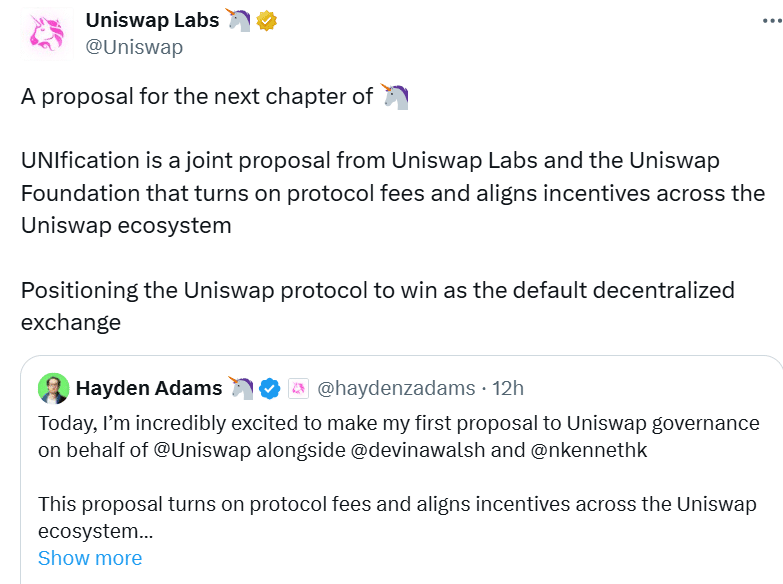
The Uniswap proposal, “UNIfication,” marks a key moment for the decentralized exchange. Announced on November 10, it aims to reshape how value flows through the protocol.
It introduces trading fee activation, a permanent burn mechanism, and a significant cut in UNI’s circulating supply. The Uniswap proposal also brings organizational and governance reforms to align its operations for the long term.
Uniswap Proposal Introduces Fee System and Supply Reduction
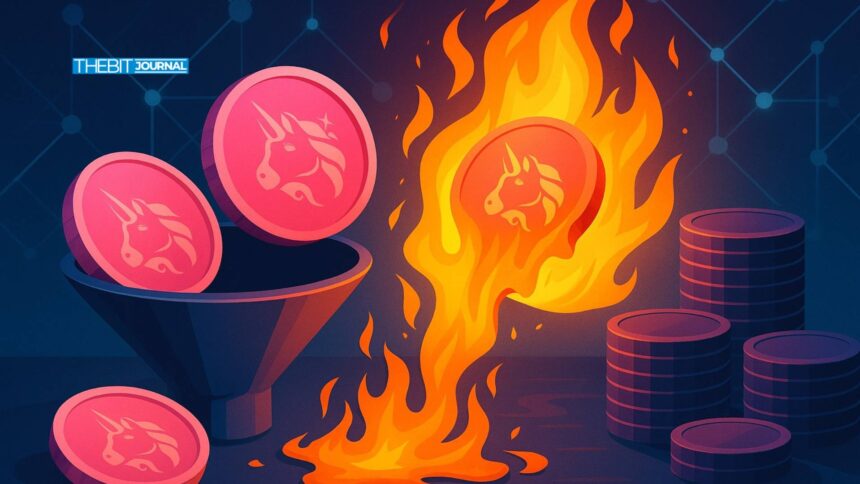
The Uniswap proposal activates protocol fees for the first time since UNI’s 2020 launch. A share of these fees will be directed to a continuous burn system, reducing token supply and linking UNI’s value to actual trading activity.
A one-time burn of 100 million UNI from the treasury will occur. This represents the amount that could have been burned if the fee system existed since inception. The immediate effect would cut the circulating supply by about 16%, from 625 million to around 525 million UNI.
Also Read: Uniswap Breaks EVM Boundaries with Solana Integration
Strengthening Token Utility
The Uniswap proposal introduces a new auction system where traders can bid UNI to receive discounted trading fees. UNI used in these auctions will be burned. This setup connects trading activity with token scarcity.
It also supports liquidity and improves the link between trading demand and token value. The goal is to make UNI’s role more active in the protocol’s economic design.
Organizational Merger
Another major feature of the Uniswap proposal is the merger of Uniswap Labs and the Uniswap Foundation. This unification aims to simplify the structure, eliminate duplicate roles, and focus both entities on a single mission.
Foundation staff will move to Labs. The new unified organization will drive development, community support, and long-term protocol growth.
Shifting to Protocol-Level Revenue
The Uniswap proposal also changes how revenue is earned. Uniswap Labs will stop collecting money from its interface, wallet, and API. Instead, future growth will come from protocol-level adoption.
A growth budget from the treasury will fund incentives and development across the ecosystem. Starting in 2026, this budget will be distributed quarterly. This transition moves Uniswap toward sustainable, decentralized funding rather than short-term profits.
Expanding the Ecosystem
The Uniswap proposal builds on years of ecosystem investment. Over $40 million in grants have been awarded to developers, researchers, and contributors. These funds supported more than 180 Unichain teams and 1,500 hook developers from over 60 countries.
Programs such as the Hook Incubator and Hook Design Lab have driven 20,000 hook initializations and $9.4 billion in hook trading volume since the v4 launch.
Projects like EulerSwap, Aegis, and Doppler have grown through Uniswap’s support. Unichain has also seen more than $70 billion in DEX volume, while Uniswap v4 reached $230 billion in cumulative trades.
Focus on Research and Security
The Uniswap proposal highlights ongoing investment in research and security. Grants have supported studies on AMM design, MEV dynamics, and restaking systems. The launch of TLDR, a DeFi research conference with over 400 global participants.
The Foundation also launched the Uniswap Security Fund. This program has supported more than 20 teams with audits and expert reviews from over 30 verified providers. Such efforts ensure the ecosystem remains secure and resilient as adoption grows.
Regulatory Clarity and Future Vision
The Uniswap proposal comes after changes in the U.S. regulatory environment. These shifts removed previous barriers to governance participation and fee activation. Uniswap leadership says this new clarity allows the project to pursue its full potential.
The proposal also mentions the DUNA framework, which strengthens governance legitimacy. Together, these changes set up Uniswap for a new phase of growth where protocol usage drives value, and the community shapes direction through transparent governance.
Conclusion
The Uniswap proposal represents a comprehensive update to how the protocol operates. It reduces supply, unifies teams, activates fees, and strengthens the link between usage and token value.
The plan also redefines how revenue is generated and how growth is funded. With a clear regulatory environment and unified governance, Uniswap is positioning itself for long-term success in the decentralized finance ecosystem.
Also Read: Altcoins Price Predictions for 2025 Show Big Targets for Polkadot, Uniswap and Monero
Appendix: Glossary of Key Terms
UNIfication: The name of the new Uniswap proposal aiming to align governance, tokenomics, and protocol operations.
Protocol Fees: Charges applied to trades within Uniswap to generate revenue for token burns and ecosystem growth.
UNI Burn: A mechanism that permanently removes UNI tokens from circulation to reduce supply and increase scarcity.
Unichain: Uniswap’s layer-2 network where sequencer fees contribute to the UNI burn and improve transaction efficiency.
Treasury Burn: A one-time burn of 100 million UNI tokens from the Uniswap treasury to reflect retroactive fee burns.
Uniswap Labs: The core development arm responsible for Uniswap’s technical products and future upgrades.
Uniswap Foundation: The organization supporting research, grants, and community initiatives, now merging with Uniswap Labs.
Hook Design Lab: A program supporting developers in building and testing custom hooks for Uniswap v4.
Frequently Asked Questions About Uniswap Proposal
1- What is the Uniswap proposal?
It is a new plan called “UNIfication” that introduces protocol fees, token burns, and governance restructuring to improve value flow.
2- How will it affect UNI’s supply?
The proposal includes a one-time burn of 100 million UNI, cutting supply by about 16%, with more burns tied to trading activity.
3- Why is Uniswap merging Labs and the Foundation?
To create a single, efficient organization focused on protocol growth and ecosystem expansion.
4- When will the new treasury budget begin?
Quarterly allocations for incentives and development will start in 2026.