

Last updated: November 2, 2026
To verify crypto wallet address details, check more than whether the characters look right. Confirm the full address, the network, the asset and the recipient through a trusted channel before approving a transfer.
These checks can catch common mistakes, but they can’t prove who controls an address or ensure that funds will arrive safely. A valid address is not automatically the right destination.
TL;DR
- Compare the complete address with a trusted source, not just its first and last characters.
- Check the blockchain network and asset, since a valid address can still be incompatible with the transfer.
- Review the final transaction in your wallet and consider a small test transfer when appropriate.
How to check an address
Start with the address supplied by the recipient through a channel you trust. If possible, confirm it independently, such as by asking the recipient through a separate conversation. A message that appears to come from a familiar person or business can still be compromised.
Paste the address into the wallet’s recipient field, then compare the full string against the original. Bitcoin.org advises checking the entire receiving address rather than relying on a few characters at either end. That matters because clipboard malware can replace a copied address with one controlled by someone else. Bitcoin.org also reports that independent on-chain analysis identified tens of thousands of address-poisoning attempts on Bitcoin since 2023.
Don’t treat a matching name, profile image or transaction history as proof of ownership. A blockchain address identifies a destination, not the person behind it.
Check address format and checksum
Address formats differ by blockchain. A string that looks plausible may still be invalid, or belong to a different kind of account. A format check can flag some errors, but it cannot confirm the intended recipient.
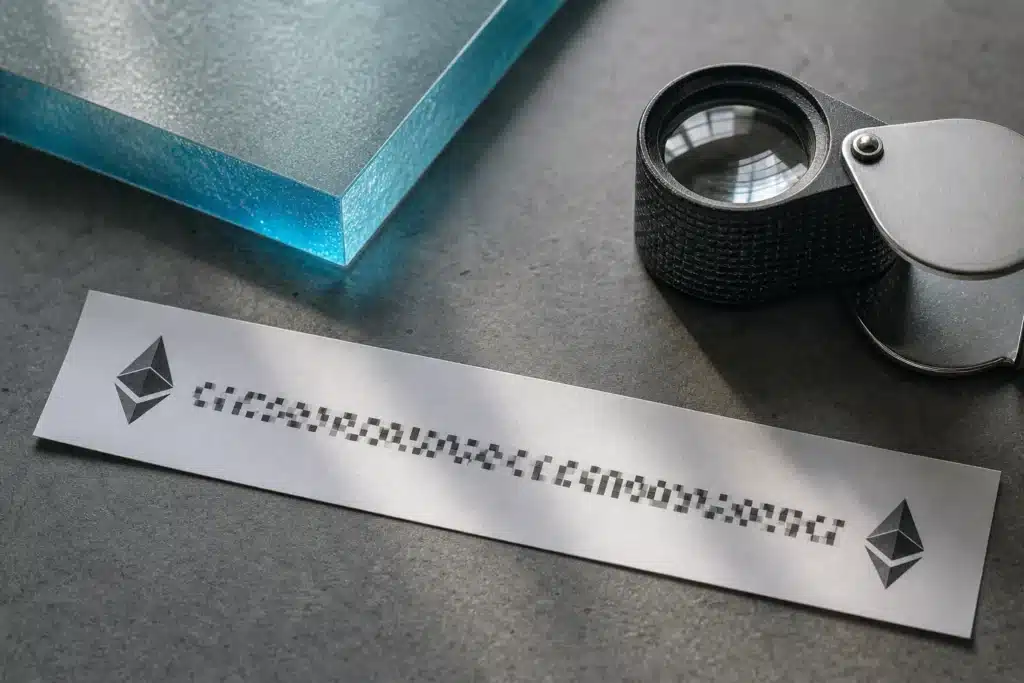
Ethereum addresses contain 40 hexadecimal characters after the prefix. Ethereum’s EIP-55 checksum uses mixed uppercase and lowercase letters to help detect typing errors while preserving those characters. The EIP estimates that a randomly mistyped address has a 0.0247% chance of accidentally passing the checksum. That’s a useful error check, not identity verification. Read the specification at Ethereum’s EIP-55.
Bitcoin Core provides a technical validation method called validateaddress. Its result indicates whether an address is valid under Bitcoin’s rules, but, as the Bitcoin developer documentation explains, it doesn’t establish that the address belongs to the intended recipient.
Check the network, asset and destination
A crypto transfer needs to match the network and asset the recipient can accept. Don’t assume that similar-looking address formats mean two networks are interchangeable. In your wallet, select the intended network and token, then check the transaction details again before confirming. MetaMask gives the same instruction in its sending guidance and notes that an ERC-20 recipient must support the token being sent.
Solana addresses are 32-byte values displayed as base58 strings, according to Solana’s account documentation. But not every Solana address is a standard wallet public key. The network also has program-derived addresses, or PDAs, which have no corresponding private key.
That distinction can matter for native SOL. Solana’s payment-address guide says SOL can be sent to any account, including token accounts, mints, programs and PDAs, and that such a transfer may permanently lock the SOL. Its guidance recommends classifying the recipient before signing. Before sending SOL, confirm what kind of account the destination is and whether it’s suitable for the asset.
Review the final transaction
Before approving, read the wallet’s final summary rather than relying on the address you copied earlier. Check the recipient, network, token and amount. If the wallet shows a warning, an unexpected network or a different destination, stop and confirm the details with the recipient through a trusted channel.
- Get the address from a trusted source and confirm it independently when possible.
- Copy and paste it, then compare the complete address for any change.
- Choose the correct network and asset, and check that the destination supports them.
- Review the final transaction details before signing.
- For a transfer where a mistake could be costly, consider whether a small test transaction is appropriate.
Bitcoin.org suggests considering a small test transaction before a large transfer. Coinbase Prime also offers a destination-address test feature for its users, subject to limits described in its help page. A successful test can show that a small transfer reached the supplied destination, but it doesn’t prove the recipient controls it or that a later transfer will be error-free.
Pros and cons of address checks
| Check | What it can do | What it can’t do |
|---|---|---|
| Format or checksum | Catch some invalid characters or typing errors. | Prove who controls the address. |
| Full-address comparison | Reveal a mismatch or clipboard substitution. | Confirm the right network or asset by itself. |
| Test transfer | Show whether a small transfer reaches the destination. | Establish that a larger transfer will be recoverable or safe. |
Who these checks are for
These steps are useful for anyone sending crypto, whether you’re transferring between your own wallets, paying a person or withdrawing from a platform. They can also help teams add a pause for recipient and network review before authorizing payments.
They’re not a substitute for verifying a recipient’s identity, checking a platform’s withdrawal instructions or protecting your signing device. If a device or wallet may be compromised, address checks alone won’t resolve that risk.
These checks may not be enough when the recipient won’t confirm details, the asset or network is unclear, or the wallet displays information you don’t recognize. Pause rather than guessing. Bitcoin.org explains that confirmed Bitcoin payments cannot be reversed by the sender.

Bottom line
Before sending, validate the format, compare the whole address, confirm the network and asset, and inspect the final transaction. No single check proves that an address belongs to the intended person. If anything doesn’t match, don’t approve the transfer until you can confirm the destination through a trusted channel.
Sources
- ERC-55: Mixed-case checksum address encoding (eips.ethereum.org)
- validateaddress, Bitcoin (developer.bitcoin.org)
- FAQ – Bitcoin (bitcoin.org)
This article is for informational purposes only and does not constitute financial or investment advice. Cryptocurrencies are highly volatile; always do your own research before investing.