






The global payments landscape is undergoing a structural shift as the Visa stablecoin payment system quietly expands its role in settlement infrastructure. Rather than targeting consumers directly, the focus has moved to backend financial rails where value is transferred between banks, issuers, and acquirers.
In 2026, Visa’s stablecoin settlement pilot has reached a $7 billion annualized run rate while operating across nine blockchains. This evolution signals a deeper transformation in how money moves globally, reinforcing stablecoin adoption in traditional finance as a foundational shift rather than a speculative trend.
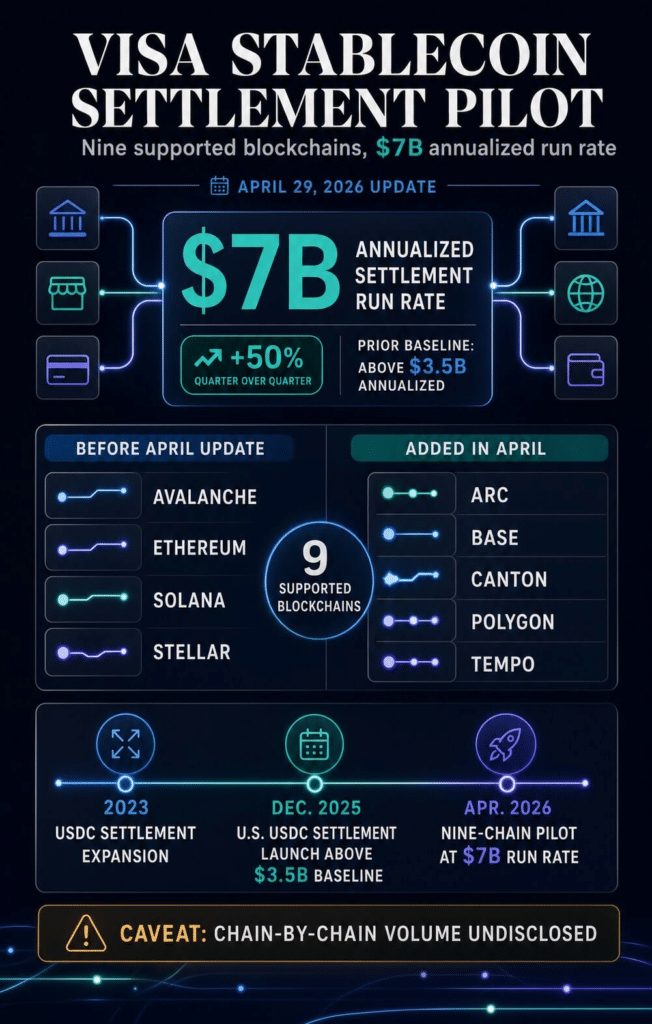
Expansion across nine blockchain networks
The Visa stablecoin payment system now spans nine major blockchain ecosystems, including Ethereum, Solana, Avalanche, Stellar, Base, Polygon, Canton, Arc, and Tempo. This expansion highlights how Visa is building flexibility into its settlement layer instead of relying on a single chain. Each network serves different use cases, from low-cost consumer payments to institutional-grade privacy transactions.
The Visa blockchain payment infrastructure strategy reflects a broader attempt to unify fragmented blockchain environments into a single operational framework for global settlement. This multi-chain approach is positioning Visa as a bridge between traditional finance and decentralized payment systems.
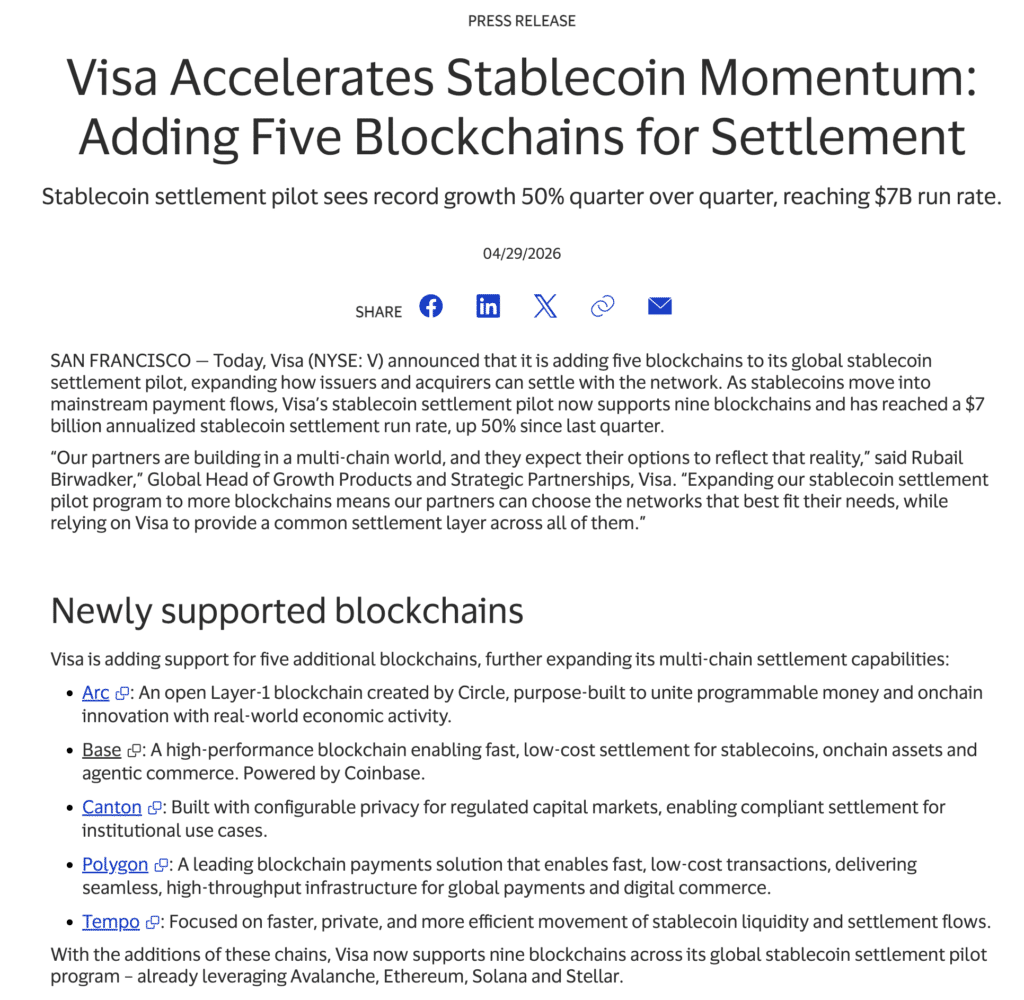
Chain diversity and infrastructure strategy
The design of the Visa stablecoin payment system reflects a carefully structured multi-chain strategy rather than experimental adoption. Arc introduces stablecoin-native infrastructure, Base connects consumer and exchange ecosystems, and Canton provides privacy-focused settlement for institutions. Polygon and Tempo enhance scalability and payment efficiency.
This diverse architecture supports the growing Visa blockchain settlement pilot program, enabling different financial participants to operate under tailored conditions while still interacting within a unified settlement layer. The strategy demonstrates how how Visa uses stablecoins for payments is evolving into a modular and adaptive system for global finance.
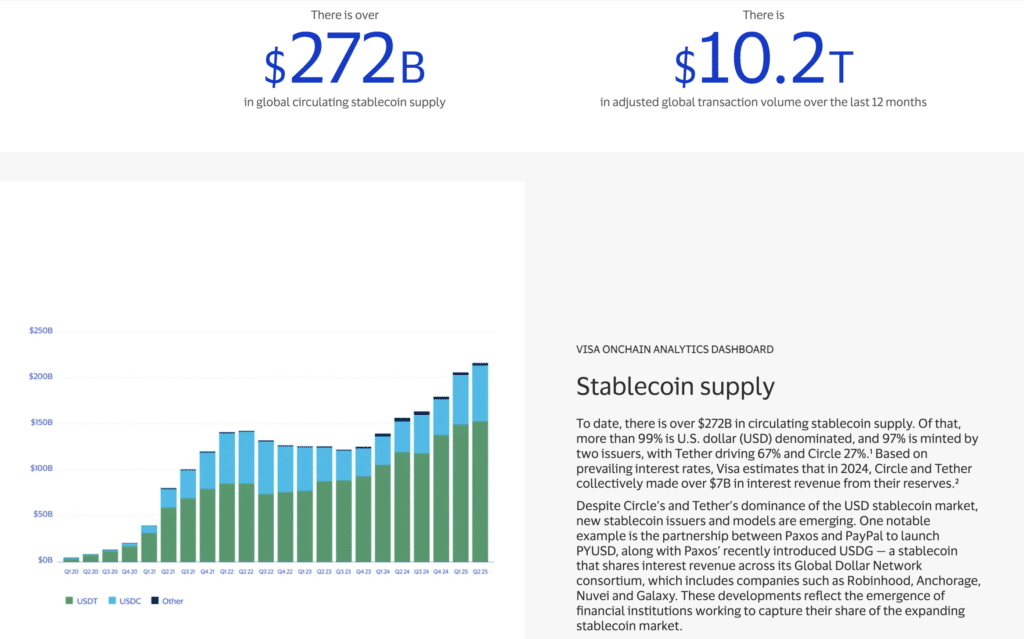
Operational signal behind settlement modernization
The Visa stablecoin payment system is not just about blockchain integration but about redefining settlement efficiency in global payments. Traditional card networks separate authorization and settlement, often requiring multiple days for final reconciliation. Stablecoins compress this timeline dramatically, enabling near-real-time value transfer between financial institutions.
This shift represents a critical upgrade in Visa crypto payment integration news, where blockchain is used behind the scenes rather than at the checkout. The operational signal suggests that stablecoins are becoming embedded in core financial plumbing, reinforcing how stablecoins are powering Visa payment infrastructure at scale.
Evolution toward a nine-chain settlement model
Visa’s journey toward a nine-chain ecosystem began with early experiments in 2023 using Ethereum and Solana for USDC transfers. Over time, partnerships expanded to include banks and payment processors, gradually shaping today’s Visa stablecoin payment system. By 2025, settlement pilots in the U.S. introduced stablecoin-based reconciliation between financial institutions.
The latest expansion in 2026 builds on this foundation, pushing the Visa stablecoin settlement network 2026 into a broader multi-chain environment. This evolution reflects how Visa is building stablecoins into global payment system architecture step by step rather than through abrupt disruption.
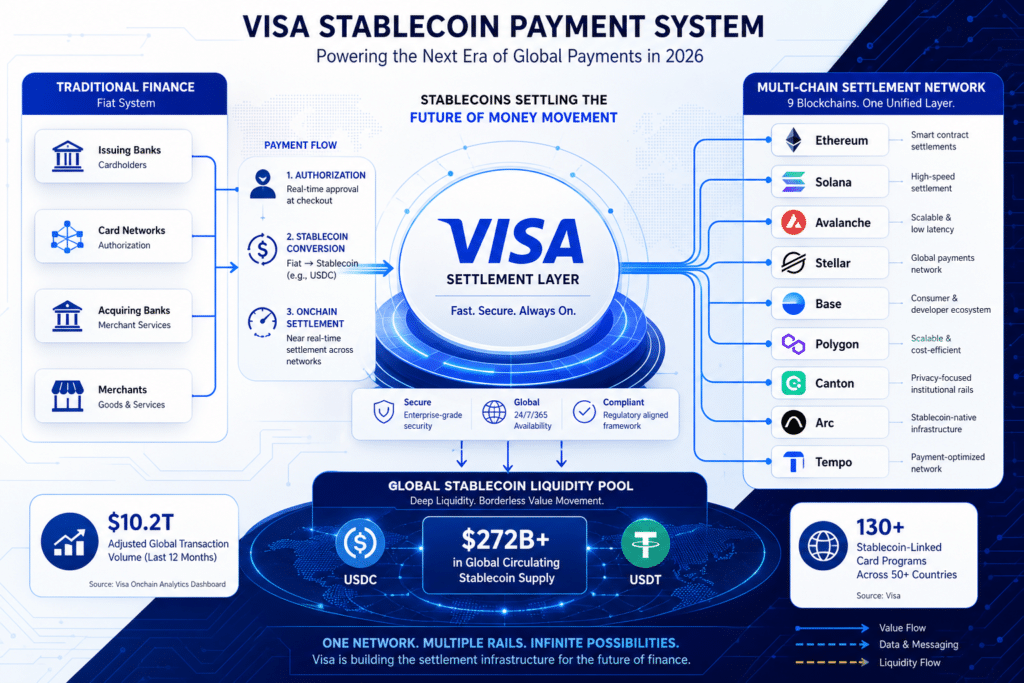
Settlement pilot growth and financial implications
The Visa stablecoin payment system has reached a $7 billion annualized run rate, marking a 50% increase from the previous quarter. This growth underscores rising institutional confidence in blockchain-based settlement mechanisms. While consumers continue using traditional card experiences, backend systems are increasingly powered by stablecoins for liquidity movement and treasury operations.
The stablecoin adoption in traditional finance trend is becoming more visible as banks and payment processors integrate blockchain rails into daily operations. This transformation signals that settlement efficiency, not speculation, is driving real-world blockchain utility.
Market implications and global payment transformation
The rise of the Visa stablecoin payment system highlights a major turning point in global financial infrastructure. Instead of replacing existing systems, blockchain is being integrated into them, creating hybrid networks that combine traditional banking with decentralized settlement layers.
This reflects the broader Visa blockchain payment infrastructure evolution, where interoperability and scalability are more important than ideological replacement of legacy systems. The shift also supports the growing narrative of future of payments Visa stablecoin adoption analysis, where digital assets become invisible yet essential components of global finance.
Conclusion
The Visa stablecoin payment system represents a structural transformation in how global money movement is engineered in 2026. By integrating stablecoins across nine blockchains and scaling settlement to billions in annualized volume, Visa is quietly reshaping financial infrastructure without altering the consumer experience.
This evolution signals that blockchain is no longer experimental but operational. As settlement systems become faster, more efficient, and globally interoperable, the foundation of digital payments is being rebuilt from the inside out. Continuous monitoring of this transition remains essential for understanding the next phase of global finance.
Appendix: Glossary of Key Terms
Stablecoins refer to blockchain-based digital assets pegged to fiat currencies such as the U.S. dollar, designed to maintain price stability.
Settlement layer describes the backend system where financial transactions are finalized between institutions.
Blockchain payment infrastructure refers to distributed ledger networks used to transfer value and data across financial systems.
Multi-chain architecture is a system that operates across multiple blockchain networks simultaneously to improve scalability and flexibility.
Frequently Asked Questions
What is the Visa stablecoin payment system?
It is Visa’s blockchain-based settlement framework that uses stablecoins to move value between financial institutions across multiple networks.
How does Visa use stablecoins for payments?
Stablecoins are used in the backend settlement process between banks, issuers, and acquirers after a transaction is authorized.
Why are multiple blockchains used?
Different blockchains provide varying benefits such as speed, privacy, cost efficiency, and institutional compatibility.
Is this visible to consumers?
No, the system operates in the background and does not change the card payment experience.
References