
This article was first published on The Bit Journal.
Blockchain nodes are the machines that power a blockchain network. They accept, validate and pass on transactions using these protocols, and each node stores or can store a copy of the blockchain ledger.
By sharing copies of the ledger on thousands of independent nodes, blockchain networks make sure that there is no single point of failure. Even when some nodes are made unavailable or under attack, the network remains resilient.
Blocks are added to a blockchain via nodes, which validate transactions (checking funds and signatures), etc., according to consensus rules (e.g. Proof-of-Work or Proof-of-Stake). Due to reliance on all nodes agreeing, it is almost impossible for an attacker to fake a transaction without having majority control of the nodes.
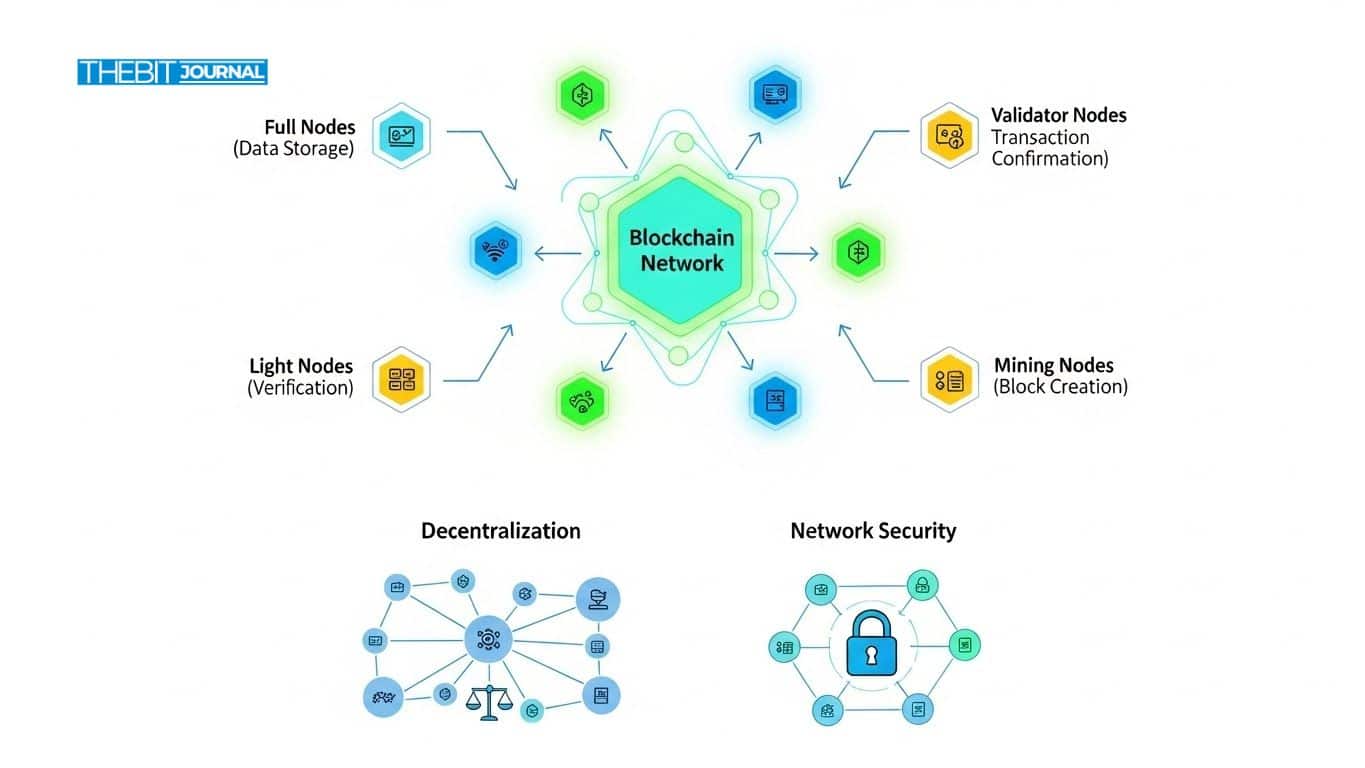
Nodes of different types have different tasks: Full nodes, which validate all the blocks, light (SPV) nodes using only a fraction of the data, miner nodes creating new blocks in networks working with PoW, and validators (staking) for PoS-networks. The more nodes that are running, the more decentralized and secure the network is
Blockchain Nodes Explained
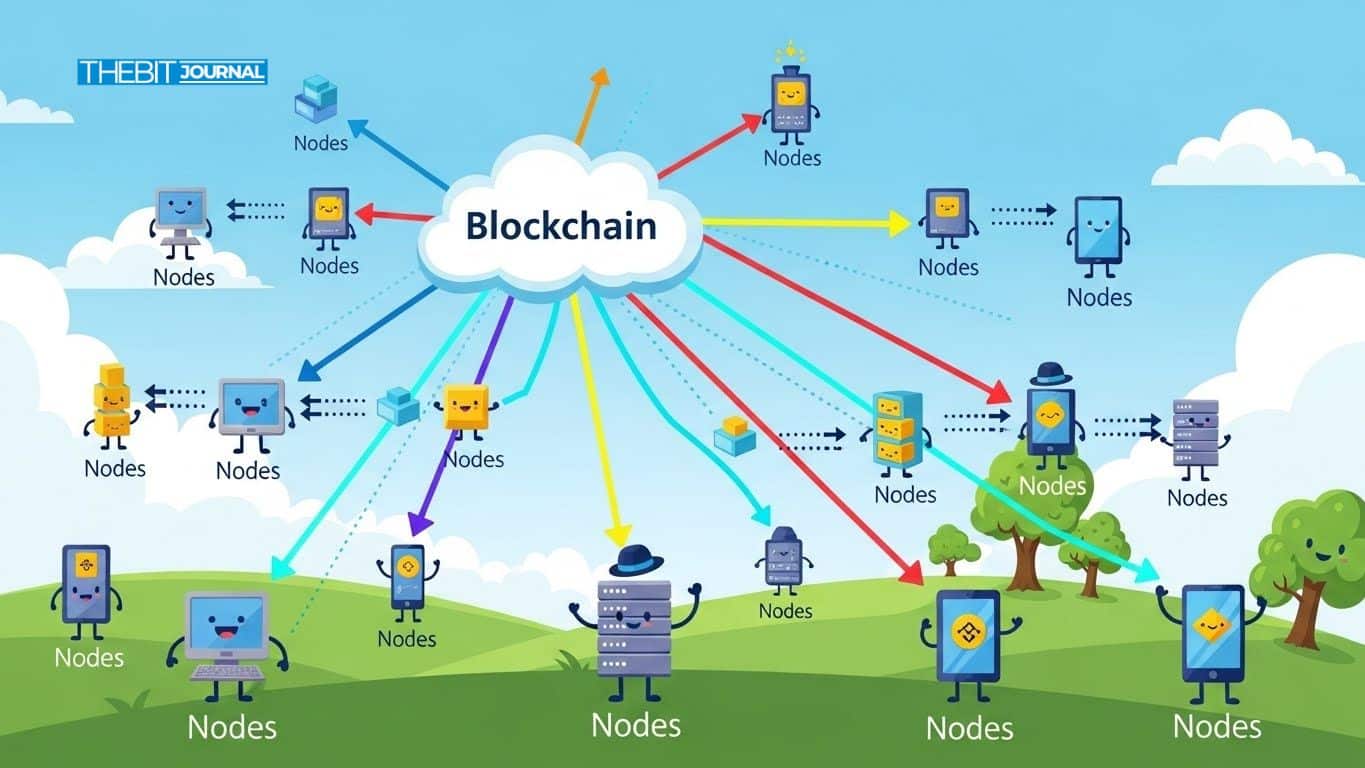
A blockchain node is a computer or any other device that participates and is connected to the blockchain network. Nodes run the software that carries the blockchain and communicate with one another to keep the system working.
Every node sees new transactions and blocks, verifies whether they are valid (i.e., comply with the network’s rules), and if so, relays them to other nodes. In other words, the nodes form a distributed peer-to-peer network that jointly maintains the blockchain.
Every blockchain node stores a copy of the ledger, or at least important parts of it.
Nodes are the components of a network that receive, store, verify, and transmit data and which are responsible for securing, decentralizing, and ensuring consensus on the network.
The nodes keep the ledger on many machines to prevent a single entity from controlling the blockchain. Chainalysis points out that in a public blockchain, every participant has their own copy of the ledger and therefore there is no single point to which control can be ceded, or one which constitutes a failure in itself.
This translates to a high level of fault-tolerance: if many nodes fail, the blockchain is still available as long as at least one node is accessible.
On most of the public networks, anyone can run a blockchain node. For instance, with most blockchains, anyone can set up a node by downloading and running the official client software.
In the case of Bitcoin, for example, one can download and install a copy of the Bitcoin Core software on their computer and become connected to the network.
Every such node alone will check each transaction and block using the rules of Bitcoin. This community-driven participation is why thousands of people and organizations run nodes across the globe to help maintain decentralization and trustlessness.
How Blockchain Nodes Work
Blockchain nodes perform several functions to maintain a healthy functioning network:
Receiving transactions: When someone makes a transaction, the information is propagated across the network. Nodes receive these new transactions in to a temporary pool (known as the mempool).
Transaction validation: Anytime a new transaction arrives, it must be cross-verified by all existing nodes. This involves verifying that the digital signature is valid and that the sender has sufficient funds (with a mechanism to prevent “double-spending”). If a transaction does not pass these validation checks, the node discards it.
Transaction broadcasting: Once a transaction has been validated, it is passed on to other nodes such that through the network, all nodes eventually receive the transaction. This peer-to-peer gossip makes sure the entire network knows about it.
Consensus and block production: In PoW networks (e.g., Bitcoin), miner nodes aggregate the valid transactions into a block and compete to solve a cryptographic challenge. Validator nodes stake coins at random or using an algorithm to propose the next block in Proof-of-Stake (PoS) networks (such as Ethereum). In either case, when a valid block is discovered or proposed, it then gets added to the blockchain.
Block inclusion: Blocks are sent to each node and must be checked for correct content and proof. Then if the block complies with all consensus rules, every node puts it with local copy of the blockchain. The node then sends the new block to all other nodes, which record it in their ledgers. This maintains a synchronized and up-to-date copy of the ledger of every node.
This process runs continuously. The blockchain network is essentially composed of a global network of computers, called nodes, that validate and record transactions.
Since every node independently checks everything, the network results in consensus with no single point of control or authority for the status of the ledger.
Types of Blockchain Nodes
Different types of nodes are used in blockchain networks for performance reasons and specialized purposes. The main types include:
| Node Type | Role and Function |
| Full Node | Verifies every block and transaction, and maintains a complete copy of the blockchain. Full nodes independently check all rules (such as signatures and double-spend prevention) and relay validated blocks to others. |
| Light (SPV) Node | Downloads only block headers or partial data instead of the full chain. Light nodes rely on full nodes to verify transactions, making them quicker and less resource-intensive. |
| Archive Node | Stores the entire blockchain plus all intermediate state data (used in smart-contract chains). Archive nodes keep the full history of all transactions and states. |
| Miner Node | (Proof-of-Work) Specializes in creating new blocks. Miner nodes use powerful hardware to solve cryptographic puzzles. When a puzzle is solved, the new block is added to the chain. They secure the network by expending computational effort, and miners earn rewards. |
| Staking/Validator Node | (Proof-of-Stake) Locks up (“stakes”) cryptocurrency to earn the right to validate transactions and create new blocks. Validators help secure PoS networks with far less energy than PoW miners. They typically earn a portion of transaction fees or new tokens as a reward. |
| Lightning Node | Operates on a secondary layer (Bitcoin’s Lightning Network). Lightning nodes establish payment channels for rapid, low-fee transactions off-chain. They connect the Bitcoin blockchain to the Lightning Network and keep track of channel activity to route payments efficiently. |
Every type of nodes brings something to the system. Full nodes, for example, are the spine of network security; they confirm the ledger’s contents to prove that no one can ever cheat. Light nodes and layer-2 nodes (like Lightning) bring speed or efficiency by removing the work.
Role of Blockchain Nodes in Decentralization
Blockchain nodes are the backbone of decentralization. Since the ledger is copied on multiple individual machines, there is no single point of control or failure for the network. This supports the main goal of which decentralization is touted.
As a network of nodes supports the blockchain (as opposed to a single server), even if a node or group of nodes are compromised, the entire system remains relatively untouched.
Similarly, the Blockchain Council points out that with more nodes, a blockchain is more resilient to disasters because data is stored on numerous machines.
Basically, each node contributes to making the network less resilient. When it comes to corrupting the ledger, an attacker will need some way of controlling a majority of nodes at once which is quite hard if the infrastructure is spread out far and wide.
Role of Blockchain Nodes in Security
Nodes are an essential aspect of securing the blockchain from fraud and attacks. Nodes screen all transactions and block proposals for fraud.
Nodes broadcast and validate transactions, and since each node verifies transactions, it lends additional security to the network.
For an invalid transaction to be appended successfully, about 51% of the nodes would have to be under the control of an attacker (a so-called 51% attack).
But in networks that contain a thousand nodes, this is mostly infeasible. A smaller network is simpler for an attacker, but a similar attack becomes much harder to carry out at a size of thousands of nodes.
When nodes arrive at consensus (PoW or PoS), they guarantee that all legitimate transactions are included and all parties can agree on the truth of the ledger.
This consensus mechanism alone makes the network secure. Systems like PoW and PoS make it computationally non-viable for a single attacker to control the majority of nodes.
How Blockchain Nodes Maintain Network Efficiency and Scalability
Nodes play a role in the efficiency of a blockchain as well. Public blockchains will tend to favor security and decentralization over speed (as every node must process all the data).
PoW mining nodes have heavy energy power consumption; however, PoS validator nodes can secure the network effectively.
Proof of Stake makes the computational requirements for block production much less energy-intensive than those required by PoW.
Special nodes play an important role in the throughput increase of Layer-2 solutions: for example, Lightning nodes in Bitcoin’s Lightning Network make fast micropayments possible off-chain to avoid the overhead of traffic on the main chain.
The Design and the number of nodes provide a balance between decentralization and performance. Many nodes mean more security but require more resources, while fewer nodes (as in private chains) can be faster but reintroduce central points of control
Conclusion
Blockchain nodes are the core elements responsible for creating decentralized networks. They operate the core software, validate every transaction and block and maintain copies of the ledger, thereby enforcing the consensus rules and preventing fraud.
Since the data is held by many independent nodes, there is no single point of failure and the network remains secure as long as most of its participants follow the protocol.
In other words, blockchain nodes express the principles of decentralization and trustlessness. Anyone interested in building with blockchain technology from individual crypto hobbyists to major organizations, should also realize that a resilient network depends on having a variety of nodes spread throughout.
In 2026 and beyond, by powering nodes (running them, or building on top of them), participants help maintain the blockchain’s security, durability and resilience against attacks.
Glossary
Blockchain: A secure, decentralized ledger for tracking digital currency transactions using connected “blocks.”
Blockchain Node: A machine (computer) that executes the blockchain software and contributes to the network.
Consensus Mechanism: The process about how all nodes on the blockchain network come to an agreement, a decision that establishes its state at any given point in time.
Decentralization: A network architecture where there is no central authority, agency or body controlling all the devices in the network.
Proof-of-Work (PoW): A consensus mechanism in which specialized nodes (miners) compete with computational power in solving complex math problems.
Proof-of-Stake (PoS): A consensus mechanism in which nodes or validators have coins locked up as stake. A validator is selected at random (usually weighted by the amount of stake) to propose the next block. If they validate it honestly, they get a reward; if not, they lose their stake. PoS is so much more energy-friendly than PoW.
Mempool: Short for “memory pool.” It is where legitimate transactions get to sit, in every node, until they are put into a new block.
Frequently Asked Questions About Blockchain Nodes
What is a blockchain node?
A blockchain node is just a computer (or server) that is connected to a blockchain network. It hosts the blockchain’s public ledger, and copies of the blockchain are stored on hundreds or even thousands of computers (nodes) spread across the world.
Why are blockchain nodes important?
Nodes enable decentralization and security. The blockchain does not have a central authority because it distributes the ledger over many nodes.
Who are the participants who can run a blockchain node?
In most public blockchains (such as Bitcoin or Ethereum), anyone is able to run a node. All one needs is a computer (with ample storage and internet access) and the requisite blockchain software.
What kind of nodes are on a blockchain?
There are several types. Full nodes have the full blockchain and perform all verification on their own. The light (SPV) nodes only download a subset of the blockchain and rely on full nodes to validate transactions.
Can I make money with a blockchain node?
The motivation for running a node. Validator (staking) nodes normally receive rewards, or fees, for creating and validating blocks. Mining nodes compete to solve puzzles for block rewards and fees.
References