




Ethereum opened the door to smart contracts, DeFi, NFTs, and onchain gaming, but success came with a familiar problem. The more people used the network, the more expensive and crowded it became. High gas fees turned simple transactions into costly decisions, and slower confirmation times made many apps feel less practical for everyday use.
That pressure created a race for scaling solutions, and one answer rose above the noise. Blockchain rollups became the clearest path forward because they help Ethereum handle more activity without giving up the security of the main chain. As Ethereum’s scaling roadmap has evolved, official documentation has continued to frame rollups as a core layer 2 design, while current ecosystem trackers define rollups as systems that post commitments and transaction data back to Ethereum for security.
What rollups actually do
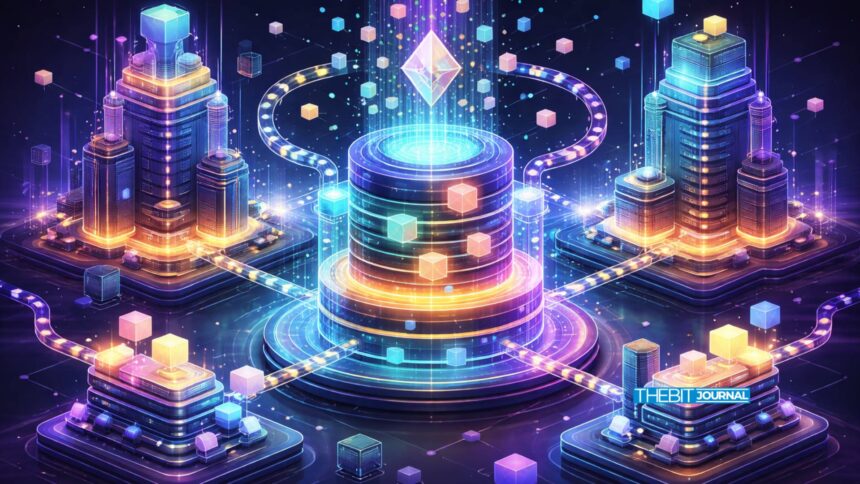
At a basic level, rollups move transaction execution away from Ethereum’s main chain, bundle many transactions together, and then send compressed data back to Ethereum for final settlement. That means users can still rely on Ethereum for security, while paying far less than they would on layer 1 for the same type of activity. Official Ethereum documentation explains that zero-knowledge rollups batch transactions offchain and submit summary data and a cryptographic proof to mainnet, while optimistic rollups process activity offchain and reduce computation on Ethereum itself.
That is the key idea behind blockchain rollups as they do not replace Ethereum. They extend it. In simple terms, Ethereum remains the court of final appeal, while the rollup handles the crowded day-to-day traffic. It is a bit like moving rush-hour traffic from a small city road onto a faster expressway, while keeping the same legal system and destination map.
Why Ethereum needed a second layer
Ethereum’s design prioritizes decentralization and security, but there is always a trade-off. A highly secure base layer cannot cheaply process endless demand at global scale all by itself. When NFT mints spike, meme coin trading explodes, or DeFi activity surges, fees can jump fast. That makes the network harder to use for smaller traders, developers, and everyday users.

This is where blockchain rollups changed the conversation. Instead of asking Ethereum to do every piece of work directly, they allow most activity to happen offchain and only anchor the important data back to Ethereum. Current Ethereum materials describe layer 2 networks as delivering lower fees and higher throughput while staying connected to Ethereum’s security.
For readers trying to understand the bigger market picture, this matters because scaling is not just a technical detail. It affects adoption, liquidity, user growth, application design, and fee competition across the entire crypto sector.
Blockchain Rollups Explained Through Optimistic and ZK Models
There are two main families of blockchain rollups. They solve the same problem in different ways, and the difference matters.
Optimistic rollups assume transactions are valid unless someone proves otherwise. They rely on fraud proofs, or fault proofs, to challenge incorrect state updates. This design keeps things conceptually simple and has helped networks like Arbitrum grow into major Ethereum scaling environments. Ethereum’s documentation describes optimistic rollups as systems that assume validity by default and only run heavier computation during a challenge. Arbitrum’s own documentation also identifies Arbitrum Rollup as an optimistic rollup that inherits Ethereum-level security.
ZK rollups work differently as they generate a validity proof that mathematically shows the batch of transactions is correct before finalizing it on Ethereum. Ethereum’s official documentation explains that ZK rollups submit both summary data and cryptographic proofs to mainnet. ZKsync’s documentation similarly describes ZK rollups as using validity proofs to provide scalable, lower-cost transactions secured by Ethereum.
That difference shapes user experience as optimistic systems often have longer withdrawal periods to Ethereum because there is a challenge window. ZK systems can offer faster final confirmation because proof verification replaces that waiting period, though the proving technology itself is harder to build. L2BEAT also notes that optimistic systems are accepted by default and can be challenged within a fraud-proof window.
Optimistic rollups
Optimistic rollups are practical, battle-tested, and easier to understand at first glance. They say, in effect, “this batch is valid unless challenged.” That approach has made them a major part of Ethereum scaling today.
For users, that usually means cheaper transactions and better speed than layer 1, especially for trading, bridging, and app interaction. For developers, it often means easier compatibility with Ethereum tools and smart contracts. The trade-off is the dispute period. Funds moving back to Ethereum may take longer because the system needs time to allow potential fraud challenges.
That trade-off does not make the model weak. In fact, it is one reason blockchain rollups became so important. They gave Ethereum a scalable path that could be deployed and used in the real market, not just discussed in research papers.

ZK rollups and the proof-first model
ZK rollups feel a bit more elegant, though they are technically more demanding. Instead of assuming honesty and waiting for disputes, they prove correctness upfront using cryptography. That can reduce withdrawal delays and improve efficiency, especially as proving systems mature.
The reason many analysts keep watching this space is simple. ZK technology has long been viewed as a powerful long-term scaling path for Ethereum. Projects such as ZKsync and Starknet built much of their value proposition around that idea, while Ethereum’s own documentation continues to present zero-knowledge rollups as a major layer 2 category.
Still, there is no need to romanticize one model and dismiss the other. Blockchain rollups are not a one-size-fits-all market. Different applications may prefer different trade-offs depending on cost, speed, compatibility, proof complexity, or liquidity.
Why rollups matter for crypto investors and users
For crypto investors, rollups are not just developer infrastructure. They influence fee trends, user migration, token utility, app growth, and the long-term value of Ethereum’s ecosystem. If users can trade, lend, mint, or play onchain at lower cost, they are more likely to stay active. That changes revenue flows, liquidity depth, and competitive positioning across the market.
For users, blockchain rollups can make crypto feel less like an expensive experiment and more like usable digital infrastructure. A cheaper swap, a faster transfer, or a low-cost game interaction sounds small on paper, but it changes behavior. People use what feels easy. They abandon what feels expensive.
Summing up
Blockchain rollups became central to Ethereum for one plain reason as they offer a way to scale without walking away from the security of the base chain. Optimistic rollups lean on challenge windows and practical deployment. ZK rollups lean on cryptographic proofs and faster final assurances. Both models matter, and both are shaping the next phase of Ethereum adoption. In that sense, blockchain rollups are no longer a niche topic for protocol researchers. They are part of the everyday foundation of modern crypto.
FAQs
What are blockchain rollups?
They are layer 2 systems that process transactions off the Ethereum mainnet and then post compressed transaction data or proofs back to Ethereum.
Why are rollups important for Ethereum?
They lower fees, increase throughput, and help Ethereum support more users and applications.
What is the main difference between optimistic and ZK rollups?
Optimistic rollups assume transactions are valid unless challenged. ZK rollups prove validity with cryptography before finalization.
Are rollups safer than sidechains?
Many rollups inherit stronger security properties from Ethereum because they settle and publish key data on Ethereum.
Do rollups reduce gas fees?
Yes. They usually make transactions far cheaper than executing the same activity directly on the Ethereum mainnet.
Glossary of Key Terms
Layer 1: The base blockchain, such as the Ethereum mainnet.
Layer 2: A network built on top of a base chain to improve speed and lower costs.
Fraud-proof: A mechanism used by optimistic rollups to challenge invalid transactions.
Validity proof: A cryptographic proof used by ZK rollups to show transactions are correct.
Settlement: The process of anchoring final transaction results to Ethereum.
Data availability: The requirement that transaction data remains accessible so the system can be verified securely.
Sources
Disclaimer: This article is for educational and informational purposes only and does not constitute investment, legal, or financial advice. Crypto assets and blockchain infrastructure involve risk, and readers should verify current technical and market developments before making decisions.