





Demand for tokenized real-world assets has surged in 2026 over the previous years, climbing to about $25 billion in value as traditional financial institutions further their involvement within blockchain-based finance.
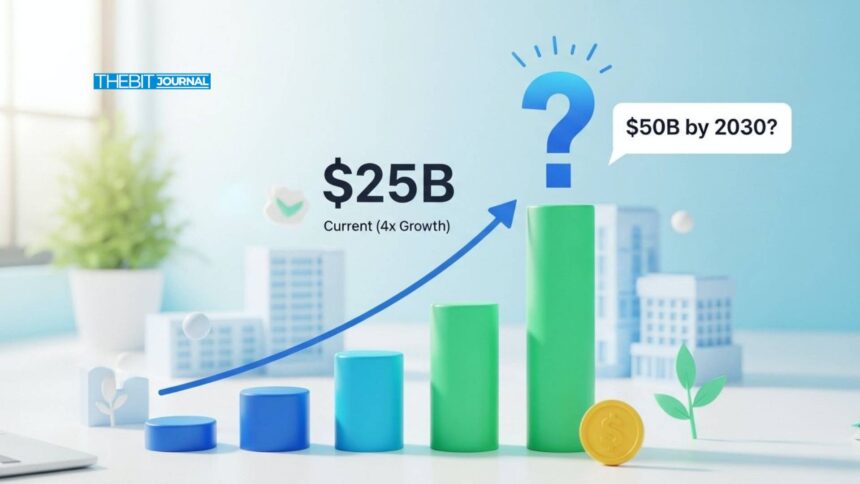
New data has revealed that tokenized real-world assets hit approximately $24.9 billion, a growth of around four times in the past 12 months. Much of this expansion has been led by institutions moving various kinds of assets, including U.S. Treasury securities, commodities, private credit and corporate bonds; onto blockchain rails.
These now make up a huge portion of the tokenized real world assets market as investment firms experiment with different formats of digital settlement. Along with the value, adoption metrics have increased as well. The wallets believed to hold tokenized real-world assets across major blockchain networks, including Ethereum, Solana, BNB Chain, and Celo have also risen.
Institutional Demand Drives Rapid Expansion
Banks, asset managers and financial platforms have adopted decentralized blockchain networks to issue tokenized versions of securities. This allows on-chain settlement for assets like bonds, treasury bills and funds while still being linked to the basic financial instruments.
In the latest market report, tokenized real-world assets reached $24.9 billion, representing 289% year-on-year growth and over $18 billion in one year.
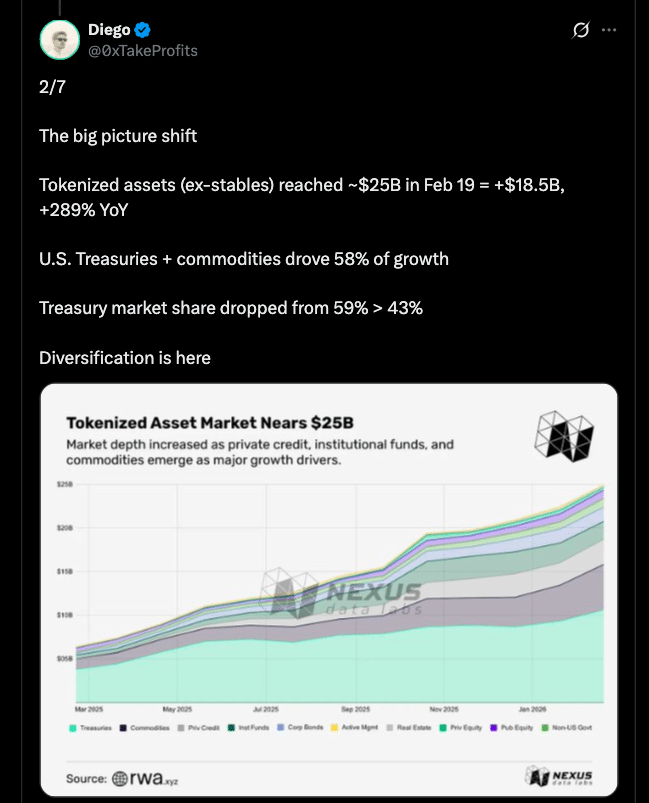
The fastest-growing segments have been Treasury products and commodities. Combined, the two segments now make up over $16 billion of tokenized value, putting them in a majority position in terms of market share.
Government securities especially have taken off as firms test tokenized treasury funds that offer exposure to conventional debt markets while operating in decentralized finance spaces.
The Market: Treasuries, Commodities and Institutional Funds
There are several asset classes that dominate activity in the tokenized real world assets space.
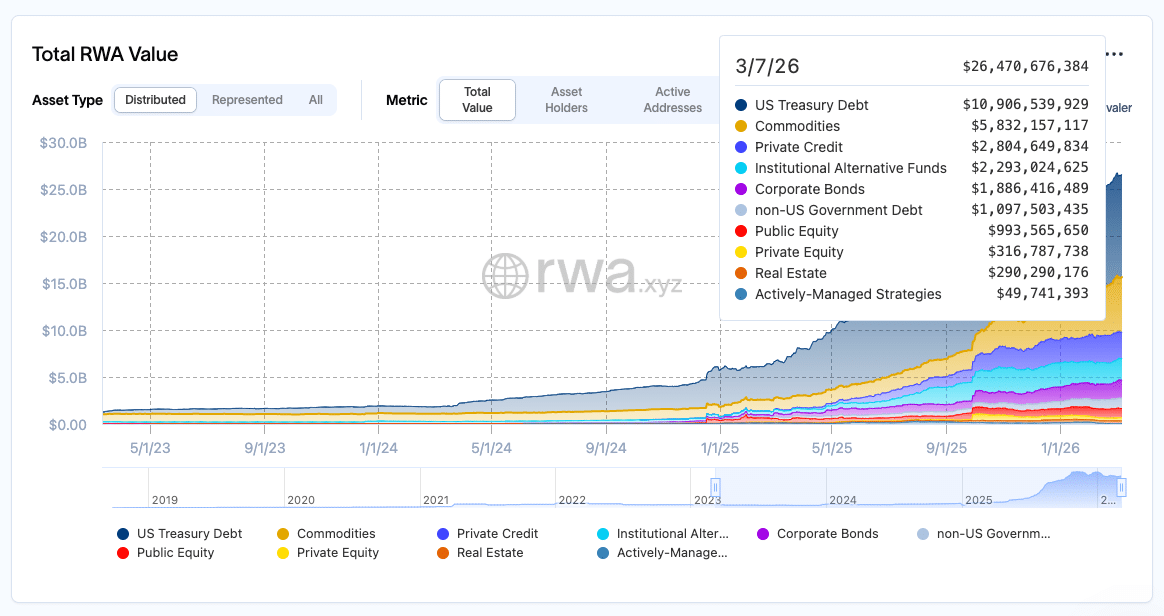
The tokenized U.S. Treasury instruments have grown to be one of the biggest segments in the market. There has been an increase of new investment firms launching treasury products based on the blockchain that traditional money-market funds, while offering on-chain settlement and programmable ownership structures.
Commodities are a big part of it, too. Gold-backed tokens, like those from Tether and Paxos, are finding a place as investors demand blockchain-based access to precious metals.
Another category is institutional funds. BlackRock’s BUIDL tokenized treasury fund has crossed about $2.2 billion, making the product one of the largest single products in this space.
Tokenized credit markets have also seen an increase of projects. Ondo Finance, a platform for tokenized yield products, has about $2 billion in the value of its tokenized assets.
Despite this concentration across these sectors, market data suggests diversification is on the rise. The share of all top asset categories combined has fallen to approximately 61%, demonstrating that new types of tokenized real-world assets are emerging.
Treasuries remain dominant even though it is down from around 59% to 43% as new products and asset classes arise.
Growth of RWA Holders Reveals Increasing Adoption
In addition to the increase in asset value, the number of investors holding tokenized real-world assets also grew across a multitude of blockchain networks. Data shows that the total amount of tokenized real-world assets currently held across various wallets continues to surge into 2026.
Ethereum is still the largest network for RWA activity. The number of Ethereum wallets holding tokenized RWAs recently hit a new all-time high around 169,000. In a distant second is Solana, with around 163,000 holders.
Participation has also increased on other networks. Celo had over 77,000 RWA holders and BNB Chain saw about 42,000 holders.
Growth has sprung also on newer ecosystems like Base and Arbitrum. The overall number of RWA holders between networks has crossed over 663,000, a 4% increase.
Stablecoins, which are commonly used as settlement assets for tokenized markets, have also grown. The number of stablecoin holders has climbed to approximately 233.2 million.
The Broader Blockchain Finance Ecosystem
While the tokenized RWA market itself is only valued to under $25 billion, the assets that these tokens encapsulate are worth much more. The estimated value of the combined represented assets is over $346 billion, despite a slight downturn of roughly 6% in just the month before.
Meanwhile, the total value of stablecoins which often provide liquidity for tokenized markets, stands at around $308 billion.
Ethereum is still a top dog in the RWA ecosystem. According to circulation figures, the network has approximately $14.7 billion of tokenized real-world assets and about 58% of the global market.
Major financial entities like BlackRock and Franklin Templeton have introduced blockchain-enabled financial products, while banks and fintechs are still trying to devise tokenization architectures.
Conclusion
The explosive growth of tokenized real world assets is an example of how quickly blockchain infrastructure is being embraced by traditional finance. Almost quadrupling in size over the past 12 months to about $25 billion, the sector has been driven by institutional participation and new tokenized investment products.
The surge in wallet activity across the major blockchain networks indicates that adoption is broadening beyond early adopters. But new categories keep emerging, with Treasury securities, commodities and institutions funds still the biggest segments.
If the current trend continues, analysts anticipate that the value of tokenized real-world assets will also grow further in coming years. Market estimates predict the sector crossing $50 billion by 2030, assuming it is over-collateralized as much established lending today is.
Glossary
Real-World Assets (RWA): Financial assets like bonds, commodities or credit instruments which are on a blockchain network and security tokens.
Tokenization: Tokenization is the process of converting rights to an asset into a digital token that can be issued on a blockchain.
Tokenized Treasury: A digital, blockchain-based form of government debt instruments like U.S. Treasury bills
Stablecoins: Cryptocurrencies that aim to keep a stable value, usually pegged to fiat currencies such as the U.S. dollar.
Blockchain: Distributed digital ledger that records transactions on multiple computers in a way so that the registered transactions cannot be altered retroactively.
Frequently Asked Questions About Tokenized Real World Assets
What are tokenized real-world assets?
Real-world assets are traditional financial products, such as bonds or commodities, that are converted into digital tokens on blockchain networks.
How big is the tokenized real-world asset market in 2026?
Approximately $24.9 billion, pushed by institutional demand.
What assets are prevalent in the RWA space?
A significant share of the market is dominated by U.S. Treasury securities, commodities (e.g., tokenized gold), investment funds opened to institutional investors, etc.
Which blockchain holds the highest amount of tokenized RWAs?
Ethereum is on top of the sector, owning over half of all global tokenized RWA value.
References