
The Layer 1 race in 2026 is not about who talks the loudest as it is about who ships, who stays online under stress, and who attracts builders that keep showing up after the hype cycles fade. In that sense, top layer 1 Blockchains are less like lottery tickets and more like operating systems: the winners tend to be boring in the best way, reliable, well supported, and hard to replace once real activity settles in.
Top Layer 1 Blockchains: the 2026 short list
The 2026 watchlist for top layer 1 Blockchains is best framed around measurable traction and credible technical direction, not slogans. Networks that combine steady throughput, predictable fees, and developer velocity usually earn the next wave of applications, even when price narratives lag for a while.
Ethereum remains the settlement anchor, even as much of the user activity lives on rollups. The key story is that Ethereum continues tightening its base layer economics and validator experience through upgrades such as Pectra, which developers scheduled and shipped in 2025, with broader user facing benefits depending on wallet and application support.
Solana, meanwhile, is treating performance and resilience as a product. A growing focus is client diversity, with Firedancer positioned as a second independent validator client alongside the main implementation, a meaningful step for reducing single client risk.
The signals that separate winners from noise
A serious 2026 review of top layer 1 Blockchains usually starts with a few indicators that tend to predict staying power.
First is reliability. Downtime is not a meme when real money is flowing. It becomes a direct tax on market makers, consumer apps, and payment rails. Second is execution quality: finality behavior, fee stability, and how the network handles spikes. Third is developer practicality, meaning tooling, debugging, audits, and whether teams can ship without building a full workaround stack.
A fourth signal is composability at scale. If the chain forces every successful application to isolate itself to survive, the ecosystem becomes a set of islands, not a market. Finally, the most overlooked signal is governance and upgrade discipline. Upgrades that ship on time, with clear scope, tend to attract long term builders who do not want to rebuild every quarter.
Ethereum in 2026: security premium and rollup gravity
Among top layer 1 Blockchains, Ethereum still earns a security premium. It functions as the base settlement and data availability hub for a large share of activity, even when users are not transacting directly on mainnet. The practical takeaway is that Ethereum often captures value through its role as a trust layer and coordination layer, not necessarily through raw base layer throughput.
Pectra is part of that arc. It is described as the next major Ethereum network upgrade and was scheduled to go live in May 2025, with improvements that support validator operations and broader usability, while the full user impact depends on ecosystem adoption.
For 2026 analysis, Ethereum’s key question is not whether it can scale alone. The question is whether its rollup centered design keeps improving user experience while preserving the credibility that institutions and high value protocols still care about.
Solana in 2026: performance, client diversity, and execution at scale
Solana sits on the opposite end of the design spectrum, and that is precisely why it stays in any honest discussion of top layer 1 Blockchains. Its pitch is simple: fast blocks, low fees, and an environment where consumer style apps can run without apologizing for every click.
The 2026 narrative is heavily shaped by client diversity and roadmap execution. Firedancer is frequently cited as a full reimplementation designed to improve throughput and fault isolation, while research notes also discuss multiple validator clients on mainnet as a resilience milestone.
None of that guarantees long term value capture by itself, but it does reduce platform risk, which matters when onchain markets start to resemble real venues rather than experiments.
Avalanche: modular networks and the cost of launching new chains
Avalanche stays on the list of top layer 1 Blockchains because it treats scaling as a network of customizable chains rather than a single crowded highway. The Avalanche9000 upgrade went live in December 2024 and was framed as a major step toward cheaper and easier launches of Avalanche L1 style networks, with changes linked to proposals such as ACP 77.
From an analysis angle, the bet is that many teams will want application specific environments without surrendering connectivity. If the tooling makes launching and maintaining those environments straightforward, Avalanche can win a meaningful slice of enterprise and gaming style deployments where predictable performance beats maximal composability.

Sui: low latency design and a move based developer story
Sui is often discussed as one of the newer top layer 1 Blockchains because it pushes parallel execution and low latency as first class design goals. The project highlights Mysticeti as a consensus approach aimed at reducing latency and improving throughput, and independent research has discussed sub second finality characteristics as a differentiator.
What matters in 2026 is whether that performance translates into sticky applications: games, social, high frequency trading style experiences, and consumer onboarding that does not feel like a ritual. The strongest thesis is not speed alone, but speed paired with onboarding features and developer productivity that reduce the usual friction.
Aptos: parallel execution, Move, and production maturity
Aptos belongs in a conversation about top layer 1 Blockchains when the criteria include predictable execution under load. Aptos has continued positioning around parallel execution and a Move based architecture, with recent materials emphasizing pipelined transaction processing and hardware efficient parallelism.
Aptos updates and roadmap communications in late 2025 also framed the next phase around execution stack improvements and performance maturity.
The 2026 lens is straightforward: the network needs to keep proving that performance remains stable as usage grows, and that its developer ecosystem becomes less niche. When that happens, it starts to look less like a promising chain and more like dependable infrastructure.
NEAR: chain abstraction and intent driven UX
NEAR enters the top layer 1 Blockchains shortlist through a different door: user experience and chain abstraction. NEAR’s own 2025 review and 2026 lookahead put chain abstraction and scaling an MPC network at the center of the roadmap, aiming to make multichain interactions feel native.
If that direction lands, NEAR can win a category that most chains talk about but rarely deliver: making cross chain activity feel like a single coherent product rather than a set of bridges and warnings.
BNB Chain and Cardano: governance, performance, and operating discipline
Any short list of Top Layer 1 Blockchains in 2026 usually includes BNB Chain due to operational scale and roadmap clarity. BNB Chain published a 2026 tech roadmap focused on scaling performance, execution quality, and resilience, while also citing previous performance benchmarks such as low fees around $0.01 in earlier updates.
Cardano remains the governance heavyweight in this mix. Cardano communications highlighted transitions toward community governance, including the Plomin hard fork and the broader governance framework that enables onchain actions and voting roles.
For 2026, governance is not a philosophical point. It is about whether a network can evolve without fracturing its social layer.
Conclusion
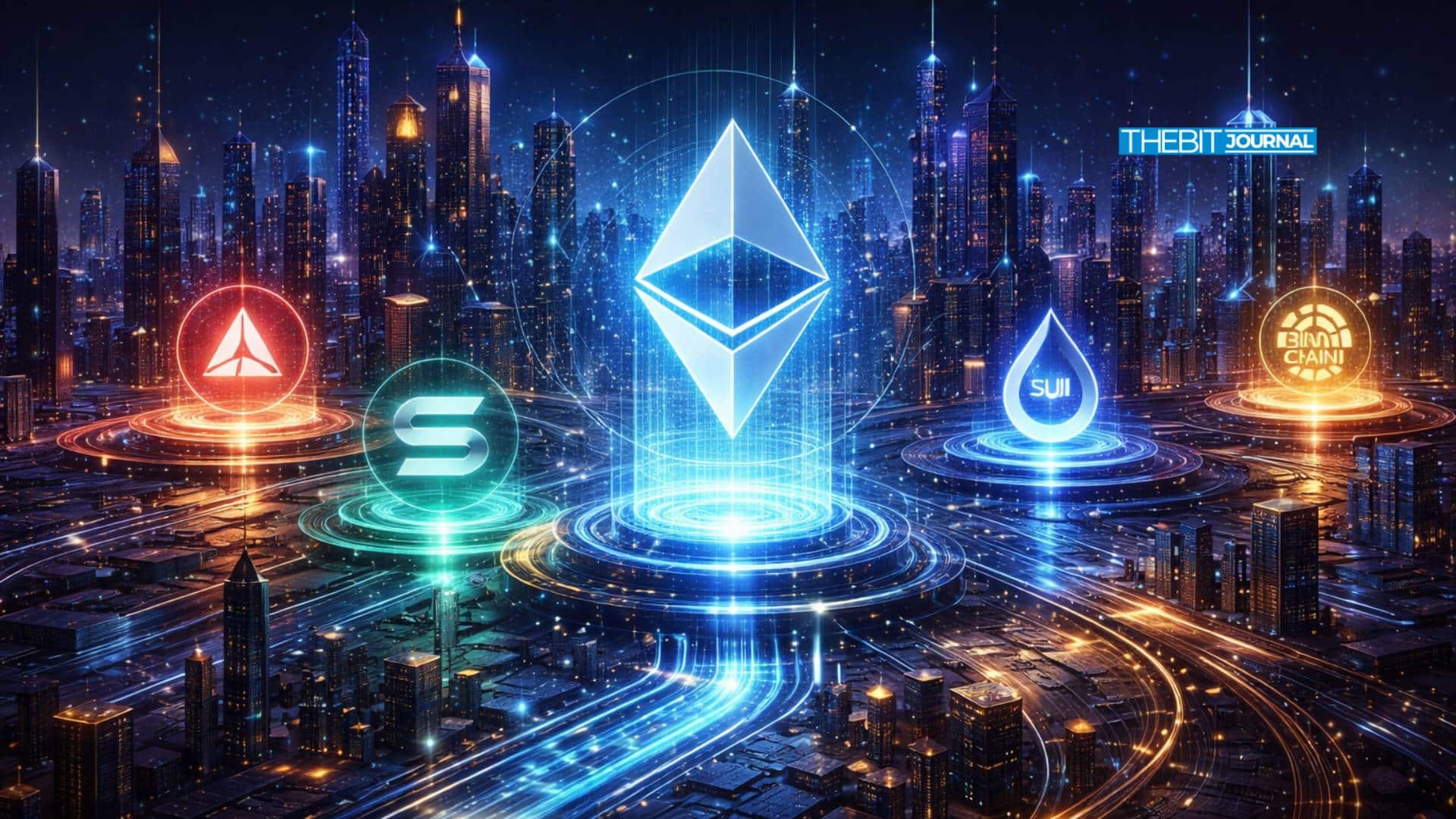
In 2026, top Layer 1 Blockchains are increasingly judged like infrastructure, not like experiments. Ethereum offers credibility and settlement gravity. Solana pushes performance and resilience through client diversity.
Avalanche leans into modular deployments. Sui and Aptos chase parallel execution and latency as product features. NEAR aims to hide multichain complexity behind a better UX, while BNB Chain and Cardano bring scale and governance into the mix. None of these narratives should be treated as a guarantee, but they do provide a practical map: follow uptime, follow developers, follow real usage, and treat flashy claims like background noise.
Frequently Asked Questions (FAQs)
What makes a Layer 1 “worth watching” in 2026?
Analysts typically focus on reliability, fee stability, upgrade cadence, and developer traction. A chain that stays online, ships upgrades cleanly, and keeps builders productive usually compounds adoption over time.
Is faster always better for Layer 1 networks?
Speed helps, but only when it comes with predictable behavior under load. A chain that is fast but fragile can lose institutional and consumer grade use cases quickly after one widely felt incident.
Why do rollups matter when discussing Layer 1 networks?
Rollups shift execution off the base layer while keeping settlement and security anchored to it. That changes how value and activity show up across the stack, especially for Ethereum style ecosystems.
Do token prices reflect network health?
Sometimes, but not consistently. Network health often shows up first in usage metrics and developer behavior, while price can be driven by macro liquidity and narrative cycles.
Glossary of key terms
Finality: The point at which a transaction is considered irreversible in practice.
Throughput: How many transactions a network can process over time, often measured as transactions per second.
Client diversity: Multiple independent implementations of node software, reducing the risk that a single bug brings down the network.
Data availability: The requirement that transaction data remains accessible so the network can verify state and prevent hidden manipulation.
MPC (multi party computation): A cryptographic approach where multiple parties jointly compute results without exposing private inputs, often used in advanced wallet and abstraction systems.
Sources
Disclaimer
This content is for informational and educational purposes only and does not constitute financial, investment, or legal advice.