







This article was first published on The Bit Journal.
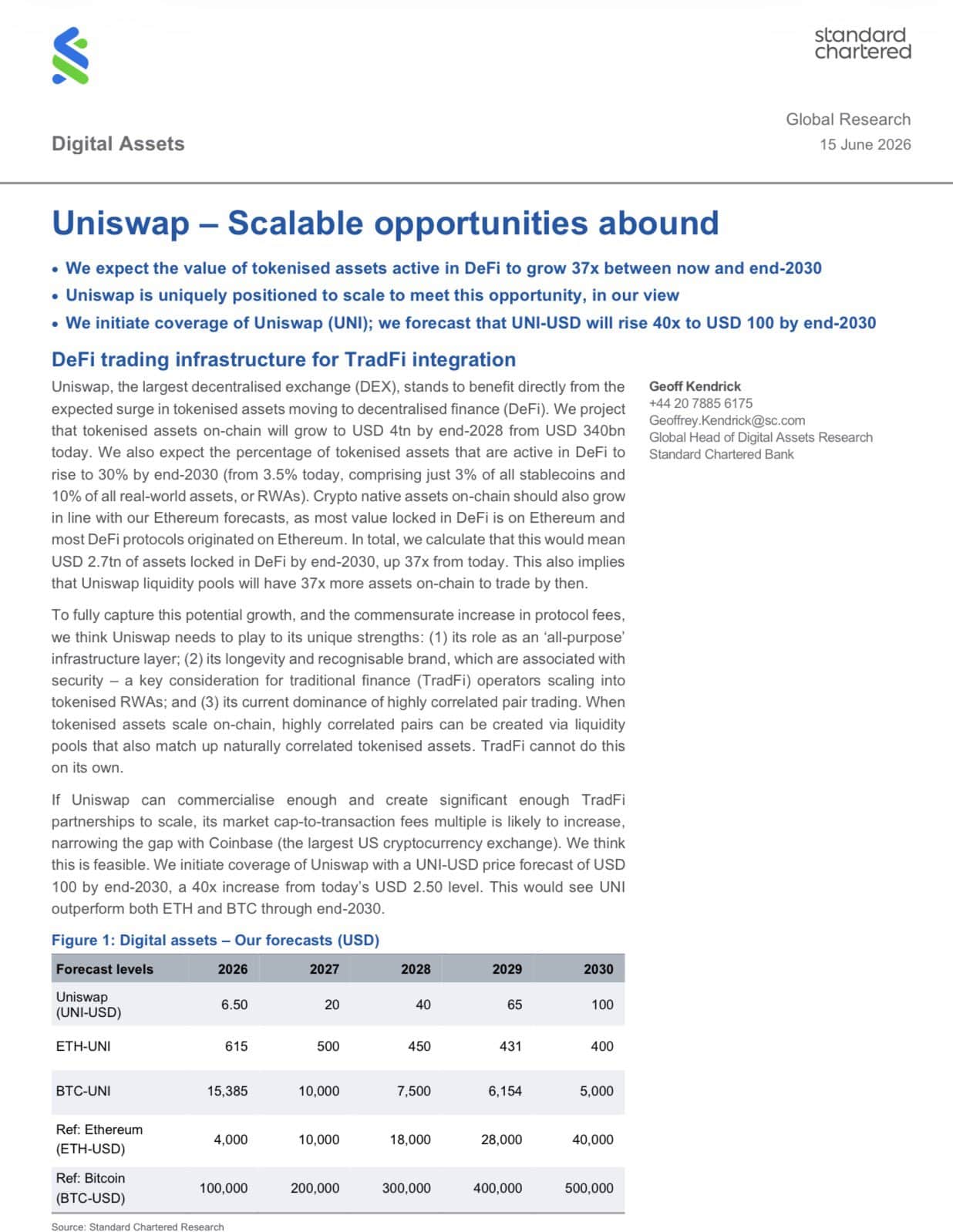
Standard Chartered is revisiting its $500,000 Bitcoin price target, along with $40,000 for Ethereum and $100 for Uniswap’s UNI token, all by 2030.
The bank’s latest projections come from Geoffrey Kendrick, Global Head of Digital Assets Research at Standard Chartered, who has repeatedly pressed the point that tokenization, stablecoins, DeFi and institutional blockchain adoption are going to be among the biggest growth drivers of the digital asset market in this decade.
Compared to this latest Standard Chartered crypto predictions, Bitcoin is currently trading at around $66,000, Ethereum is near $1,800, and UNI is around $3 after a recent rally that was fueled by the bank’s optimism.
Why Standard Chartered Remains Bullish Despite Current Weakness
The latest Standard Chartered crypto prediction is being projected after the bank decided to reduce several near-term targets.
According to Kendrick; Bitcoin could still face downside toward $50,000, while Ethereum could fall toward $1,400 before a durable recovery develops. Earlier projections for 2026 were also revised lower, with Bitcoin’s target reduced from $150,000 to $100,000 and Ethereum’s target cut from $7,500 to $4,000.
Yet despite the short-term worries, the bank’s long term forecasts remain unchanged.
Kendrick genuinely believes that current price weakness is not a direct indicator of what’s going on in the blockchain space. He points to rising stablecoin activity; growing adoption of tokenized assets, and continued institutional participation as reasons for sticking to their 2030 targets.
The main point here is that the forecast is about what’s going to happen over the next few years, not how the market is feeling right now.
Ethereum’s Amazon Comparison Still Makes Sense
Ethereum plays a role in the Standard Chartered crypto prediction. Kendrick recently made an interesting comparison between Ethereum’s current situation and that of Amazon in the aftermath of the dot-com crash. Amazon’s stock collapsed from around $113 to just $6 between 1999 and 2001 even though the company’s business fundamentals were improving.
The bank is arguing that Ethereum may be experiencing a similar disconnect between its price and the network activity. Despite ETH’s underperformance relative to Bitcoin, Ethereum is still the dominant network for stablecoins, DeFi and tokenized real-world assets.
Standard Chartered expects Ethereum to be one of the primary beneficiaries of institutional tokenization efforts. The bank argues that traditional financial firms are more likely to build on Ethereum because of its security, maturity and established ecosystem. This is one of the reasons why they’re forecasting ETH to reach $40,000 by 2030, one of the most ambitious institutional targets currently on record.
Why UNI Could Take the Lead
While Bitcoin and Ethereum get most of the headlines, the most aggressive component of the Standard Chartered crypto prediction is actually Uniswap.
The bank is forecasting UNI to hit $6.50 in 2026, $20 in 2027; $40 in 2028, $65 in 2029 and $100 by 2030. Kendrick thinks that the growth of tokenized assets will have a huge impact on DeFi and that assets actively used in DeFi could see a 37 fold increase by 2030; pushing the total value locked in the sector up to $2.7 trillion.
Because Uniswap is still one of the largest decentralized exchanges, Standard Chartered views it as a direct beneficiary of rising on-chain trading volumes.
Kendrick went on to say that UNI could outperform both Bitcoin and Ethereum by the end of the decade assuming those trends keep rolling on.

What Could Prevent These Standard Chartered Crypto Prediction From Becoming Reality?
Standard Chartered crypto prediction is by no means a certainty.
For Bitcoin to make it to the $500,000 target, institutional investors will have to remain strong despite all the ETF outflows and changing macroeconomic conditions. Ethereum meanwhile needs to turn its network growth into sustained price gains after years of underperforming Bitcoin.
UNI depends heavily on continued expansion of decentralized finance and tokenized asset adoption.
There are also a lot of other uncertainties like regulatory risks, other competing blockchain ecosystems and even general economic issues that could slow things down.
Conclusion
The latest Standard Chartered crypto prediction shows a bullish vision for the future of digital assets by 2030. Bitcoin at $500,000; Ethereum at $40,000 and UNI at $100 are enormous gains from where prices are right now.
While Kendrick acknowledges that Bitcoin could revisit $50,000 and Ethereum could drop to $1,400 before recovering; the bank continues to argue that stablecoins; tokenization, and decentralized finance will create substantial value over the next decade.
Glossary
Bitcoin (BTC): The biggest cryptocurrency in terms of market cap
Ethereum (ETH): A blockchain platform that is used for smart contracts, stablecoins and DeFi
UNI: The governance token of the Uniswap decentralized exchange
Tokenization: The process of representing real-world assets on blockchain networks.
DeFi: Decentralized finance applications that operate without traditional financial intermediaries.
Frequently Asked Questions About Standard Chartered Crypto Prediction
What is Standard Chartered’s Bitcoin forecast for 2030?
Standard Chartered predicts Bitcoin could hit $500,000 by 2030.
What is Standard Chartered’s Ethereum prediction?
The bank expects Ethereum to reach $40,000 by 2030 and by the end of 2026 it predicts it could be at $4,000.
What is Standard Chartered’s UNI forecast?
Standard Chartered are forecasting UNI to climb to $100 by 2030, with some more specific targets on the way at just $6.50 in 2026.
Why is the bank so optimistic about Ethereum?
The bank believes stablecoins, DeFi activity, and tokenized assets will increasingly rely on Ethereum’s network infrastructure.
References