






When a big crypto theft hits the headlines, the public story moves fast, as wallets get labeled, investigators post warning threads, exchanges tighten filters, and everyone watches the same addresses like hawks. What happens next is quieter and more methodical, because the people moving stolen funds rarely rely on one trick. They follow a pipeline, and in that pipeline privacy coins tend to appear at a very specific moment, like a quick change of clothes before walking back into a crowded room.
Why privacy coins show up after hacks
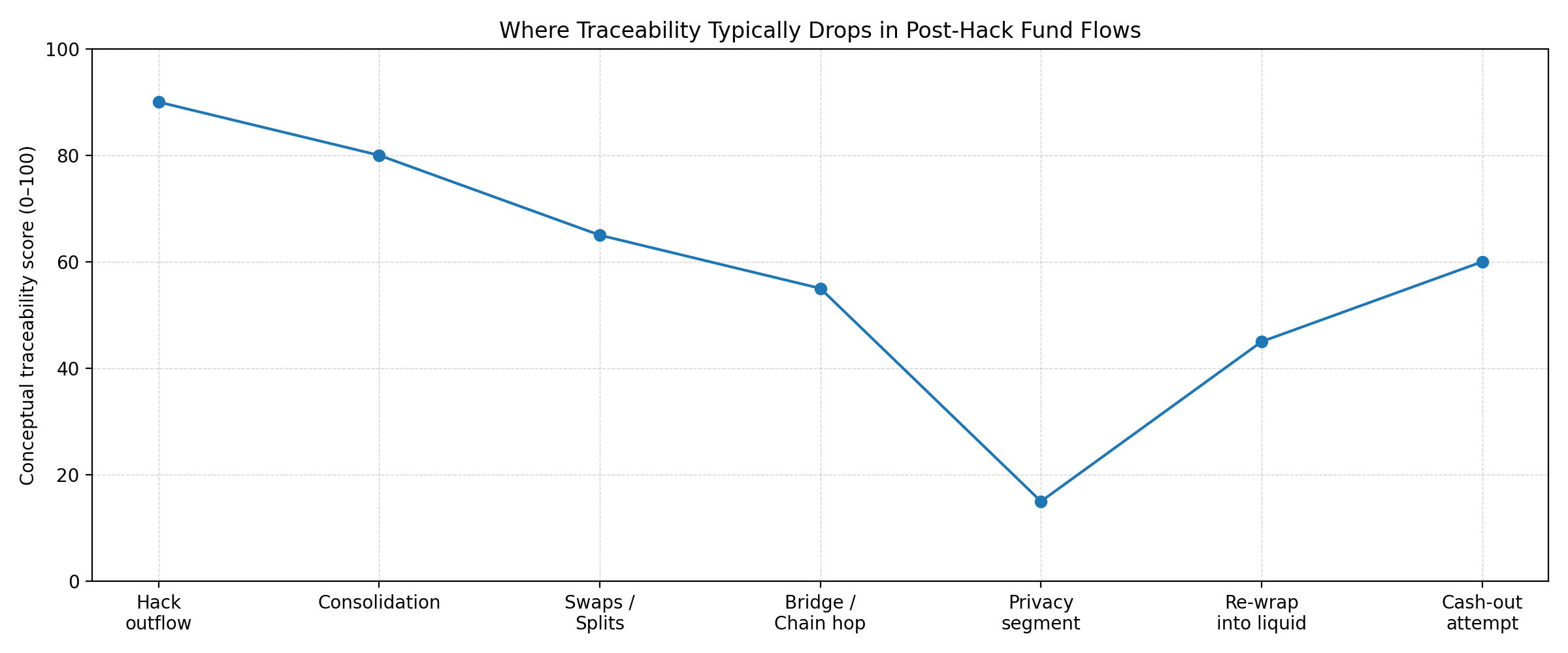
The common myth is that hackers steal assets, swap into a shielded token, then vanish. Real-world fund flows are usually more layered. Stolen crypto often starts as highly liquid assets, then moves through consolidation wallets, cross-chain routes, and swapping patterns that are designed to exhaust basic tracking. Only after that groundwork does the “visibility break” become useful, which is why privacy coins can look like a sudden clue in the middle of the trail.
The first stage is consolidation as attackers typically sweep funds from many source wallets into fewer addresses, because managing hundreds of inputs is messy and risky.
The second stage is obfuscation through routine-looking transfers: splitting amounts, recombining them, and timing movements to avoid simple heuristics.
The third stage is chain hopping, often via bridges, because moving value across networks can interrupt clean attribution and force analysts to rebuild context. A major blockchain analytics firm has repeatedly flagged bridges as a favored laundering step for service-targeting thefts in recent years.
Then comes the privacy layer. This is where privacy coins function less like an end destination and more like a temporary fog machine. If the attacker can insert one segment where amounts, counterparties, or linkage become hard to verify, it can break the neat story that investigators want to tell.
The window when everyone is watching
Right after a hack, time becomes the enemy. The longer stolen assets sit in plain view, the higher the odds that downstream counterparties will freeze or blacklist them. That is why privacy coins are most attractive immediately after the first round of swaps and hops, when the attacker wants to reduce visibility without getting stuck in low-liquidity corners.
There is also a practical angle that gets missed in online debates about “good privacy” versus “bad privacy.” Many criminals still want to cash out into something spendable, and that usually means re-entering venues with compliance controls. So the goal is often not to live inside a privacy system forever, but to use it as a short detour. In that sense, privacy coins can act like taking side streets to avoid a traffic camera, not like moving to a different country.
The indicators analysts and traders should actually watch
A useful way to think about post-hack movements is that every step leaves a different kind of footprint. On-chain transparency does not disappear just because the flow is complex. It just means the signal is spread out.
One indicator is rapid consolidation after the event. When many inputs funnel into a small set of wallets within hours, it often points to operational control rather than organic market activity. Another indicator is the “peel” pattern, where a wallet repeatedly sends out smaller chunks while keeping a remainder, like spending from a stack of bills. Analysts also watch cross-chain moves that follow a tight rhythm, because chain hopping is often done quickly to stay ahead of blacklist updates.
A third indicator is the pivot into privacy coins after several hops. That sequence matters because it suggests intent to interrupt attribution rather than a simple portfolio change. A fourth indicator shows up at the edges: cash-out attempts through deposit addresses at centralized services, which are often where compliance teams can still intervene.
A separate money laundering review from the same analytics sector emphasizes how concentrated laundering can become at the deposit-address level, which is useful because it points to chokepoints rather than endless wallet graphs.

Regulation is shaping the route, not removing it
Policy pressure rarely eliminates laundering methods outright. It tends to reshape them. As enforcement actions target mixers and certain laundering services, criminals test alternatives that are harder to sanction or shut down. The US Treasury has sanctioned multiple mixers over time, describing their use in laundering illicit proceeds. That environment increases the incentive to experiment with routes that offer built-in opacity, which is another reason privacy coins can appear in the flow.
Global standard setters have also highlighted the risks of anonymity-enhancing tools in the virtual asset ecosystem, including anonymity-enhanced cryptocurrencies and services that reduce transparency. This matters for readers because it explains why some exchanges delist certain assets, why some jurisdictions restrict marketing or access, and why off-ramps become more selective over time. The result is not a clean “ban versus no ban” story, but a shifting map where criminals chase the weakest enforcement seams.
At the same time, it is important to avoid simplistic conclusions. The presence of privacy coins in a post-hack route does not prove that every user is suspicious, and it does not mean all laundering is unstoppable. It means defenders have to focus on the broader pipeline, especially the moments where value moves back into liquid assets and regulated rails.
What this means for markets, builders, and everyday holders
For investors, the key lesson is behavioral, not ideological. Markets can react to headlines about privacy tools because they assume fresh illicit demand. Sometimes that demand is real, but it can also be short-lived, because criminals are often using a brief segment and then moving on. Liquidity constraints and listing pressure can also cap how much value can realistically pass through a single asset class at scale.
For builders and compliance teams, the lesson is that the fight is at the seams: bridges, swapping venues, deposit clusters, and the handoff between chains. That is where alerts, better attribution, and smarter risk scoring can reduce the payoff of laundering tactics without treating normal privacy needs as a crime.
Conclusion
Hackers do not launder funds in a straight line, and they rarely bet everything on one tool. In that broader pipeline, privacy coins often show up as a tactical pause in visibility, used when scrutiny is hottest and traceability is most dangerous. Understanding that sequence helps readers separate signal from noise, and it keeps the focus on the real chokepoints where enforcement and risk controls still matter.
Frequently Asked Questions
Why do hackers use privacy tools after a hack?
They often do it to disrupt traceability during the highest-scrutiny period, then continue laundering through other routes until a cash-out path opens.
Do privacy-focused assets always indicate crime?
No. Many users want financial privacy for legitimate reasons. Risk appears when suspicious timing, routing, and cash-out behavior line up with a theft pattern.
What is the strongest on-chain sign of laundering?
A combination is more telling than any single move: rapid consolidation, repeated splitting, chain hopping, and then a detour into privacy coins before attempting to cash out.
Can exchanges stop post-hack flows?
They can slow or block some exits by flagging deposit patterns and cooperating on sanctions compliance, but criminals adapt by shifting venues and routes.
Glossary of key terms
Chain hopping: Moving value across different blockchains to complicate tracking.
Bridge: Infrastructure that transfers assets or messages between chains, sometimes used in laundering routes.
Mixer: A service designed to obscure transaction history by pooling and redistributing funds, often targeted by enforcement.
Consolidation: Sweeping many inputs into fewer wallets to simplify control of funds.
Deposit address: A receiving address tied to a user account at a centralized service, often a key compliance chokepoint.
Anonymity-enhancing cryptocurrency: A virtual asset designed to reduce transaction transparency, discussed in global AML risk guidance.
Disclaimer: This article is for educational and informational purposes only and does not constitute financial, legal, or investment advice.
Sources
U.S. Department of the Treasury