





In 2025, the question of how to secure a crypto wallet is no longer a niche concern. It is a basic survival skill for anyone who holds digital assets. With billions of dollars stolen from cryptocurrency platforms and services in the past year alone, criminals are clearly treating crypto as a prime hunting ground.
Hackers do not only target large exchanges as they go after individual investors, DeFi users, and even casual traders. Social engineering campaigns, malware, fake support chats, and phishing pages are all tuned to one goal: separating a person from a private key or seed phrase. In this environment, wallet security is no longer optional. It is part of basic financial hygiene.
Why 2025 Is Different For Crypto Wallet Security
The threat landscape has grown more aggressive and more professional. State linked groups and organized criminal networks now specialize in draining wallets and exploiting weak security setups. In some regions, a large share of investors report that they have already been targeted or scammed through phishing and fake investment schemes.
At the same time, tools for defense are better than ever. Hardware wallets, smart contract wallets, multi-factor authentication, and even wallet address checkers that flag risky destinations all exist and continue to evolve.
For anyone asking how to secure crypto wallet today, the answer sits at the intersection of technology, habits, and ongoing education.
Secure Your Crypto Wallet: Top Tips For 2025
A strong security setup follows a simple pattern. Hot wallets are treated as spending accounts. Cold wallets behave like long term vaults. Access is protected with strong authentication. Recovery plans are written, tested, and kept offline. Monitoring for new scams becomes a routine, not a special task.
In practical terms, those who really master How to secure crypto wallet build layers. If one control fails, another one stands in the way. No single password, device, or platform holds the keys to an entire portfolio.
Two Factor Authentication: First Line Of Defense
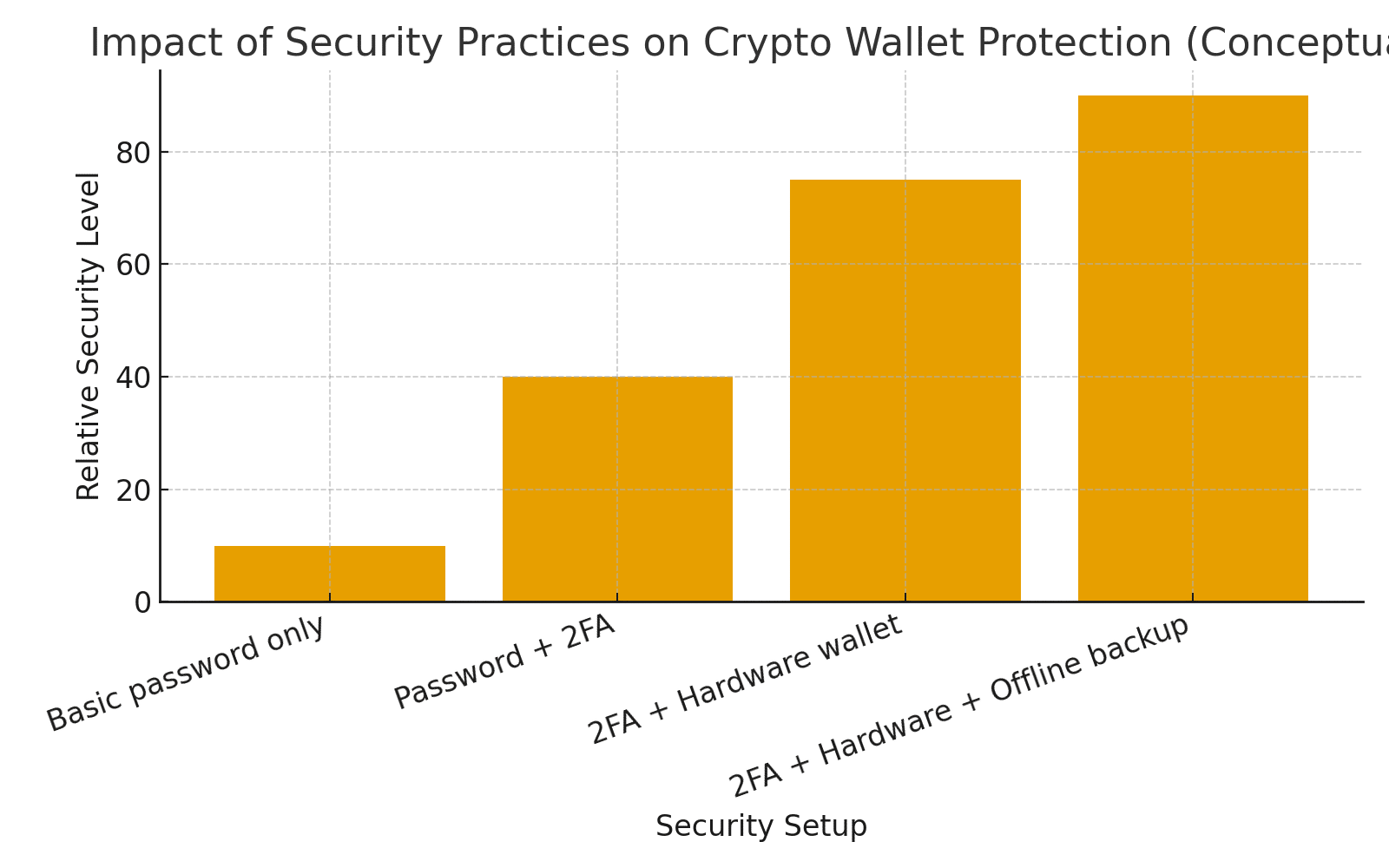
When experts explain how to secure crypto wallet, they often start with two factor authentication. Passwords alone fail far too often. People reuse them, choose weak versions, or type them into fake pages. Once a password leaks, a criminal can walk straight into a wallet account that relies on that one secret.
Two-factor authentication adds a second step. Ideally, it uses app-based codes, hardware security keys, or device-based passkeys rather than basic SMS, which can be vulnerable to SIM swap attacks. Security researchers note that multi factor setups that rely on separate devices or secure enclaves significantly reduce takeover risk in practice.
Every wallet, exchange account, or DeFi access point that allows stronger authentication deserves that setting turned on. It is boring, but it is a genuine life saver.
Cold Storage And Hardware Wallets As A Vault
Anyone with meaningful holdings who asks how to secure crypto wallet needs to think in terms of hot and cold. Hot wallets connect to the internet and DeFi apps. They provide speed and convenience, but they also expand the attack surface. Cold wallets, especially hardware devices that keep private keys offline, offer a far safer home for long term holdings.
A practical approach works like this. A smaller amount stays in a hot wallet that interacts with dApps and exchanges. Larger amounts sit in one or more hardware wallets, stored securely and only connected when required. Some security guides even recommend separate wallets for trading, savings, and experimental DeFi activity.
This structure means that a compromised browser extension or malicious smart contract cannot drain an entire portfolio in one move.
Seed Phrases, Backups, And Recovery Planning
A wallet is only as safe as its recovery plan. Seed phrases and private keys need to exist in exactly two states: fully secret and fully accessible to the rightful owner. That balance is harder than it sounds.
Best practice keeps seed phrases offline, written by hand and stored in a secure location such as a safe, or split into parts across multiple locations to reduce the impact of physical theft or disaster. Digital screenshots, cloud backups, and email attachments create easy targets for attackers and should be avoided.
Investors who truly understand how to secure crypto wallet treat recovery like a fire drill. They know where their backups are, who has access, and how to restore a wallet step by step. Families and business partners also need clarity, so that funds are not lost forever if something happens to the primary holder.
Phishing, Social Engineering, And The Human Factor
In many cases, hackers do not break cryptography. They attack people. Phishing emails, fake support chats, malicious browser extensions, and counterfeit airdrop pages all aim to convince a person to sign a toxic transaction or reveal a seed phrase. Studies show that phishing and social engineering drive a large share of crypto related fraud and losses globally.
That reality changes how to secure a crypto wallet should be understood. Security is not only a matter of software settings. It is also about habits. Careful users double-check URLs, type addresses manually for critical actions, and treat any unsolicited message about a wallet as suspicious by default. They do not share seed phrases with support agents, influencers, or supposed auditors, because legitimate services never ask for that information.
New tools, such as wallet address checkers that compare targets against known scam databases, can provide an extra safety net, but they do not replace basic caution.
Device, Network, And App Hygiene
Wallet security also depends on the health of the devices that hold it. Malware that records keystrokes or intercepts clipboard data can bypass even careful behavior. Security professionals recommend regular software updates, reputable antivirus solutions, and clean, dedicated devices for significant crypto operations.
Public Wi-Fi, untrusted VPNs, and random browser extensions can all introduce risk. A conservative setup uses a modern operating system, a hardened browser, and a minimal list of extensions that are genuinely required. For high-value operations, many serious investors even prefer offline signing on air-gapped devices, although that level of rigor may be overkill for small portfolios.
Why Asset Quality And Crypto Indicators Also Matter
The phrase how to secure crypto wallet sounds like it refers only to keys and passwords, but asset choice also influences risk. Some tokens sit in poorly audited smart contracts or in ecosystems with frequent bridge exploits. Holding them can feel like parking a car in a rough neighborhood.
Key indicators help investors judge this risk. Market capitalization and liquidity show whether a token has depth or can be easily manipulated. Volatility shows how violent price swings can be. On-chain activity, such as daily active addresses and transaction volume, provides a sense of real usage rather than hype. Security indicators, such as completed smart contract audits, bug bounty programs, and a history without major exploits, add another layer of comfort.
When these metrics look weak, even the best technical answer to How to secure crypto wallet may not be enough. Fragile assets in fragile ecosystems carry structural risk, regardless of personal hygiene.
Segmentation, Limits, And Ongoing Learning
Effective security does not try to eliminate all risk. It aims to keep losses survivable. That is why segmentation matters. Splitting funds across multiple wallets, using separate accounts for experimentation, and setting personal limits for any single platform can reduce the impact of one failure.
Education is the final ingredient. Crypto crime reports show that attackers constantly change tactics, from fake job offers to deepfake support calls.
Investors who regularly review security news, read about recent hacks, and adjust their own setups stay ahead of many threats.
Conclusion: Security As An Ongoing Practice
In the end, how to secure crypto wallet is not one action. It is a routine. Strong authentication, cold storage, clean devices, careful recovery planning, and regular education all work together. There will always be new exploits, clever scams, and sophisticated attackers.
However, those who treat wallet security like a long-term habit, not a one-time checklist, dramatically improve their odds. For anyone holding meaningful digital wealth, that shift in mindset may be the most valuable protection of all.
This article offers general educational information only and cannot replace tailored advice from a qualified security or financial professional. Investors should assess their own risk profile, regulatory environment, and technical skills before choosing any specific setup.
Frequently Asked Questions
What is the safest way to store a large crypto balance?
For most long term holders, a reputable hardware wallet used as cold storage, combined with offline seed phrase backups, is considered one of the safest options, provided that device security and recovery planning are handled carefully.
Is two factor authentication really necessary for a crypto wallet?
Yes. Two factor authentication significantly reduces the risk of account takeover when a password leaks. App based codes or hardware keys are generally safer than SMS alone.
Can a seed phrase be stored in the cloud if it is encrypted?
Technically it can, but this approach increases the attack surface. Many security professionals prefer offline storage in secure physical locations, with clear access controls and, if needed, a split phrase model.
How often should a crypto holder review security settings?
A regular review every few months is sensible, and any major portfolio change or new DeFi activity should trigger another check of wallet settings, backups, and device hygiene.
Glossary Of Key Terms
Crypto Wallet
A software or hardware tool that stores private keys and allows users to send, receive, and manage cryptocurrencies.
Private Key
A secret cryptographic string that proves ownership of funds on a blockchain. Anyone with the private key can control the associated assets.
Seed Phrase
A human readable list of words that can recreate a wallet and its private keys. It serves as the master backup for many wallets.
Two Factor Authentication (2FA)
A security method that requires two separate forms of verification, usually a password plus a second factor such as an app code or hardware key.
Cold Storage
A storage method that keeps private keys completely offline, often in a hardware wallet or on an air gapped device, to reduce exposure to online attacks.
Hot Wallet
A wallet that stays connected to the internet for frequent use in trading or DeFi. It offers convenience but also more exposure to attacks.
Social Engineering
A set of tactics where attackers manipulate people into revealing confidential information or performing actions that compromise security, often through phishing or fake support.
References/Sources