





This article was first published on The Bit Journal.
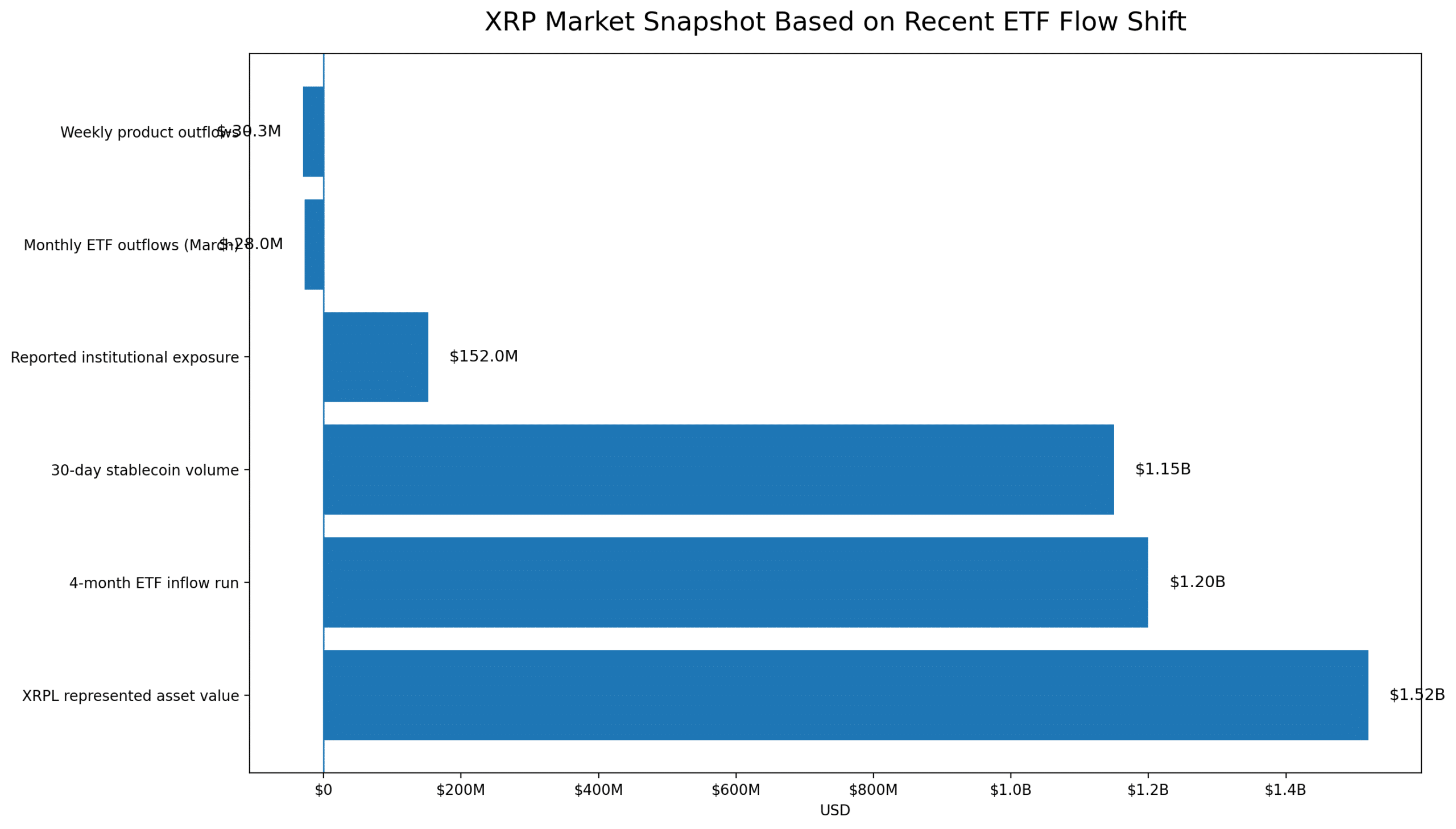
After months of strong demand, XRP ETFs have finally hit a patch of softer ground. March is shaping up to be the first month of net outflows since the funds began trading in late 2025, ending a streak that had pulled in roughly $1.2 billion in just a few months.
At first glance, that looks like a warning sign. In practice, it is more complicated than that. The flow picture has weakened, yes, but the wider institutional case around XRP and the XRP Ledger still appears to be moving forward, which makes this less of a collapse and more of a reality check after an unusually hot start.
Why XRP ETFs just lost momentum in March
The latest flow data shows that the market has cooled, one dataset points to about $28 million in monthly net redemptions for the spot funds, while another showed XRP-linked investment products posting $30.3 million in weekly outflows earlier in March.
That does not erase the earlier surge, but it does show that fresh money is no longer arriving at the pace seen in November and December. In plain terms, the honeymoon phase looks over. Funds often launch with a burst of curiosity, media attention, and fast allocation. After that, investors start asking harder questions about staying power, liquidity, and whether the underlying asset can justify the initial excitement.
That shift matters because ETF flows often act as a sentiment gauge. When money enters steadily, it tends to reinforce the idea that institutions are building exposure with conviction. When flows flip negative, even modestly, traders read it as a sign that demand is becoming selective.
March has also been a choppier month for digital asset products more broadly, with post-Fed caution and shifting macro expectations cooling risk appetite across the sector. That means the recent weakness around XRP ETFs may say as much about the market mood as it does about XRP itself.
Institutional interest has not vanished with the outflows
Here is where the story gets more interesting as even with softer fund flows, institutional exposure has not disappeared. Recent reporting tied a major global bank to more than $152 million in exposure across four spot XRP products. That detail matters because it suggests the buyer base is not made up only of fast money looking for a trade.
Some traditional players still appear willing to keep a seat at the table, even after the first wave of easy inflows faded. That is usually how a market matures. The loud early enthusiasm fades, and quieter, longer-horizon positioning starts to matter more.
The underlying network story also helps explain why interest has not simply fallen apart. Data from the XRP Ledger page on a leading tokenization analytics platform shows represented asset value near $1.52 billion and stablecoin transfer volume above $1.15 billion over 30 days. Stablecoin market cap on the network was around $400.77 million as of March 26.
Those figures do not prove instant success, but they do suggest that activity on the ledger is broadening beyond price speculation. That is important because institutions usually care more about utility, settlement rails, and compliance-friendly infrastructure than they do about a single strong month of ETF demand.
That is why the recent turn in XRP ETFs should be read carefully. Fund flows tell one part of the story, but adoption at the network level tells another. If the ledger keeps attracting stablecoin usage, tokenized asset activity, and enterprise-friendly tooling, then ETF demand may end up following utility rather than leading it. In other words, the market may be moving from a hype phase into a proof phase. That is not always comfortable, but it is often healthier.

What the market should watch next
For now, the key indicators are fairly clear. Investors should watch whether XRP ETFs continue posting redemptions into April or stabilize after March. They should also watch network-side metrics such as stablecoin transfer volume, represented asset value, and whether more institutional names show exposure to the products. If flows recover while ledger activity stays firm, the current weakness may look like a temporary pause. If both sides weaken together, the market will have to reassess the strength of the thesis.
The bigger takeaway is simple enough. XRP ETFs have lost some early momentum, but that alone does not settle the argument around XRP. The first burst of enthusiasm has clearly cooled. Even so, the asset is still backed by a live infrastructure story, and that gives the market something more durable to measure than sentiment alone. For a sector that often swings between excitement and doubt, that is not a bad place to be.
Conclusion
The recent reversal in XRP ETFs marks an important change in tone, but not necessarily a broken narrative. Early inflow streaks were always going to be hard to sustain, especially in a market that still reacts sharply to liquidity conditions and macro headlines. What matters now is whether real network activity can carry the story forward after the easy momentum fades. That next stretch will say much more than one month of outflows ever could.
Frequently Asked Questions
What happened to XRP ETFs in March?
XRP ETFs shifted from steady inflows to monthly net outflows, ending their early post-launch streak.
Does that mean institutions are leaving XRP?
Not necessarily. Reported institutional exposure and XRPL activity suggest interest has not disappeared.
What should investors watch next?
They should watch fund flows, stablecoin transfer volume, and tokenized asset growth on XRPL.
Glossary of Key Terms
XRP ETFs: Exchange-traded funds that give investors exposure to XRP through a regulated fund structure.
Net outflows: The amount of money withdrawn from a fund after subtracting new inflows.
Stablecoin transfer volume: The value of stablecoin transactions processed on a blockchain over a set period.
Represented asset value: The on-chain value of tokenized real-world assets tracked on a network.
Sources
Disclaimer: This article is for informational purposes only and does not constitute investment advice. Digital assets are volatile, and readers should conduct independent research before making financial decisions.