







This article was first published on The Bit Journal.
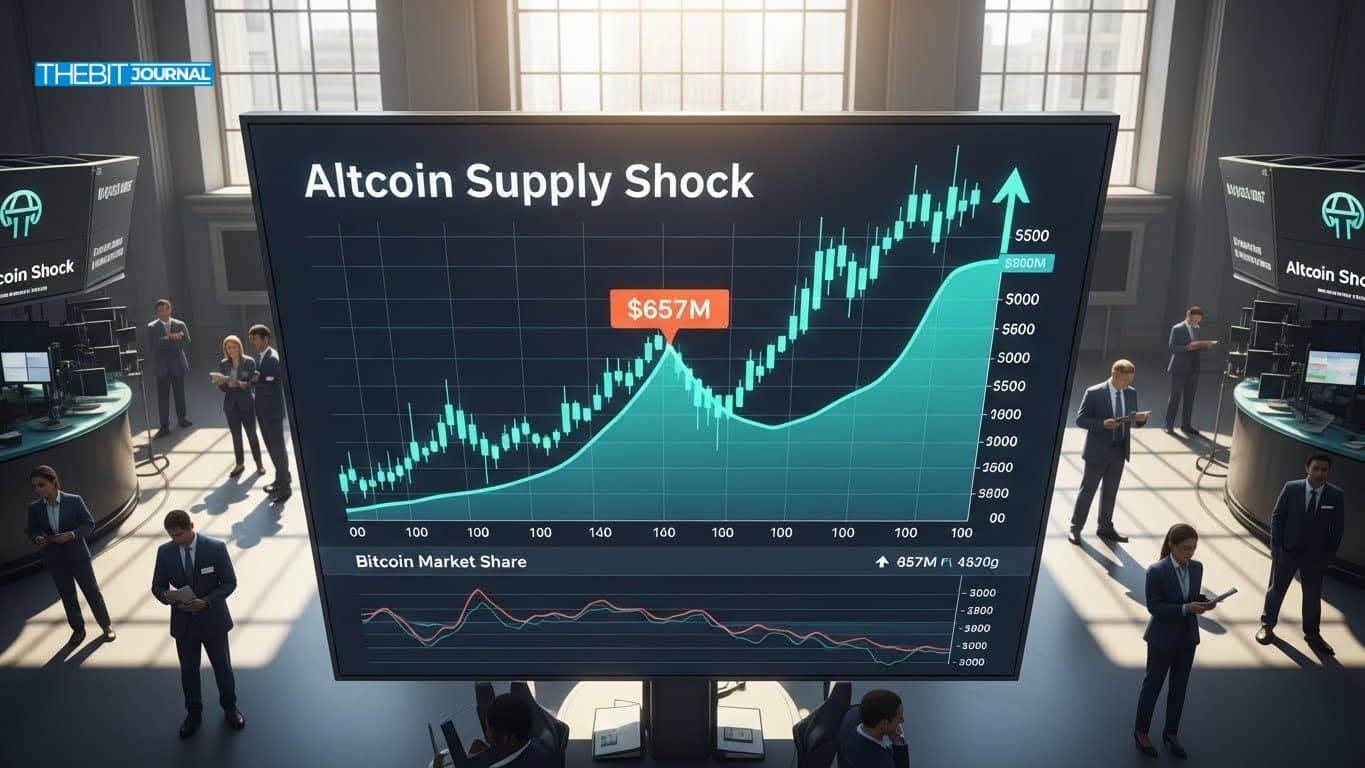
Altcoins seem to have entered a critical phase as over $657 million worth of scheduled token unlocks hit the markets at a time when capital isn’t concentrated only on Bitcoin.
Since the beginning of 2026, almost $250 billion has entered crypto markets with not even half of that going to Bitcoin.
This is notable because it hints at a market-driven rally, not just built on Bitcoin dominance.
The scale and distribution of future altcoin token unlocks present a real supply test, clarifying whether capital rotation into alts is structural or fleeting.
Sensitivity Around a $657 Million Supply Event And Its Message
Token unlocks inflate the circulating supply of a cryptocurrency as locked tokens become unlocked and can be made available on the market.
Economically speaking, more supply can push prices lower if demand does not grow at the same rate. That is why large unlock events are generally considered cautiously, particularly in negative sentiment/low liquidity environments.
The current situation is different. Over $657 million of altcoin tokens unlocking is scheduled in a short period to come, but in this instance, they are coming during risk-on market dynamics.
Inflows of capital since early 2026 indicate renewed interest in digital assets, and, significantly, that interest is not plotting the course toward Bitcoin.
Typically, only about 40% of the $250 billion net inflows has gone toward Bitcoin. The remaining has gone to other portions of the market. This is a tell-tale sign that more investor capital allocation decisions are being made with opportunity in mind and not simply throwing the hat into Bitcoin as the first order entry tactic.
Now, the upcoming supply increase is not arriving to an empty market. It is entering one that is already circulating more widely.
Capital Allocation Implies A Market-Driven Rally
One major conclusion to be drawn from this data is the difference of a rally led by Bitcoin versus one led by the market. In Bitcoin-driven uptrends, money begins in BTC and slowly moves over to altcoins. This dynamic frequently holds back meaningful participation from altcoins.
Now the current environment has a different shape. With less than a half of inflowing new capital going to Bitcoin, the rally seems diversified from the get-go.
This has importance because it changes how supply shocks are absorbed. With ample liquidity already live across a number of assets, new supply doesn’t automatically equal sell-side pressure. That instead becomes a test of whether demand can absorb the increase.
This however is not to say that the full altcoin cycle has arrived. What it does demonstrate is the presence of the preconditions for rotation.
Capital is flowing regardless of Bitcoin dominance, and that sets the stage for altcoins to start reacting to their own fundamentals and market structures.
Long Compression Period in ALT/BTC Structure
One of the most relevant signals is provided by ALT/BTC. In the past, long altcoin cycles usually occurred after alts had underperformed against BTC for longer periods of time before they turned around.
Market report points out that ALT/BTC has been decreasing for nearly four years. At that time, RSI was very oversold and momentum was still negative. The prolonged compression also matters because it provides the grounds for structural shifts once momentum changes.
The relative strength index appears extremely oversold, and the MACD has flashed bullish after nearly 21 months. This indicates that downside momentum might have run out at the end of 2025.
This is not a guarantee of breakout, but it suggests that the longstanding downtrend may no longer be increasing.
Previous cycles like late 2016 into early 2017 played out in a similar fashion with relative altcoin strength bottoming first and expanding after. The comparison is for context, not to predict. Structurally, it’s similar, but the follow-through with respect to the flows of capital and liquidity is still required.
One-Time and Linear Unlocks Create Uneven Supply Pressure
All token unlocks are not created equal on the market. The approaching supply event of $657 million includes both one-time cliff unlocks and gradual linear unlocks, which is important for the distribution of pressure.
One-time unlocks release a lot of tokens at the same time, flooding out into circulation. Hyperliquid and Aptos fall into this category.
Hyperliquid alone is scheduled to unlock some 12.7 million HYPE, or nearly $330 million in tokens based on current prices. This is a meaningful supply increase that will challenge short-term demand.
Linear unlocks on the other hand, adds supply in increments. Other assets like Solana, TRUMP and DOGE also release over $1 million in their daily token dumping beyond a one time event. This structure helps spread supply pressure out over time, giving markets an opportunity to adjust.
Ironically, the fact that both models are present in the same week shows why this is an important time. It produces several experiments in real time in how disparate supply mechanisms intersect with liquidity and demand under the same macro conditions.
Hyperliquid as a Special Case of Absorbing Supply
Of the past unlocks, Hyperliquid is notable for its on-chain location. Its open interest, meanwhile, is around $8.79 billion now, higher than the coin’s 24-hour trading volume of over $7 billion, according to Coinglass. Total value locked is $4.30B, making it the leading DEX token by these measures.
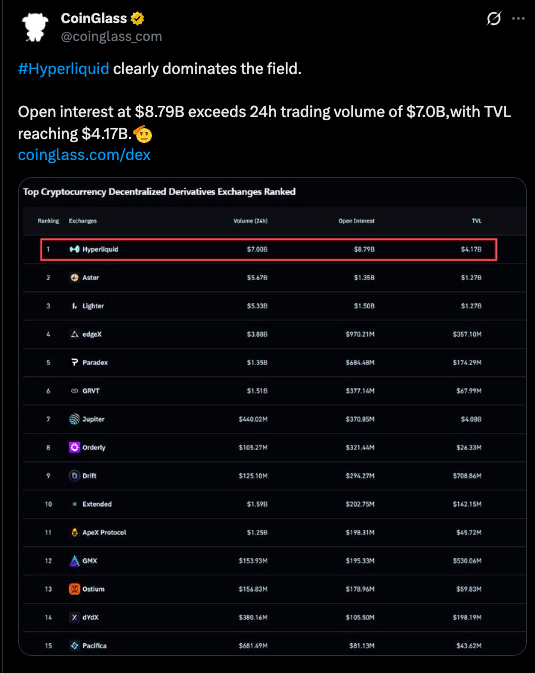
These numbers matter because they imply active participation and a deep pool of liquidity. When open interest exceeds trading volume, it indicates sustained engagement rather than short-term speculation. High TVL also means that capital is being put to use within the ecosystem instead of lying idle.
This doesn’t mean market will not see volatility on the unlock. What it does suggest is that some altcoins come into this supply event with structural assistance behind them.
Tokens with weaker engagement on slimmer liquidity, however, might suffer other results on equivalent supply boosts.
Conclusion
That $657 million altcoin supply shock isn’t happening in a vacuum. It is colliding with a market that has already moved off its focus on Bitcoin and onto more widely distributed capital.
Following verified data, new inflows are not decidedly Bitcoin-focused and the changes in technical indicators indicate that the underperformance of altcoins compared to BTC could have calmed down after several years of sluggish performance.
The unlocks themselves provide legitimate supply pressure, but their impact will hinge on the structure and depth of liquidity. One-off releases test on-spot demand, linear release indicates the prolonged absorption.
Together, they give a clear indication of whether current market conditions can withstand an altcoin-driven cycle not based on Bitcoin dominance.
Glossary
Token unlock: release of previously restricted tokens into circulation supply.
ALT/BTC: It indicates how the altcoins are performing compared to Bitcoin.
Open interest: The total value of all derivative open positions.
Total value locked: how much capital is committed in a protocol.
Linear unlock: percentage released over time advancing.
Frequently Asked Questions About Altcoin Supply Shock
Why is there an altcoin supply shock now?
The shock is supply related in that over $657M of programed unlocks in tokens is being released to daily tradability within a short period .
Why does the shifting of capital away from Bitcoin make a difference?
It indicates that capital is being spread throughout the market and no longer only betting on Bitcoin, reconfiguring the way supply increases are absorbed.
Are token unlocks always bearish?
Not necessarily. Their effects vary according to timing, market liquidity and whether demand can absorb the added supply.
Does it mean an altcoin cycle is reestablishing?
No. The data shows the structural factors are in place to assist rotation, but it warns against assuming a full altcoin cycle.
References