






The Bitcoin price climbed above $67,000 after news of a ceasefire agreement between the United States and Iran sparked fresh optimism across global markets. Stocks rallied, oil prices tumbled, and investors returned to risk assets. Yet despite the strong move, not everyone in the crypto market is convinced the rally has staying power.
According to the source, Bitcoin gained nearly 4% in a single day and triggered more than $210 million in short liquidations. While the surge caught bearish traders off guard, derivatives markets continued to flash warning signs. That disconnect has reignited debate over whether the latest move could become a Bitcoin bull trap, even as broader market conditions improve.
A Geopolitical Breakthrough Lifts Risk Assets
The ceasefire announcement immediately boosted investor confidence. Brent crude oil dropped to a 100-day low, while the Nasdaq 100 Index advanced 3% and traded just 1% below its all-time high. Falling oil prices often reduce inflation pressure and recession concerns, creating a more supportive environment for growth assets.
The Bitcoin price benefited from this shift, but traders remain cautious. The agreement reportedly lacks a final implementation deadline, and conflicting reports about future shipping tolls in Iran continue to create uncertainty. Since the current arrangement only covers a two-month period, investors are waiting for clearer guidance before fully embracing the rally. Those unanswered questions continue to fuel discussion about a potential Bitcoin bull trap.
Bitcoin Price Rally Fails to Win Over Derivatives Traders
While the Bitcoin price surged, futures data suggests professional traders remain unconvinced. Verified data shows Bitcoin’s annualized futures basis rate remains near 2%, well below the neutral 4% threshold associated with stronger bullish demand.
The Bitcoin price is also still down 24% year to date, helping explain the market’s hesitation. Although short sellers were squeezed out of positions, traders have not aggressively increased leveraged bullish bets.
The options market tells a similar story. Bitcoin put options traded at a 16% premium over call options, showing strong demand for downside protection. These signals suggest concerns about a Bitcoin bull trap have not disappeared despite the recent rally.
ETF Demand and Strategy Keep Long-Term Confidence Alive
Institutional demand remains mixed. US-listed spot Bitcoin ETFs attracted $86 million in net inflows on Friday. However, those inflows have not been enough to offset the $730 million in net outflows recorded since June 5.
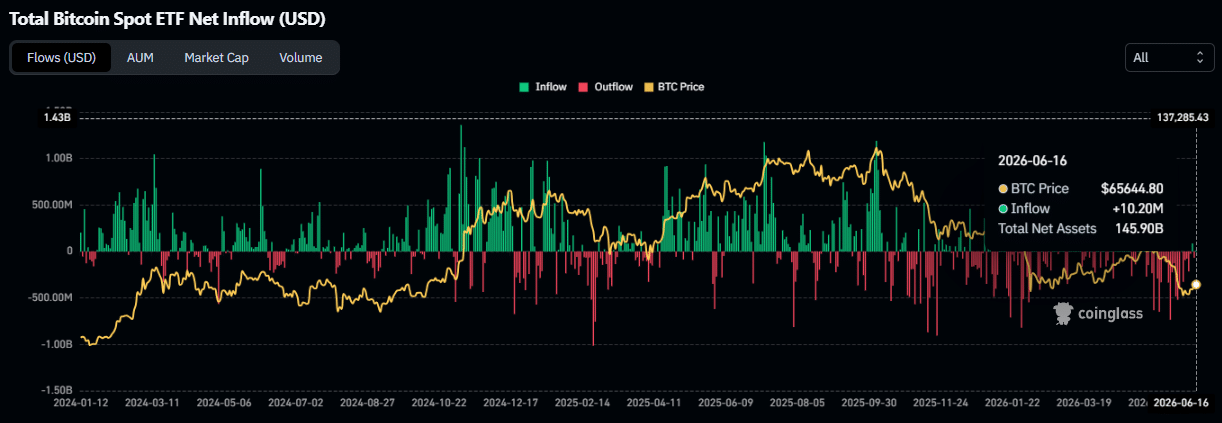
The Bitcoin price continues to find support from corporate buyers. Strategy remains committed to accumulating Bitcoin, helping reduce fears of a sudden market capitulation. This steady buying activity continues to strengthen the long-term outlook for the Bitcoin price.
Many analysts believe Strategy’s continued purchases weaken the argument for a Bitcoin bull trap, particularly as institutional investors maintain exposure during periods of uncertainty.
Stocks Embrace Risk While Crypto Traders Stay Defensive
One of the most striking themes in the market is the contrast between traditional finance and crypto derivatives. While stock investors embraced risk, crypto derivatives traders remained defensive.
The Nasdaq traded near record highs, and enthusiasm around artificial intelligence stocks continued to grow. SpaceX added to that optimism after completing a record-breaking $75 billion IPO. The company reached a valuation of roughly $2.1 trillion after shares surged 14%.
Recent SEC filings also revealed that SpaceX holds 18,712 Bitcoin on its balance sheet. This highlights continued corporate confidence in digital assets. Yet despite these bullish developments, traders remain cautious. For now, Bitcoin bears maintain control of the broader market structure as derivatives data continues to show weak conviction.
Traders are not only questioning the rally but also showing limited confidence that the $60,000 support zone can withstand another wave of selling pressure. This lingering uncertainty keeps the Bitcoin bull trap narrative alive across the market.

Conclusion
The Bitcoin price has gained support from improving geopolitical conditions, falling oil prices, institutional accumulation, and stronger risk appetite across traditional markets. At the same time, weak futures premiums, cautious options positioning, and uncertainty surrounding the Iran agreement show that skepticism remains deeply rooted.
Still, current data does not provide clear evidence of a Bitcoin bull trap. While derivatives traders remain cautious, current market data does not support the view that the latest Bitcoin price rally is a Bitcoin bull trap. Strategy’s continued accumulation also reduces the risk of a sudden market capitulation, offering additional support for the Bitcoin price.
If lower oil prices continue easing recession concerns and give the Federal Reserve room to adopt a less restrictive policy stance, the Bitcoin price could regain momentum toward $70,000 and beyond. Until then, the Bitcoin price remains at the center of a market divided between caution and optimism.
Glossary of Key Terms
Bitcoin Bull Trap: A false rally that attracts buyers before prices reverse lower.
Futures Basis: The difference between Bitcoin’s spot price and futures price.
Spot Bitcoin ETF: An exchange-traded fund that directly holds Bitcoin.
Put Option: A contract that gains value when an asset’s price declines.
Short Liquidation: The forced closure of bearish positions after a sharp price increase.
FAQs About Bitcoin Price
What caused the latest Bitcoin price rally?
The rally followed a ceasefire agreement between the United States and Iran, which improved risk sentiment across financial markets.
Why are traders concerned about a Bitcoin bull trap?
Weak futures data and elevated demand for downside protection suggest many traders remain cautious.
How much money flowed into Bitcoin ETFs?
US-listed spot Bitcoin ETFs recorded $86 million in net inflows, although recent outflows still total around $730 million.
What could help Bitcoin move above $70,000?
Lower oil prices, stronger ETF demand, continued institutional buying, and a less restrictive Federal Reserve could support further gains.
Sources/References