






Bitcoin Is Walking a Tightrope at $60,000
Bitcoin has not exactly been printing confidence lately as for five straight days heading into late June 2026, the leading cryptocurrency has been breaching the $60,000 level on a daily basis, with $59,000 stepping in as the fragile floor beneath it. At the time of reporting, BTC was trading at $60,352, slipping 0.19% on the daily chart. That kind of price action, grinding, uncertain, and range-bound, is exactly the environment where big money tends to make its most calculated moves.
And that is precisely what happened as a newly created Bitcoin whale wallet withdrew 1,350 BTC, valued at roughly $81.87 million, directly from Binance. No gradual accumulation, no layered orders spread across weeks. Just one decisive move that immediately triggered conversations across the on-chain analytics community.
A Bitcoin Whale Makes an $81.9M Move at a Critical Price Level
When a Bitcoin whale operates through a freshly created wallet and pulls nearly $82 million worth of BTC off a major exchange in a single transaction, it sends a clear signal to anyone paying attention.
This is not speculative retail behavior, this is the kind of capital deployment that institutional-grade participants or ultra-high-net-worth investors make when they believe the risk-reward setup favors accumulation.
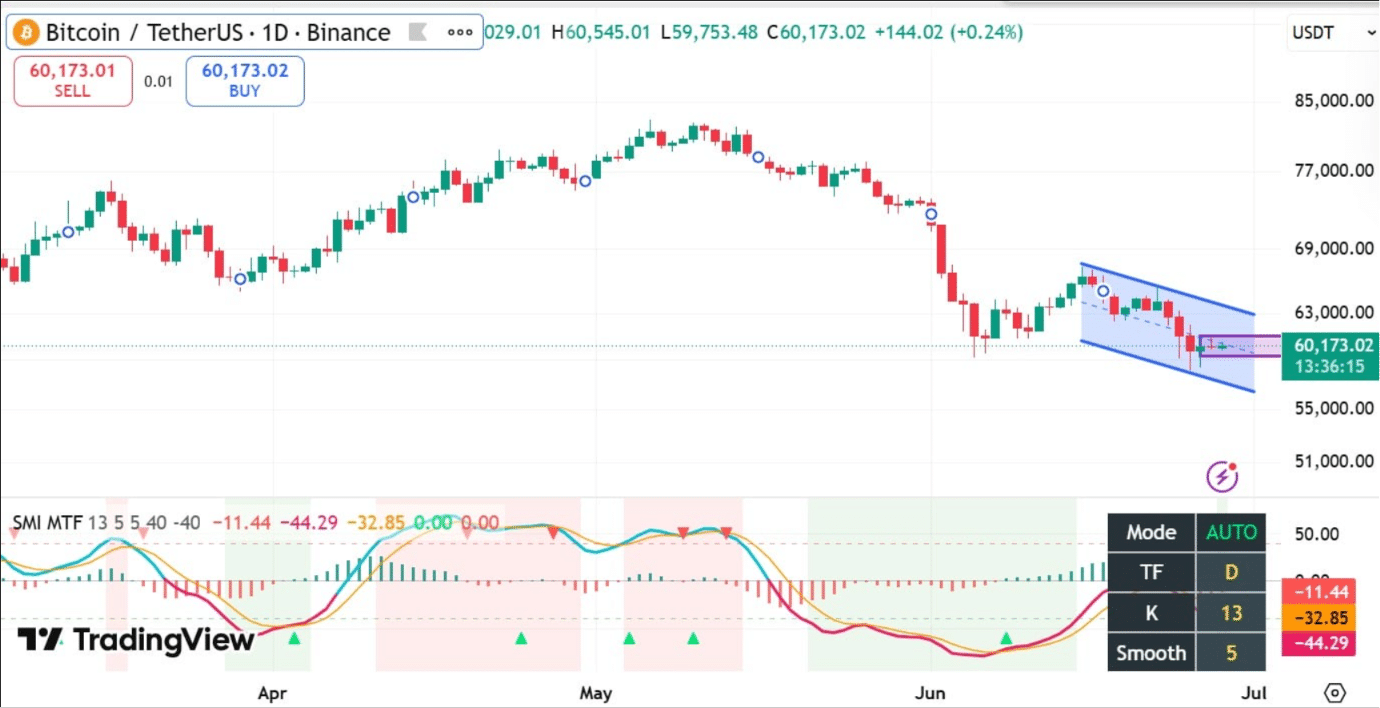
According to on-chain data from a leading blockchain monitoring platform, the withdrawal happened against a backdrop of heavy Bitcoin whale activity across the spot market over the past week.
Large spot orders have been clustering consistently at the $59,000 and $60,000 price levels, effectively marking this zone as a recognized accumulation range among major holders. Think of it the way value investors circle a beaten-down stock trading near its 52-week low. The logic is similar: buy where conviction is high and price is weak.
What the On-Chain Data Reveals Beneath the Surface
On-chain metrics are the closest thing crypto has to X-ray vision into market behavior, and right now they are painting a nuanced picture. Exchange Netflow, which tracks the net movement of Bitcoin into and out of trading platforms, has stayed negative for three consecutive days at around -125 BTC. That persistent outflow is meaningful because it tells analysts that spot market participants, on balance, are choosing to move Bitcoin into self-custody rather than keeping it on exchanges where it could easily be sold.
Historically, sustained negative netflow during a period of price weakness has preceded recoveries. It does not guarantee a rally, but it does suggest that selling pressure is not building the way bears would need it to in order to drive prices significantly lower. The Bitcoin whale accumulation observed this week fits directly into that pattern, reinforcing the idea that larger players are positioning for what comes next rather than running for the exits.
Bearish Momentum Is Still a Real and Present Risk
Here is where the picture gets complicated, and where any honest market analysis has to pump the brakes slightly. The SMI MTF, a multi-timeframe momentum oscillator that helps traders gauge the strength and direction of price trends, is sitting at -43 at the time of writing. Any reading in that deeply negative territory is a flag that sellers are still dictating the pace of this market, and that the bears have not handed over control yet.
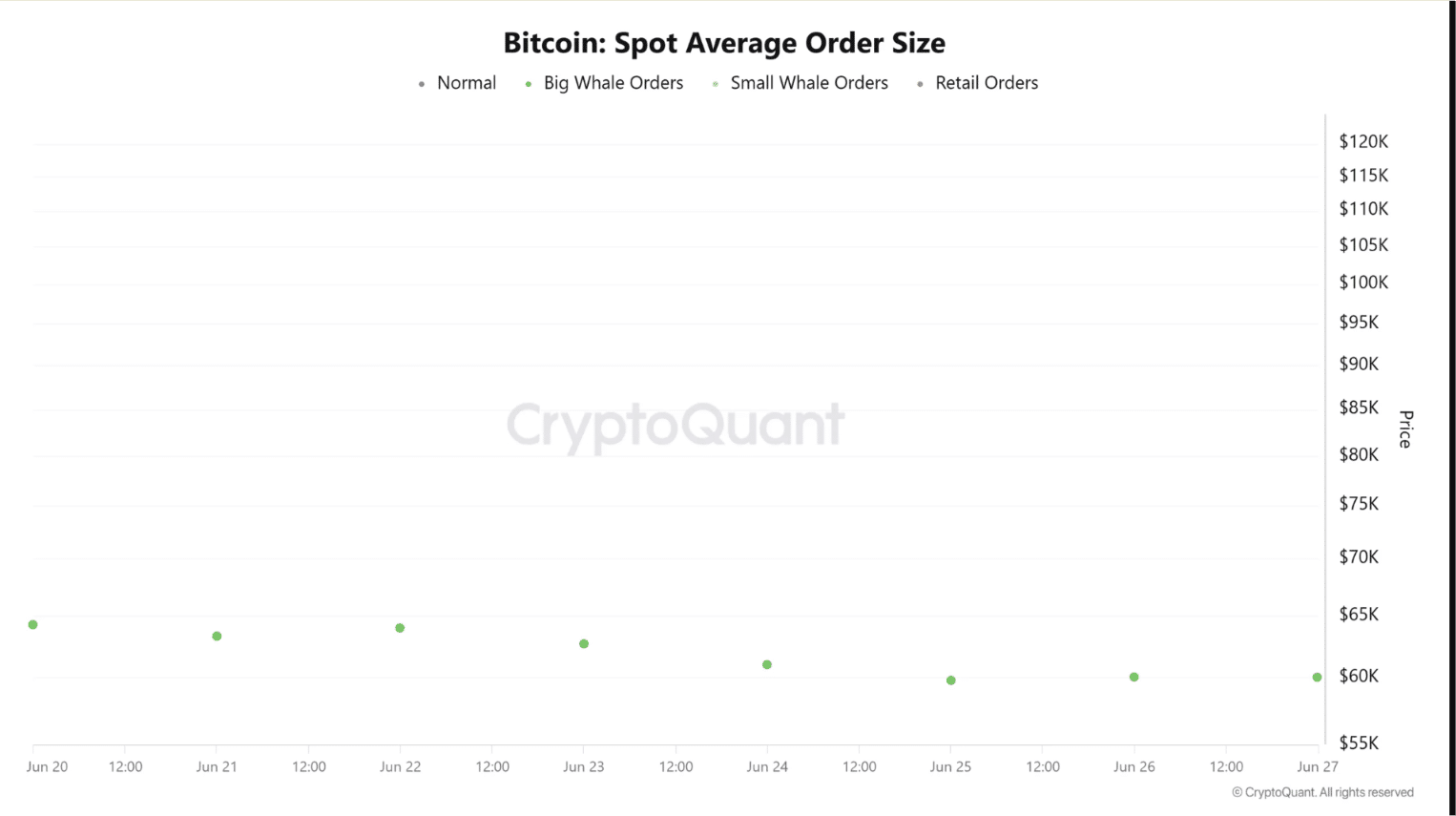
This kind of momentum setup has, in prior cycles, preceded extended price declines before any meaningful reversal took shape. It means that even with a Bitcoin whale deploying $81.9 million and on-chain netflows turning negative, the structural market conditions are not yet aligned for a clean breakout. Buyers are accumulating, but the momentum has not flipped to reflect that accumulation in price.
Where BTC Could Head from Here: Two Possible Scenarios
Given the competing forces at play, analysts watching this setup closely are eyeing two primary outcomes. If the Bitcoin whale demand that has been building over the past week finally translates into real buying pressure that overwhelms the bearish momentum, BTC has a credible path toward $64,500. That level would represent a clean break from the current range and open the door to renewed bullish momentum heading into July.
On the other hand, if sellers maintain the upper hand and momentum indicators stay deeply negative, Bitcoin is likely to continue oscillating between $59,000 and $61,000 without making any decisive directional move. The risk of a breakdown below $59,000 cannot be ruled out in that scenario, particularly if macro conditions shift or broader risk sentiment sours.
The Bigger Picture: Why Bitcoin Whale Behavior Matters to All Investors
Bitcoin whale activity has always served as one of the more reliable leading indicators in crypto markets, largely because major holders have both the information advantage and the capital to act on it decisively. When a Bitcoin whale accumulates heavily at a specific price zone while retail sentiment is anxious, it often precedes the inflection points that later get analyzed in hindsight as “obvious” buying opportunities.
That said, even the smartest Bitcoin whale can be early. Timing and structure still matter, and the current bearish momentum setup is a reminder that conviction without confirmation can be costly. Watching for a shift in the SMI MTF toward neutral or positive territory, alongside continued negative netflow, would give investors a much stronger signal that the tide is genuinely turning.
Conclusion
Bitcoin is navigating one of its more delicate moments of 2026, clinging to $60,000 while a Bitcoin whale quietly deploys more than $81 million in a single move. The on-chain evidence points toward significant accumulation in the $59,000 to $60,000 zone, and the sustained negative exchange netflow adds further weight to the bullish thesis.
However, bearish momentum indicators are not giving ground yet, and the market structure remains fragile. Investors watching this space should track the SMI MTF closely alongside exchange netflow trends, because when those two data points align with the Bitcoin whale activity already underway, that is likely when BTC makes its next meaningful move.
Frequently Asked Questions
What does it mean when a Bitcoin whale withdraws BTC from an exchange?
It generally signals the intent to hold rather than sell, since assets moved off exchanges are less accessible for immediate trading and often indicate long-term accumulation.
Is negative Exchange Netflow bullish for Bitcoin?
It is often interpreted as a bullish signal because it suggests more BTC is leaving exchanges than entering them, reducing the available sell-side supply on the market.
What is the SMI MTF indicator?
It is a multi-timeframe momentum oscillator used to measure the strength and direction of price trends. Readings below zero indicate bearish momentum dominance.
Can Bitcoin whale activity alone push Bitcoin’s price higher?
Not always as even large capital deployments need to be supported by broader market momentum and demand to produce a sustained price increase.
Glossary of Key Terms
Bitcoin Whale: An individual or entity holding a large enough quantity of Bitcoin to influence market prices through their buying or selling activity.
Exchange Netflow: A metric measuring the net difference between Bitcoin flowing into and out of cryptocurrency exchanges, used to gauge market sentiment.
SMI MTF (Stochastic Momentum Index Multi-Timeframe): A technical analysis oscillator that measures price momentum across multiple timeframes to identify trend direction and strength.
Spot Market: The market where cryptocurrencies are bought and sold for immediate delivery, as opposed to futures or derivatives markets.
On-Chain Data: Information recorded directly on a blockchain that can be analyzed to understand market behavior, wallet activity, and capital flows.
Self-Custody: The practice of holding cryptocurrency in a personal wallet rather than on an exchange, giving the holder direct control over their assets.
Disclaimer: This article is intended for informational purposes only and does not constitute financial, investment, or trading advice.
Sources