

The On-Chain Data Behind the Altseason Narrative Making a Comeback in 2026
Something has been shifting beneath the surface of the crypto market, and it is the kind of shift that tends to go unnoticed right up until it becomes impossible to ignore. Altcoin supply on exchanges is tightening, accumulation signals are strengthening, and for the first time since late 2022, a key market indicator has climbed deep into altseason territory. Whether this is the start of a genuine rotation or another head fake, the data is worth understanding closely.
What the Altcoin Cycle Signal Is Actually Telling the Market
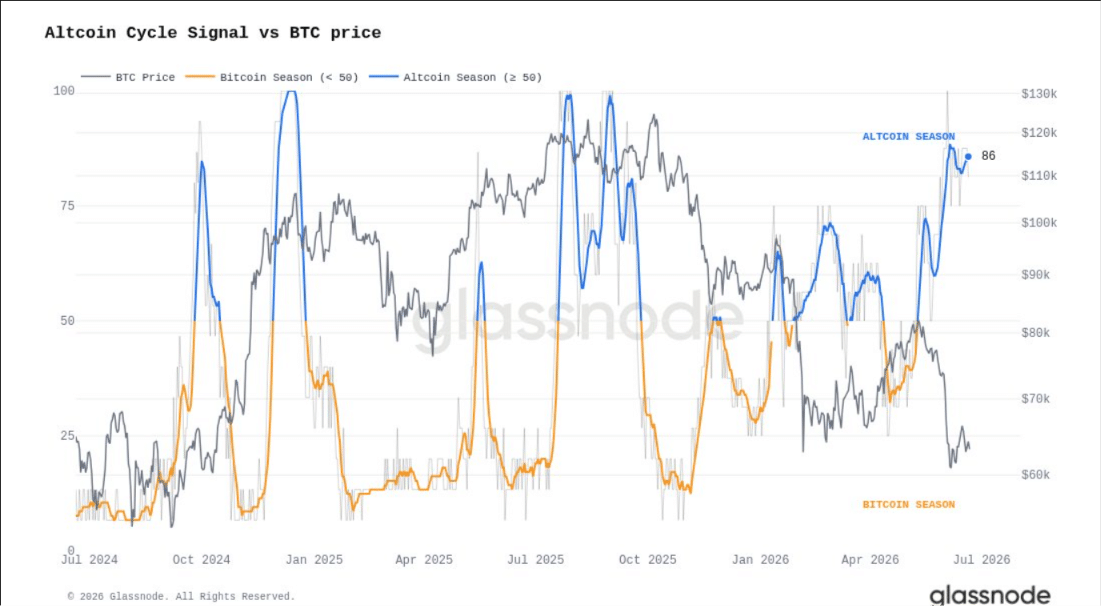
The Altcoin Cycle Signal, sourced from Glassnode, has reached a reading of 86 as of late June 2026. To put that number in context, readings above 75 are widely considered to mark altcoin season, a period where a majority of the top 50 altcoins outperform Bitcoin over a rolling 90-day window. The last time this signal reached comparable levels was during the bull cycle of late 2022, and before that, the euphoric highs of 2021.
Through most of 2024 and into early 2025, the signal stayed below the critical 50 threshold, reinforcing what many traders had already suspected: Bitcoin was absorbing nearly all available liquidity, leaving altcoins to bleed out in relative silence. That dynamic appears to be reversing, at least on paper. When the signal pushes toward 100, it historically indicates that the bulk of willing altcoin sellers have already exited their positions, reducing overhead supply pressure and creating a structural setup more favorable to price recovery.
Exchange Outflows and What Tightening Supply Really Means
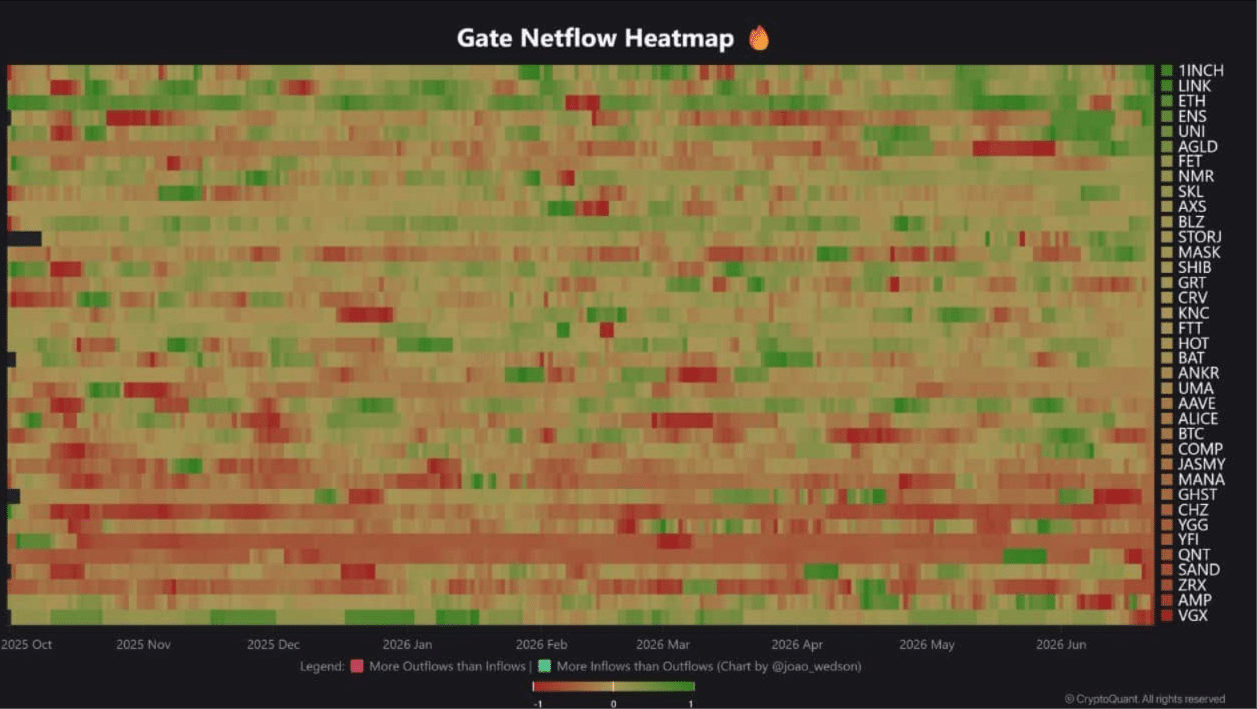
Between late 2025 and mid-June 2026, net flow data from Gate shows consistent withdrawal-dominant behavior across a broad range of altcoin asset classes. In market terminology, when coins leave centralized exchanges at a sustained rate over extended periods, it signals that holders are either moving assets to cold storage or repositioning in preparation for long-term holds rather than short-term sales.
Think of it like inventory at a retail warehouse: when shelves clear faster than they are restocked, prices tend to respond upward once demand picks back up. That is essentially what exchange outflows represent in crypto, a drawdown in the immediately sellable supply. The longer that condition holds, the more sensitive price becomes to even modest increases in buying pressure.
Not every altcoin is participating equally, though, assets including Ethereum, Chainlink, Uniswap, and 1Inch were showing higher deposit activity relative to withdrawals during the same period, which suggests that capital is not rotating into the altcoin sector uniformly. Instead, the market appears to be engaging in selective accumulation, concentrating inflows toward specific narratives or asset categories while others continue to face distribution.
Bitcoin Dominance Remains the Defining Variable for Altseason
Here is where the nuance matters as Bitcoin dominance currently sits at 56.29%, and the broader BTC price dropped from above $80,000 to the mid-$60,000 range in June 2026, a decline of roughly 15%. That kind of correction from the leading asset creates a complicated environment for altcoins.
Historically, altseason does not fully ignite while Bitcoin is in the middle of a corrective phase because risk appetite contracts across the board, and capital tends to flow toward the relative safety of Bitcoin rather than down the risk curve toward smaller cap assets.
The Altcoin Cycle Signal reaching 86 is encouraging, but it is most meaningful as a forward-looking setup indicator rather than a confirmed current reality. What the signal suggests is that the structural preconditions for altseason are forming: sellers have largely been shaken out, supply on exchanges is thinning, and market breadth is improving. However, a full-capital rotation into altcoins will most likely require Bitcoin to find price stability and establish a credible base before traders commit heavily to higher-risk positions.
Selective Rotation Is the Strategy Worth Watching
The pattern emerging from the on-chain data points toward selective capital rotation rather than a broad market-wide altcoin rally. Assets that have shown sustained exchange outflows over months are better positioned to respond sharply to demand when conditions improve, precisely because the available sell-side supply has already been absorbed. Investors monitoring these flows should differentiate between assets experiencing genuine accumulation and those simply seeing low volume with minimal price action.
Conclusion
The altseason narrative is not back in full force yet, but the groundwork is being laid in ways that on-chain data can measure and traders should not overlook. Tightening altcoin supply, a Cycle Signal reading of 86, and improving market breadth collectively point toward a market transitioning from distribution to accumulation across select assets. Bitcoin stabilizing will likely serve as the trigger that converts these structural setups into price performance. Until then, the data favors patience and precision over broad speculation.
Frequently Asked Questions
What is the Altcoin Cycle Signal?
It is an index that measures how many of the top 50 altcoins are outperforming Bitcoin over a 90-day period. A reading above 75 indicates altcoin season.
What does exchange outflow mean for altcoins?
When altcoins leave exchanges at a sustained rate, it reduces the immediately available sell-side supply, which can push prices higher when demand increases.
Why does Bitcoin dominance affect altseason?
Capital typically rotates from Bitcoin into altcoins once BTC stabilizes. While Bitcoin is correcting, investors tend to reduce exposure to higher-risk assets like altcoins.
Is 2026 considered an altseason?
As of June 2026, the Altcoin Cycle Signal has reached 86, technically within altseason range, though a full market-wide rally depends on Bitcoin price stability.
Glossary of Key Terms
Altseason: A market phase where the majority of altcoins outperform Bitcoin over a defined rolling period, typically 90 days.
Exchange Outflow: The net movement of cryptocurrency from centralized exchange wallets to external wallets, often interpreted as accumulation.
Altcoin Cycle Signal: A Glassnode-sourced metric tracking relative altcoin performance versus Bitcoin. Readings above 75 define altcoin season territory.
Bitcoin Dominance: The percentage of the total crypto market capitalization represented by Bitcoin alone. Higher dominance generally suppresses altcoin performance.
Cold Storage: Offline cryptocurrency storage not connected to exchanges, used for long-term holding away from active trading markets.
Market Breadth: A measure of how many assets within a market are participating in a trend, as opposed to just a handful of large-cap names leading movement.
Selective Capital Rotation: The gradual movement of investor funds from one asset class into specific sectors or individual assets, rather than a broad indiscriminate shift.
Sources
Disclaimer: This article is for informational purposes only and does not constitute financial or investment advice.