






This article was first published on The Bit Journal.
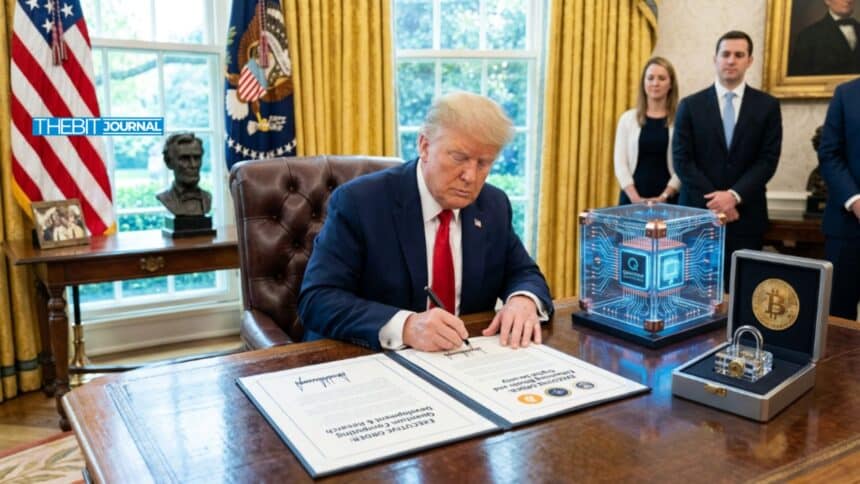
Quantum Computing and Bitcoin security is back at the top of tech discussions after US President Donald Trump signed two executive orders designed to push quantum development, while also trying to get government systems ready for the security risks that these machines are likely to create.
The White House recently announced the measures, telling all federal agencies to get to work on building a large scale quantum computer while at the same time fast tracking the migration to post-quantum cryptography.
White House Aims for a Large-Scale Quantum Computer by 2028
The first directive, Executive Order 14411, launches the Quantum Computing at Department of Energy Scale initiative, or QC-ADDS for short. This is aimed at getting at least one large scale quantum computer up and running by 2028 at a Department of Energy facility and making it available to researchers where possible. The administration believes such a machine could be operational by 2028, a target that would place the government ahead of many industry projections.
Building a machine this powerful isn’t the only thing on the agenda.
The Pentagon has been told to make sure that quantum sensors that can run in places where GPS signals can’t get through are top priority. In fact, the directive requires the Department of Defense to identify at least three next-generation quantum sensor projects within 60 days and field those systems by September 30, 2028.
According to White House science adviser Michael Kratsios, all of this is in an effort to keep the US ahead of the game in the tech race that includes China and other major powers.

The Government Is Also Preparing for Quantum Threats
The second order, Executive Order 14409, focuses on the security challenges created by quantum computing.
One of the main worries is the “harvest now, decrypt later” scenario. Intelligence agencies and cybersecurity experts have warned that adversaries may already be collecting encrypted information today with the expectation that future quantum computers could unlock it.
To counter this, the order establishes a new and accelerated migration timetable for switching over to post-quantum cryptography.
Federal agencies are being told to make sure their most sensitive systems are all using post-quantum cryptography for key establishment by the end of 2030, and for digital signatures by the end of 2031. The aim is to swap out the existing encryption methods for versions that are specifically designed to resist the attacks that future quantum computers are going to pose.
The administration described this as a critical national security priority as quantum capabilities continue advancing.
Why Quantum Computing and Bitcoin Are Being Discussed Together
Quantum computers and Bitcoin aren’t just news because of the White House orders. The crypto sector has been buzzing with talk of how vulnerable existing encryption methods are to quantum computers.
Earlier in the year, a team of researchers from Google, the Ethereum Foundation and Stanford University published a paper that suggested breaking the encryption used in Bitcoin and Ethereum might be a lot simpler than previously thought. In fact, they reckoned it might require fewer than 500,000 qubits which is roughly a 20-fold reduction on previous estimates.
That study was co-authored by Ethereum Foundation researcher Justin Drake and Stanford cryptographer Dan Boneh. While current quantum computers are a long way off from the point at which they’d pose a significant threat to blockchain security models, the revised estimate has shortened the perceived distance between today’s technology and a machine capable of threatening existing blockchain security models.
Bitcoin heavily relies on elliptic curve cryptography for protecting wallets and verifying ownership, and if a powerful enough quantum computer were to emerge, then the public-key systems currently in use could need some serious upgrades to stay secure.

The Crypto Industry Is Already Getting Ready For This
Major tech companies and blockchain networks are already working on developing quantum-resistant defenses.
Google has announced plans to have its entire infrastructure migrated over to post-quantum cryptography by 2029. Meanwhile, Ethereum developers are also talking about similar timelines as part of their network security planning.
Researchers within the blockchain sector are still exploring all sorts of quantum-resistant signature schemes and other cryptography alternatives that could eventually replace the current standards.
It’s also worth noting that most experts don’t actually think that Bitcoin is at any real risk from a quantum threat right now. The challenge is still mostly theoretical because the current quantum systems are nowhere near the scale required to break through to Bitcoin’s cryptography.
Still, the U.S. government’s decision to invest in both quantum development and quantum defenses shows just how seriously policymakers view the long-term implications of this technology.
Conclusion
The new executive orders are a clear indication that the U.S. is no longer treating quantum computing as some distant scientific experiment. They’re now committing to build a large-scale quantum computer while also stepping up the preparations for the potential security risks the machine could pose.
For Bitcoin and the rest of the crypto industry, the announcement serves as another reminder that becoming “quantum ready” is fast becoming an important conversation even if the current blockchains themselves are still secure.
Glossary
Quantum Computing: A computing approach that uses quantum mechanics to perform its calculations.
Bitcoin: The biggest cryptocurrency in terms of market cap.
Post-Quantum Cryptography (PQC): Cryptographic systems designed to withstand attacks from quantum computers.
Elliptic Curve Cryptography: The cryptography method that Bitcoin and a lot of other blockchain networks currently use.
Qubit: The fundamental unit of information in a quantum computer.
Frequently Asked Questions About Quantum Computing
What is Quantum Computing?
Quantum computing is a method of using quantum mechanics to process information and solve certain types of problems much faster than normal computers.
Can quantum computers break Bitcoin?
No, at least, not right now. However, researchers do think that future large-scale quantum computers could eventually pose a threat to Bitcoin’s cryptography if some kind of protective upgrade isn’t implemented.
What is Post-Quantum Cryptography?
Post-quantum cryptography refers to encryption methods that are designed to stay secure even in the face of attacks from powerful quantum computers.
Why did Trump sign two separate orders?
One order is about speeding up the development of quantum tech, while the other is about protecting government systems from potential quantum-enabled cyber threats.
References