






The KelpDAO hack has sent shockwaves through decentralized finance, raising serious questions about system safety and trust. What began as a hidden flaw quickly turned into a crisis that now tests the strength of the entire DeFi ecosystem.
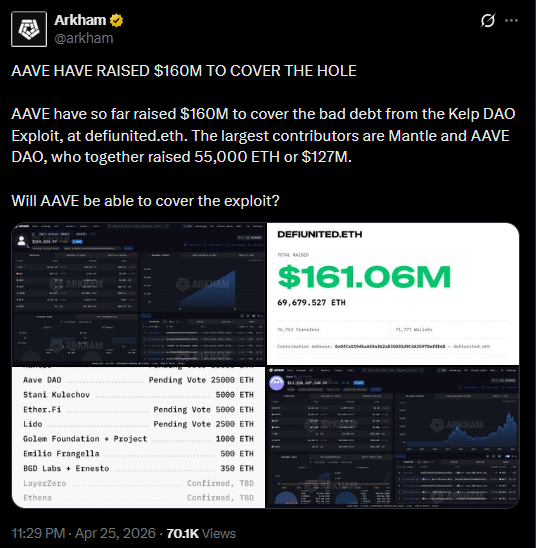
According to the source, Arkham reported that Aave has already raised about $160 million to manage the fallout. The KelpDAO hack now stands as the largest DeFi exploit of the year, forcing urgent action across multiple platforms.
When One Weak Link Breaks the Chain
The KelpDAO hack traces back to an integration flaw with LayerZero. This issue allowed an attacker to mint 116,500 unbacked rsETH tokens. These tokens entered Aave as collateral, creating a dangerous illusion of value.
Soon after, reality hit hard. The system held assets with no real backing. Panic spread quickly, triggering withdrawals of nearly $10 billion. This moment exposed deep DeFi risks, where trust can collapse faster than expected.
KelpDAO Hack Recovery Effort and DeFi United Plan
The KelpDAO hack pushed Aave and its partners to act fast. A coordinated plan called DeFi United emerged, led by Aave service providers. Its goal is clear. Restore stability, rebuild rsETH backing, and prevent further damage.
As Arkham stated in a recent analysis update, “AAVE have so far raised $160M to cover the bad debt from the Kelp DAO Exploit.” The report also confirmed that Mantle and Aave DAO contributed 55,000 ETH, worth about $127 million.
Adding personal commitment, Stani Kulechov said in a public statement, “I’m personally contributing 5,000 ETH to DeFi United.” This contribution alone exceeds $11 million.
Despite this progress, the KelpDAO hack still reflects ongoing DeFi risks, especially when recovery depends on collective bailouts.
$292M Shock Reveals Hidden DeFi Risks
The full scale of the KelpDAO hack becomes clearer when viewed in context. The exploit caused total losses of around $292 million, placing heavy pressure on lending markets.
This crisis highlights how layered systems can hide DeFi risks beneath the surface. Yield-bearing tokens like rsETH rely on multiple protocols working together. When one fails, the entire structure feels the impact.
A recent blockchain report shows that integration flaws now rank among the fastest-growing causes of exploits. This trend signals that security must go beyond code and focus on system design.
Not a Bug but a Feature Misused
The KelpDAO hack is not an isolated case. Another major exploit this year hit Drift Protocol, where attackers drained $270 million using “durable nonces.”
Durable nonces are designed to keep transactions valid over time. However, attackers used this feature in unexpected ways, proving that not all threats come from bugs. This pattern deepens concerns around DeFi risks, where even legitimate tools can turn dangerous.
Together, these incidents show a shift. The threat is no longer just faulty code. It now includes how systems interact and how features behave under stress.
Conclusion
The KelpDAO hack stands as a wake-up call that cannot be ignored. While Aave’s recovery effort shows strength and coordination, it also reveals how fragile trust can be in complex systems.
Looking ahead, the focus must shift toward stronger safeguards and smarter integrations. Without this change, DeFi risks will continue to grow, and future shocks may hit even harder.
Glossary of Key Terms
DeFi: A blockchain-based system offering financial services without banks.
rsETH: A token representing staked Ethereum that earns yield.
Bad Debt: Losses caused by collateral that no longer holds value.
Durable Nonces: A feature that extends transaction validity over time.
DAO: A decentralized group that manages decisions through voting.
FAQs About KelpDAO Hack
What is the KelpDAO hack?
The KelpDAO hack is a major exploit where unbacked tokens were created, leading to large losses for Aave.
How much damage did the exploit cause?
The total impact reached about $292 million, with $200 million in bad debt.
What is DeFi United?
It is a recovery effort led by Aave service providers to stabilize the system and restore rsETH value.
Why are DeFi risks increasing?
Complex integrations and shared systems create new vulnerabilities beyond traditional coding bugs.
Sources/References